
A brand awareness campaign launch is a series of defined steps designed to expand your brand’s reach and recognition in your target market. The industry term for this process is “brand campaign development,” and following structured brand awareness campaign launch steps is what separates businesses that grow predictably from those that spend without results. SMART goals, a clear positioning statement, and consistent channel execution form the foundation of every effective campaign. Campaigns planned 6–12 months before major business milestones produce the strongest results, making early preparation a competitive advantage for small businesses.
What are the brand awareness campaign launch steps?
Brand awareness campaign launch steps are the sequential actions a business takes to plan, execute, and measure a campaign that builds recognition among its target audience. The process covers everything from brand documentation to channel selection, content creation, and performance tracking. Skipping any step creates gaps that reduce campaign impact and waste budget.
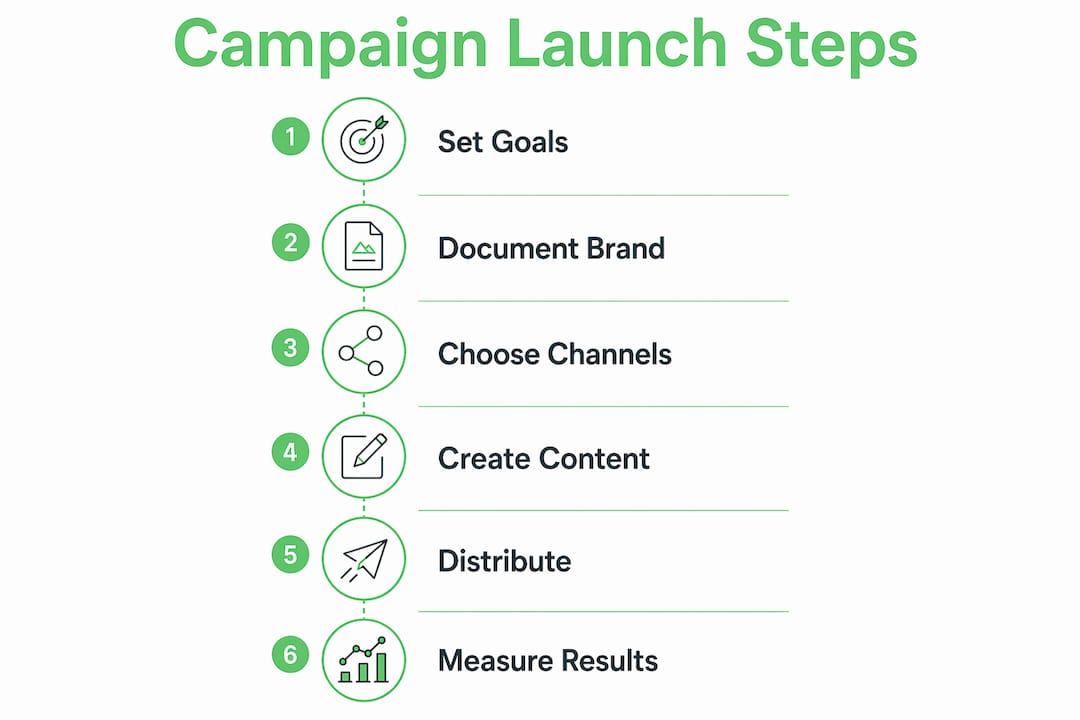
The core steps follow this order: define objectives, document your brand identity, select channels, create content, distribute consistently, and measure results. Each step feeds the next. A weak positioning statement, for example, produces inconsistent content, which produces poor engagement metrics.

Setting SMART goals is the first and most critical step. SMART stands for Specific, Measurable, Achievable, Relevant, and Time-bound. Without clear objectives, campaign resources scatter across activities that produce no measurable return.
What do you need before launching a brand awareness campaign?
Preparation determines whether your campaign runs smoothly or stalls after the first week. Three prerequisites matter most: a concise brand style guide, a clear positioning statement, and the right tools.
Building a minimal brand style guide
A single-page brand document covering only the essentials keeps small teams agile and prevents scope creep. The document should include one primary color, one accent color, two typefaces, and one social media template. That is enough to maintain visual consistency across channels without requiring a design team.
Crafting a positioning statement
A positioning statement answers three questions: who you serve, what you offer, and why you are different. Keep it to two sentences. Every piece of campaign content should trace back to this statement.
Tools to support your campaign
| Category | Purpose | Example tools |
|---|---|---|
| Content creation | Design graphics and write copy | Canva, Google Docs |
| Scheduling | Publish content consistently | Buffer, Later |
| Tracking | Monitor brand mentions and search | Google Alerts, Google Search Console |
| Analytics | Measure traffic and conversions | Google Analytics 4 |
Pro Tip: Lock down your brand voice before you create a single piece of content. Write three to five sample posts in the founder’s voice, then use them as a reference for every future content decision.
How do you execute the core campaign launch steps?
Execution is where most small businesses lose momentum. A clear sequence prevents that.
Set SMART objectives. Define what success looks like before spending a dollar. Examples include increasing branded search volume by a specific percentage within 90 days or reaching a set number of podcast appearances in 60 days.
Build content clusters. Focus on a narrow topic your brand can own. Publish three to five pieces of long-form content around that topic before launching any paid promotion. Content marketing builds compounding visibility that paid ads cannot replicate.
Select two to three channels. Multi-channel marketing works best when you concentrate on the channels where your audience already spends time. Spreading across five or six channels with a small team produces weak results on all of them.
Start with low-cost, high-impact tactics. Mention-based outreach and podcast guesting are the most cost-effective brand awareness plays for small businesses. Both produce measurable signals within 30 days with minimal fixed costs.
Publish on a consistent cadence. Consistency matters more than volume. Two high-quality posts per week outperform seven rushed ones. Include a mix of founder voice posts, educational long-form content, and short-form social updates.
Apply FAQ schema and internal linking. Adding FAQ schema to your content improves discoverability in search results. Internal links between related pages help search engines understand your content structure and keep readers engaged longer.
Pro Tip: Run a focused 30-day sprint at the start of your campaign. A 30-day sprint builds your content foundation, establishes measurement loops, and generates early signals you can use to adjust before committing to a full six-month plan.
How do you measure brand awareness campaign performance?
Measuring the right metrics is what separates a campaign that improves over time from one that runs on guesswork. Raw impressions are not a reliable indicator of brand awareness growth. Skip raw impressions and focus on metrics with a direct connection to brand recognition.
The five metrics that matter most are:
- Branded search volume: The number of people searching your brand name directly in Google. Track this in Google Search Console.
- Direct traffic: Visitors who type your URL directly into a browser. Rising direct traffic signals growing brand recall.
- Mention count: How often your brand appears in online conversations, articles, and social posts. Google Alerts tracks this at no cost.
- Share of voice: Your brand’s presence in a topic category compared to others in your space.
- Assisted conversions: Sales or leads where a brand awareness touchpoint appeared earlier in the customer journey.
| Metric | Tool | Review cadence |
|---|---|---|
| Branded search volume | Google Search Console | Monthly |
| Direct traffic | Google Analytics 4 | Weekly |
| Mention count | Google Alerts | Weekly |
| Share of voice | Manual or AI monitoring tools | Monthly |
| Assisted conversions | Google Analytics 4 | Monthly |
Early signals from a well-executed campaign appear within 2–4 weeks. Full impact typically takes 4–6 months. Plan your digital marketing metrics review schedule before the campaign launches, not after.
Pro Tip: Set up a simple weekly dashboard in Google Sheets that pulls branded search volume and direct traffic side by side. Reviewing both together reveals whether your content is building recognition or just generating clicks.
What mistakes should you avoid when launching a brand awareness campaign?
Most brand awareness campaigns underperform for predictable reasons. Knowing the common pitfalls in advance gives you a clear advantage.
- Spreading too thin across channels. Choosing too many channels divides your team’s attention and produces inconsistent messaging. Concentrate on two to three channels and do them well.
- Focusing on impressions over engagement. High impression counts feel encouraging but rarely correlate with brand recall. Branded search volume and direct traffic are far more reliable signals.
- Skipping internal alignment. If your sales team, content team, and leadership use different language to describe your brand, the campaign message fragments. Consistent brand messaging across every channel is not optional.
- Setting unrealistic timelines. A typical brand awareness campaign lasts about six months. Expecting significant results in two weeks leads to premature pivots that reset progress.
- Ignoring the style guide. Without a documented visual and messaging standard, every new piece of content risks looking like it came from a different brand.
Clarity and focus outperform volume and variety every time. A campaign built on one strong positioning statement, two well-chosen channels, and a consistent publishing cadence will outperform a scattered effort with three times the budget. The businesses that win on brand awareness are the ones that show up the same way, every week, for months.
Avoiding common digital marketing mistakes requires discipline, not just knowledge. Build a short pre-launch checklist that confirms your style guide, positioning statement, and channel selection are locked before you publish anything.
Key Takeaways
A successful brand awareness campaign requires clear objectives, a minimal but consistent brand identity, focused channel selection, and disciplined measurement of branded search volume and direct traffic over a 4–6 month period.
| Point | Details |
|---|---|
| Set SMART objectives first | Define specific, measurable goals before selecting channels or creating content. |
| Keep brand documentation minimal | One primary color, one accent color, two typefaces, and one template prevent scope creep. |
| Focus on two to three channels | Concentrated effort on fewer channels produces stronger, more consistent results. |
| Measure branded search and direct traffic | These two metrics reflect real brand recognition better than raw impressions. |
| Plan for a 4–6 month timeline | Early signals appear in 2–4 weeks, but meaningful brand lift takes sustained effort. |
What I have learned about brand awareness campaigns for small businesses
The most common mistake I see small business owners make is treating a brand awareness campaign like a product launch. They build everything in secret, release it all at once, and then wonder why nothing sticks. Brand awareness does not work that way.
What actually works is showing up consistently in a narrow space over a long period. The 30-day sprint concept is not just a planning tool. It is a discipline test. If you cannot maintain a publishing cadence and a consistent message for 30 days, a six-month campaign will fall apart by week eight.
Founder voice content is underused by most small businesses. People connect with people, not logos. Publishing content in the founder’s authentic voice, even on a simple LinkedIn page or a basic blog, builds trust faster than polished brand content. The businesses I have seen grow their brand recognition fastest are the ones where the founder is visibly present in the content.
The other lesson is about measurement. Most small business owners check their follower count and call it a day. Branded search volume is the metric that tells you whether your campaign is actually working. When people start searching your name directly, the campaign is doing its job.
— Steel
How Punchvirtualmanager supports your brand awareness campaign
Punchvirtualmanager works with small businesses across South Africa to plan and execute brand awareness campaigns that produce measurable results.
The agency’s digital marketing services cover content strategy, channel management, and performance tracking, giving business owners a complete campaign structure without the overhead of an in-house team. Punchvirtualmanager integrates brand awareness efforts into a wider digital marketing plan that connects visibility goals to real business outcomes. With a 99% advertising success rate and a transparent reporting process, the agency gives marketing managers the clarity they need to make confident decisions at every stage of the campaign.
FAQ
What are the first steps to launch a brand awareness campaign?
The first steps are setting SMART objectives, documenting your brand identity in a concise style guide, and selecting two to three channels based on where your audience is most active.
How long does a brand awareness campaign take to show results?
Early signals such as increased mention counts and direct traffic typically appear within 2–4 weeks. Full brand awareness impact generally takes 4–6 months of consistent execution.
What metrics should I track for brand awareness success?
Track branded search volume, direct traffic, mention count, share of voice, and assisted conversions. Raw impressions have a weak correlation with meaningful brand recognition and should not be your primary metric.
What is the most cost-effective brand awareness tactic for small businesses?
Mention-based outreach and podcast guesting are the most cost-effective tactics for small businesses. Both produce measurable signals within 30 days with minimal fixed costs.
How many channels should a small business use for a brand awareness campaign?
Concentrate on two to three channels where your audience is most active. Spreading resources across more channels produces inconsistent messaging and weaker results across all of them.