
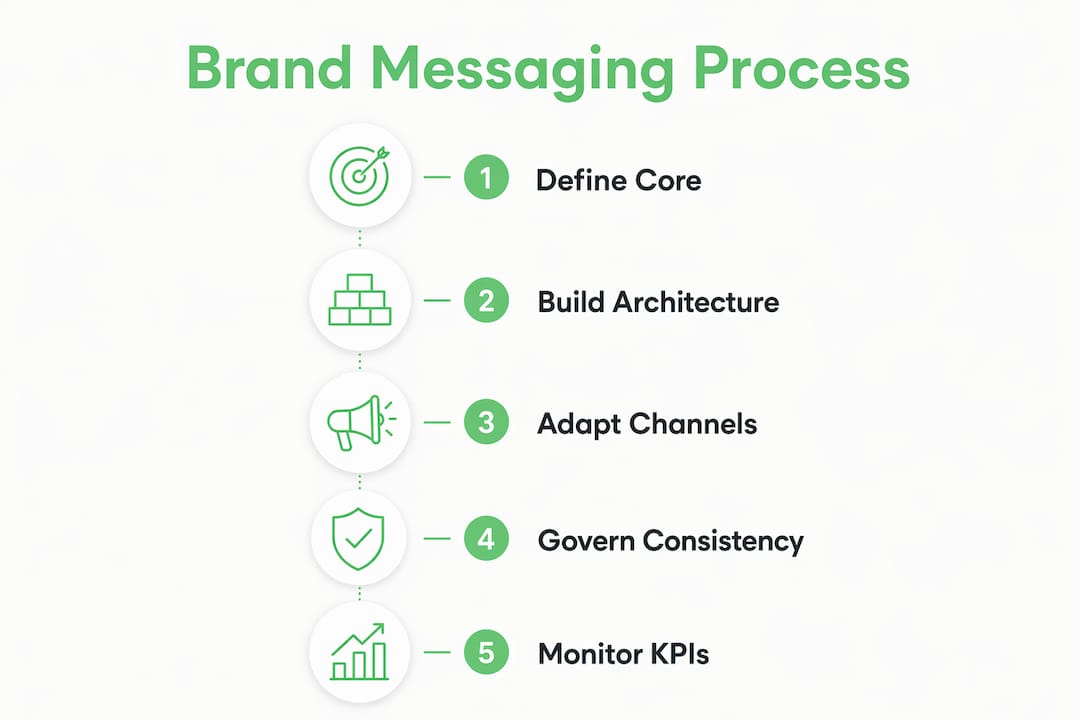
Consistent brand messaging across channels is defined as delivering a unified core message and values on every platform while adapting tone and format to each channel’s expectations. Brand consistency improves customer recognition by 50%, increases engagement by up to 40%, and boosts conversion rates by 25–35%. Those numbers reflect a direct business outcome, not a design preference. Achieving this requires three things: a clear message architecture, channel-specific translation rules, and a governance cadence that catches drift before it compounds. Punchvirtualmanager works with business owners and marketers across South Africa to build exactly that kind of operational discipline.
What is consistent brand messaging across channels?
Consistent brand messaging across channels means your positioning statement, core value propositions, and proof points say the same thing everywhere. Your website, LinkedIn page, email campaigns, customer support scripts, and product documentation all carry the same central claim. The tone and format change by platform, but the underlying message does not.
Brand positioning is a leadership decision, not a marketing task. When leadership owns the positioning, it guides product development, customer experience, and communications strategy together. When it gets delegated too far down, fragmentation follows. The industry term for the document that holds all of this together is a message architecture, and it functions as the single source of truth for every team that produces content.

What is a message architecture and why does it matter?
A message architecture is a centralized document that defines your brand’s core messaging elements and serves as the operational reference for marketing, PR, and sales teams. It goes well beyond a style guide. A style guide tells teams what fonts and colors to use. A message architecture tells them what to say and what not to say.
A complete message architecture includes:
- Positioning statement: One or two sentences defining who you serve, what you do, and why you are different.
- Value propositions: Three to five specific claims that explain the benefit you deliver.
- Proof points: Data, case studies, or credentials that back each value proposition.
- Do/don’t lists: Explicit examples of approved and unapproved language for common scenarios.
- Terminology glossary: Standardized names for products, features, and categories.
Companies that use a message architecture reduce revision cycles on PR and social media drafts by measuring brand alignment edits over time. Fewer revisions mean faster content production and less internal friction. The document also makes onboarding faster because new team members and external agencies get one reference point instead of piecing together guidance from multiple sources.
Pro Tip: Review your message architecture every quarter. Markets shift, products evolve, and language that was accurate six months ago may now be outdated or off-brand.
How do you adapt brand messaging to different channels?
The concept that governs this is controlled variation. Consistency means cohesion, not uniformity. The core claim stays rigid. The tone and format flex to match what each platform’s audience expects. Forcing identical copy across every channel produces robotic branding that disengages readers.
A practical tool for managing this is a channel translation matrix. It maps each core value proposition to a channel-specific output. Here is an example of how one claim translates across four channels:
| Channel | Core claim | Adapted output |
|---|---|---|
| Website | Expert financial and marketing support | Long-form service page with proof points and case studies |
| Expert financial and marketing support | Professional post with a data point and a clear call to action | |
| TikTok | Expert financial and marketing support | Short video showing a before-and-after business result |
| Expert financial and marketing support | Personalized subject line with a single benefit and one link | |
| Customer support | Expert financial and marketing support | Plain-language script focused on solving the client’s specific problem |
The translation layer prevents message drift by making the adaptation process explicit. Without it, each channel owner interprets the core message independently, and small deviations accumulate into a fragmented brand experience. For marketers managing social media platforms, this matrix is the difference between a coherent brand presence and a scattered one.
Pro Tip: Build your channel translation matrix in a shared document that all channel owners can access and edit. Update it whenever the message architecture changes.
How do you govern and monitor brand messaging consistency?
Governance is the operational system that keeps messaging aligned after the initial documents are created. The largest consistency challenge comes from multiple channel owners each optimizing for their own platform without cross-channel coordination. A governance model solves this by assigning ownership and scheduling regular reviews.
A practical governance structure uses four review levels:
- Weekly: A 15-minute social content review by the social lead to check that posts match the approved message architecture before publishing.
- Monthly: A template spot check by the brand lead to confirm that email, PR, and web copy still use approved terminology and claims.
- Quarterly: A cross-channel alignment meeting with all channel owners, including the PR/comms lead, to compare outputs and resolve drift.
- Annual: A full brand audit that reviews the message architecture itself and updates it to reflect business changes.
Role assignments matter as much as the schedule. Each channel needs a named owner who is accountable for consistency within that channel. The brand lead holds the master document and approves changes. Legal review applies to high-risk content such as regulatory claims or financial statements.
Key performance indicators to track include:
- Message alignment rate: The percentage of published content that matches approved claims without edits.
- Revision cycle count: The number of rounds of edits required before content is approved.
- Terminology consistency: Whether approved product and feature names appear correctly across all channels.
- Approval response time: How quickly reviewers return feedback on submitted content.
Tracking these KPIs monthly gives teams early warning when drift is occurring. A rising revision cycle count, for example, signals that the message architecture needs clarification or that a channel owner needs additional training.
What mistakes cause brand messaging inconsistency?
Most messaging inconsistency comes from a small set of repeatable errors. Recognizing them early prevents the kind of drift that takes months to correct.
- Delegating messaging without leadership alignment. When a CEO hands messaging entirely to a junior marketer or an external agency, the brand loses its strategic anchor. Brand positioning requires leadership ownership to stay coherent across teams.
- Forcing identical language across channels. Identical copy across channels fails because each platform has its own norms. A LinkedIn post written in the same voice as a TikTok script will underperform on both.
- Ignoring platform-specific tone and format. Each channel has audience expectations. Ignoring them signals that the brand does not understand its own audience.
- Lacking a centralized update process. When the message architecture changes but channel owners are not notified, outdated claims continue to circulate.
“The biggest risk to brand consistency is not a style error on a social post. It is a fragmented internal understanding of what the brand actually stands for. When teams do not share a common definition of the brand’s value, every channel drifts in a different direction.”
Common mistakes like delegating messaging to agencies without clear guidelines cause brand dilution over time. The fix is not more creative control. It is better documentation and clearer accountability.
What tools support consistent brand messaging?
The right tools reduce the manual effort required to maintain consistency. They also make it easier to onboard new team members and external partners without losing alignment.
- Message architecture document: A shared, version-controlled file that all teams reference. Google Docs or Notion work well for this because they support comments and revision history.
- Channel translation matrix: A table mapping core claims to channel-specific outputs, updated whenever the message architecture changes.
- Content management system templates: CMS templates enforce brand rules at the point of content creation, reducing inconsistency before it reaches review.
- Collaboration platforms: Tools like Slack or Microsoft Teams with dedicated brand channels allow channel owners to flag questions and share updates in real time.
- Creative briefs: Standardized briefs for internal teams and external agencies that include the relevant message architecture sections for each project.
- Training programs: Onboarding sessions that walk new hires and agency partners through the message architecture and governance model.
| Tool type | Primary function | Best for |
|---|---|---|
| Message architecture doc | Single source of truth | All teams |
| CMS templates | Enforce brand rules at creation | Web and email teams |
| Translation matrix | Map claims to channel outputs | Multi-channel marketers |
| Creative brief | Align external partners | Agencies and freelancers |
An omnichannel branding approach ties these tools together by treating every channel as part of one connected brand experience rather than a set of independent outputs.
Key Takeaways
Consistent brand messaging across channels requires a message architecture, a channel translation matrix, and a governance cadence working together as an operational system, not a one-time creative exercise.
| Point | Details |
|---|---|
| Message architecture is foundational | Build a single source of truth document before creating channel-specific content. |
| Controlled variation beats uniformity | Keep core claims identical but adapt tone and format to each platform’s norms. |
| Governance prevents drift | Assign channel owners and run weekly, monthly, quarterly, and annual reviews. |
| Leadership must own positioning | Brand consistency fails when positioning is delegated without executive alignment. |
| KPIs make consistency measurable | Track message alignment rate, revision cycles, and terminology consistency monthly. |
Brand consistency is an operational discipline, not a creative one
Most business owners treat brand consistency as a design problem. They update their logo guidelines, choose a color palette, and call it done. That approach misses the real issue. The fragmentation that damages brands does not come from inconsistent fonts. It comes from inconsistent claims, inconsistent promises, and inconsistent understanding of what the business actually stands for.
What I have observed working with businesses across multiple channels is that the brands with the strongest recognition are not the ones with the most polished visuals. They are the ones where every person in the organization, from the CEO to the customer support agent, can articulate the same core value proposition without looking it up. That kind of alignment does not happen by accident. It requires a documented message architecture, a governance model with named owners, and leadership that treats positioning as a strategic priority rather than a marketing deliverable.
The other thing worth saying directly: consistency does not mean rigidity. The businesses that get this right give their channel owners real flexibility in tone and format. They just never compromise on the core claim. That distinction, between what is fixed and what is flexible, is where most brands get lost. A clear digital marketing strategy defines both boundaries explicitly so that every team knows exactly where their creative freedom starts and stops.
— Steel
How Punchvirtualmanager supports your brand messaging strategy
Maintaining a unified brand voice across digital and physical channels takes more than good intentions. It takes a structured approach, the right documentation, and consistent execution across every platform.

Punchvirtualmanager helps business owners and marketers build and maintain that structure. The agency’s digital marketing services cover multi-channel strategy, content execution, and brand alignment across web, social, email, and PR. With a 99% advertising success rate and a track record of measurable digital growth, Punchvirtualmanager brings both the strategic framework and the hands-on execution that brand consistency requires. Explore the available marketing service packages to find the right fit for your business.
FAQ
What is consistent brand messaging across channels?
Consistent brand messaging across channels means delivering the same core value propositions and positioning on every platform while adapting tone and format to suit each channel’s audience and norms.
Why does brand consistency matter for business growth?
Brand consistency improves recognition by 50% and boosts conversion rates by 25–35%, making it one of the highest-return investments a business can make in its marketing.
What is a message architecture?
A message architecture is a centralized document containing your positioning statement, value propositions, proof points, and approved terminology. It serves as the single source of truth for all teams producing content.
How often should you audit brand messaging consistency?
A practical governance model includes weekly social reviews, monthly template checks, quarterly cross-channel alignment meetings, and an annual full brand audit.
What causes brand messaging to drift across channels?
Messaging drift most often results from multiple channel owners optimizing independently without cross-channel coordination, combined with a lack of a centralized message architecture and no named accountability for consistency.