
Financial forecasting is the process of estimating your small business’s future revenue, expenses, and cash position using historical data and informed assumptions. It is not the same as budgeting. A budget is a spending plan; a forecast is a prediction of what will actually happen. Small businesses that forecast regularly can spot cash shortfalls before they hit, time hiring decisions with confidence, and make investment calls based on data rather than instinct.
The core forecast types every small business owner should understand:
- Sales forecast: Projects future revenue by product, service line, or customer segment
- Cash flow forecast: Tracks when money actually enters and leaves the bank account
- Expense forecast: Separates fixed costs (rent, salaries) from variable costs (materials, commissions)
- Pro forma financial statements: Forward-looking versions of your income statement, balance sheet, and cash flow statement
The importance of financial forecasting lies not in predicting the future perfectly, but in reducing uncertainty so decisions are grounded in data rather than guesswork.
Table of Contents
- What are the key components and methods of financial forecasting?
- How to create a financial forecast for your small business
- Common forecasting mistakes to avoid
- What tools and templates work best for small business forecasting?
- How do you keep your financial forecast accurate as your business grows?
- How to interpret financial forecasts for better decisions
- How do financial forecasts connect to your overall business plan?
- How to gather the right data for an accurate forecast
- Punchvirtualmanager offers expert financial clarity for growing businesses
- Key Takeaways
What are the key components and methods of financial forecasting?
A complete financial forecast has four building blocks: a sales projection, an expense model, a cash flow statement, and pro forma financials. Each one feeds the next. Get the sales projection wrong and every downstream number is off.
Two main approaches drive how forecasts are built:
- Bottom-up forecasting: Starts with operational inputs like unit sales, conversion rates, and average transaction value. This method is more defensible because every assumption ties back to something measurable in the business.
- Top-down forecasting: Starts with a market-size estimate and works down to a revenue share. It sounds credible but often produces numbers that are hard to justify when scrutinized.
Bottom-up forecasting is more reliable for small businesses because it is grounded in real operational data rather than arbitrary market estimates.
Scenario and sensitivity analysis add another layer. Instead of one forecast, you build three: a likely case, a best case, and a worst case. Changing a single assumption, such as the sales growth rate or the cost of goods sold percentage, shows how quickly the financial picture shifts. Documenting every assumption is not optional. If you cannot explain why you chose a 15% growth rate, the forecast loses credibility with lenders, investors, and your own team.

How to create a financial forecast for your small business
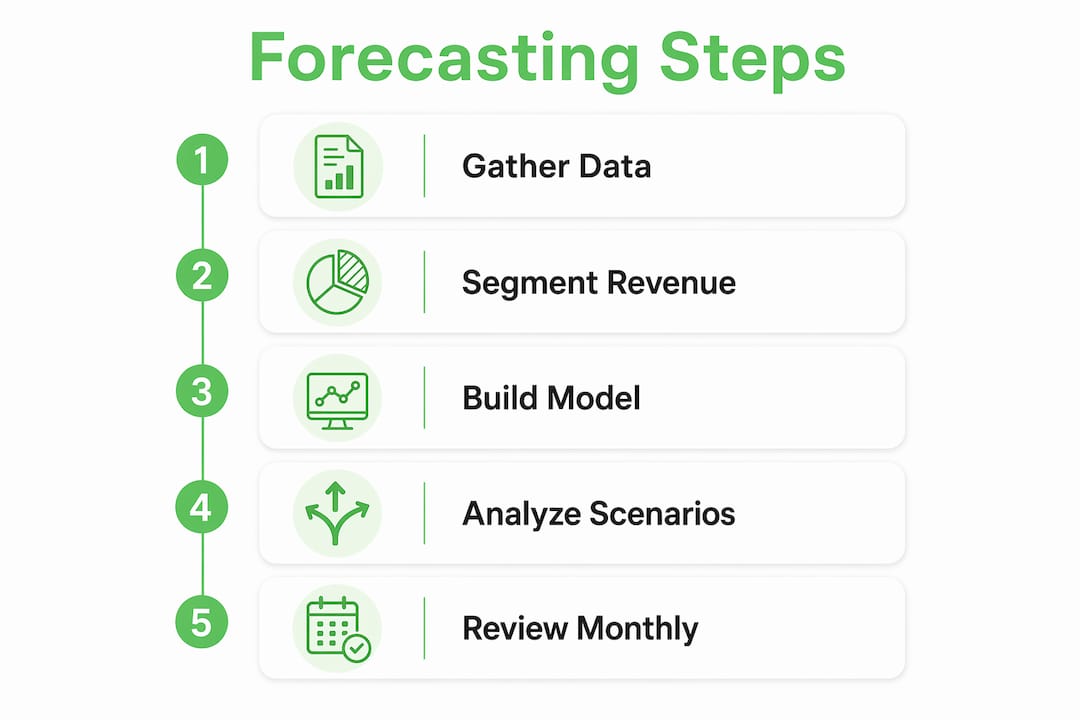
Building your first forecast is straightforward when you follow a clear sequence. You do not need expensive software to start. A spreadsheet in Excel or Google Sheets, combined with your accounting data, is enough.
- Gather historical data. Pull at least 12 months of income statements, cash flow statements, and sales records. For a new business with no history, use industry benchmarks from sources like SCORE’s financial projections template.
- Document your core assumptions. Write down your expected sales growth rate, cost of goods sold as a percentage of revenue, fixed and variable expense behavior, and payment collection timelines. Every number in the model flows from these assumptions.
- Project sales in detail. Break revenue down by product, service, or customer type. Account for seasonality, planned pricing changes, and your sales pipeline. Separate recurring revenue from one-time revenue and be conservative with the latter.
- Forecast expenses. Apply your historical cost of goods sold percentage to projected revenue for variable costs. Project fixed costs based on current commitments, adjusted for known changes like new hires or lease renewals.
- Build pro forma statements. Combine the sales and expense projections into a pro forma income statement first, then a cash flow statement, then a balance sheet. The cash flow statement is the most critical for small businesses because it shows the actual timing of money in and out.
- Run scenario planning. Scenario planning with best case, worst case, and likely case versions helps you stress-test the model and prepare contingency plans before a crisis forces your hand.
Pro Tip: Separate your revenue rows into “recurring” and “new or one-time” categories. Apply conservative assumptions to the second row. This single habit prevents the most common form of revenue overestimation.

Common forecasting mistakes to avoid
Most forecast failures trace back to a handful of recurring errors, not complex modeling problems.
- Over-optimistic revenue projections: Founders naturally skew high. Build the base case conservatively and let the upside scenario carry the ambition.
- Ignoring cash timing: A sale recorded in March may not generate cash until May if you offer 60-day payment terms. Confusing revenue with cash receipts is one of the leading causes of cash flow crises.
- Building a static model: A forecast built once becomes outdated within weeks. Continuous updates after actual results are critical to maintain forecast accuracy and operational relevance.
- Skipping team involvement: The people closest to sales, operations, and spending have data you do not. Involving them improves both accuracy and accountability.
- Tracking dollars instead of percentages: Budgets fail mostly because of many small unchecked spending decisions rather than one large expense. Tracking spend as a percentage of revenue by category provides early warning signals that dollar-amount tracking misses entirely.
Pro Tip: Set a monthly alert for any budget category that exceeds its historical percentage of revenue. A payroll line creeping from 32% to 38% of revenue is a warning sign long before it becomes a cash problem.
What tools and templates work best for small business forecasting?
The right tool depends on where your business is right now.
- Spreadsheets (Excel or Google Sheets): The starting point for most small businesses. Free, flexible, and sufficient for a 12-month rolling forecast. SCORE offers free financial projection templates that are ready to customize.
- Accounting software with forecasting features: Platforms like QuickBooks Online include a basic cash flow planner that uses historical data to project trends. Useful for early-stage businesses that want a quick view without building a model from scratch.
- Third-party forecasting apps: Tools that integrate with accounting software and add scenario planning, driver-based modeling, and automated variance reporting. These suit businesses that have outgrown a basic spreadsheet but are not yet ready for enterprise software.
- Fractional CFOs: For businesses navigating rapid growth, investor conversations, or complex cash conversion cycles, a fractional CFO interprets the model rather than just building it. The cost, typically in the range of a few thousand dollars per month, is often justified by a single avoided hiring mistake or missed runway calculation.
For startups, the financial forecasting best practices that matter most are simplicity and consistency. A model you update every month beats a complex model you abandon after two.
How do you keep your financial forecast accurate as your business grows?
A forecast that is not updated is not a forecast. It is a historical document.
- Update monthly at minimum: Replace projected figures with actuals immediately after closing the books each month. Adjust forward assumptions based on what the actuals reveal.
- Use weekly forecasts during tight cash periods: Weekly 13-week cash flow forecasting is the standard practice when liquidity is under pressure. It gives you a 90-day view of cash in and cash out at a level of detail that monthly forecasting cannot provide.
- Calculate runway regularly: Runway equals cash on hand divided by net burn rate, where net burn is monthly cash out minus monthly cash revenue. Knowing your runway in months tells you exactly how much time you have to adjust before options narrow.
- Include non-dilutive funding in the model: Cloud credits, grants, and program perks are real cash offsets. Modeling these as explicit line items prevents you from overstating cash needs and gives a more accurate runway picture.
- Run scenario updates, not just actuals: When a major assumption changes, such as losing a key client or winning a large contract, rebuild the scenario set rather than just adjusting the base case.
How to interpret financial forecasts for better decisions
A forecast is only useful if it drives action. The numbers themselves are secondary to the questions they answer.
The most important question a cash flow forecast answers is not “will we be profitable?” It is “will we have cash in the bank on the 15th to cover payroll?” A business can show a profit on its income statement and still run out of cash because of timing gaps between invoicing and collection. Reading the cash flow forecast alongside the income statement closes that gap.
Variance analysis, comparing actual results to projected figures each month, tells you whether your assumptions are holding. If revenue is consistently 10% below projection, the assumption driving that line needs to change. Leaving a broken assumption in place and explaining it away is how forecasts lose credibility.
Forecasts also inform hiring and investment timing. If the model shows three consecutive months of positive cash flow starting in Q3, that is the signal to begin a hiring process in Q2. The forecast does not make the decision; it frames the conditions under which the decision is safe to make.
How do financial forecasts connect to your overall business plan?
A financial forecast and a business plan answer different questions, but they must be consistent with each other. The business plan describes what you intend to do. The forecast tests whether the numbers support it.
A well-structured small business budget integrates with the forecast by setting spending targets that align with projected revenue. The budget tells you what each category should consume as a percentage of revenue. The forecast tells you whether that revenue will actually arrive. When the two diverge, the budget needs to adjust, not the forecast.
For startups, the 36-month integrated model, combining a profit and loss projection, a monthly cash flow, and a balance sheet, is the standard format for both internal planning and investor conversations. The marketing budget is one of the most variable line items in that model and deserves its own driver-based projection rather than a flat percentage allocation.
How to gather the right data for an accurate forecast
The quality of a forecast is determined by the quality of the data behind it. Garbage in, garbage out applies directly here.
Start with your own records. Twelve months of categorized income and expense data from your accounting software is the most reliable baseline. If your books are not clean, fix that before building a forecast. Trendline analysis using tools like those described by TechAdvisory can help identify seasonal patterns and growth trajectories from historical data.
For new businesses, industry benchmarks fill the gap. The Federal Reserve Small Business Credit Survey and SCORE’s resource library both publish expense ratio ranges by industry and business type. Use these as a sanity check against your own assumptions, not as targets to match.
External data matters too. Supplier pricing changes, interest rate movements, and market demand shifts all affect forecast accuracy. Build a habit of reviewing one or two external inputs each month alongside your internal actuals. Tracking digital marketing metrics alongside financial data gives a fuller picture of what is driving revenue and where growth is coming from.
Punchvirtualmanager offers expert financial clarity for growing businesses
Growing a business while managing cash flow, forecasting revenue, and keeping the books accurate is genuinely demanding. Punchvirtualmanager provides expert accounting and financial services built specifically for small businesses that need more than a spreadsheet but are not ready for a full-time finance team.
The agency combines financial expertise with digital marketing capability, so clients get a clear view of both their numbers and their growth channels in one place. Transparent communication and regular reporting mean you are never left guessing about where your business stands. Whether you need help building your first forecast, cleaning up your books, or connecting financial performance to your digital marketing strategy, Punchvirtualmanager has the expertise to support it. Contact Punchvirtualmanager today to get a financial review tailored to your business.
Key Takeaways
Financial forecasting works best when it is treated as a living decision tool, updated monthly with actuals and stress-tested with scenario planning across best, worst, and likely cases.
| Point | Details |
|---|---|
| Forecast vs. budget | A forecast predicts what will happen; a budget plans how to spend. Both are needed together. |
| Bottom-up method | Build revenue projections from unit sales and conversion rates, not top-down market-share estimates. |
| Update frequency | Update forecasts monthly at minimum; use weekly 13-week cash flow forecasting when liquidity is tight to monitor liquidity closely. |
| Runway calculation | Runway equals cash on hand divided by net burn; recalculate it every month to track your zero-cash date. |
| Punchvirtualmanager | Provides expert accounting and financial forecasting services for small businesses needing structured financial clarity. |