
Paid marketing delivers immediate, targetable visibility. Organic marketing builds durable, trust-based growth that compounds over time. The best results come from combining both, and the sequence matters: establish your organic foundation first, then use paid to accelerate what is already working. Understanding the organic vs paid marketing differences is not just a theoretical exercise — it directly shapes how you allocate budget, set timelines, and measure success.
Choose paid when you need:
- Fast visibility for a product launch or seasonal campaign
- Precise audience targeting by demographics, intent, or behavior
- Measurable, short-cycle return on ad spend (ROAS)
- Testing a new offer or landing page before committing to organic content
Choose organic when you need:
- Long-term brand credibility and search authority
- Compounding traffic that does not stop when spend stops
- Lower cost-per-acquisition over a 12-month horizon
- Content that can be cited by AI search systems and knowledge panels
Combine both when:
- You are scaling a business past the early traction stage
- You have organic content already gaining search traction and want to amplify it
- Your paid campaigns need a credible brand presence to convert effectively
Industry guidance consistently recommends building an organic foundation before scaling paid spend, because paid campaigns perform significantly better when a brand already demonstrates credibility through organic channels.
Table of Contents
- What is organic marketing?
- Which organic channels are worth your investment?
- What do paid channels actually buy you?
- What do you gain and trade off with each approach?
- What do organic and paid actually cost, and how long until you see results?
- When should you choose paid, organic, or both?
- How do you measure success across organic and paid channels?
- Key Takeaways
- The approach Punchvirtualmanager uses when combining organic and paid
- Further reading and useful sources
- Why the “organic vs. paid” debate misses the real question
What is organic marketing?
Organic marketing is any activity that earns audience attention without paying for placement. Traffic, followers, and leads come from the value of the content itself, not from an ad auction.
Primary organic tactics include:
- Content marketing: — Blog posts, how-to guides, whitepapers, and video tutorials that answer audience questions and build topical authority
- Organic social media: — Unpaid posts, stories, and community engagement on platforms like Instagram, LinkedIn, and X
A well-written how-to guide that ranks on page one of Google for a high-volume keyword can drive consistent traffic for years after publication. An engaged LinkedIn community built around genuine expertise can generate inbound leads without a single dollar in ad spend. Organic marketing builds long-term trust, compounds over time, and is most effective when combined with paid amplification.
Organic is not free. It requires skilled writers, SEO specialists, developers, and consistent time investment. The payoff is durability: content that earns authority keeps working long after the production cost is absorbed. One modern advantage worth noting is AI search visibility. Organic content increasingly surfaces inside AI-generated answers on platforms like ChatGPT and Perplexity, giving well-structured organic assets distribution beyond traditional search results pages.
Which organic channels are worth your investment?
The highest-leverage organic channels depend on your funnel stage, but SEO and content marketing consistently deliver the strongest long-term return for most businesses. Organic tactics like SEO, content, social, and email take longer to show results but produce durable traffic and compounding benefits.
Core organic channels and their funnel roles:
- Long-form content and blog publishing: — Builds topical authority and earns backlinks. A single comprehensive guide can rank for dozens of related queries. Timeline: Several months to reach peak traffic.
- Organic social media: — Builds community and brand recognition. Lower direct traffic impact than SEO but high for relationship-building and UGC generation. Consistent posting is required.
A practical SEO audit is the right starting point before investing heavily in content production. It identifies which pages already have traction and where technical issues are suppressing rankings.
Pro Tip: Use SEMrush’s Position Tracking or Organic Research tools to identify content that already ranks on pages 2–3 of Google. These pages are your highest-leverage organic assets — a targeted link-building push or content refresh can move them to page one, and they are also strong candidates for paid amplification because they already demonstrate search demand.
For content marketing specifically, the goal is to build a library of assets that answer the questions your audience is already searching for, at every stage of the buying journey.
What do paid channels actually buy you?
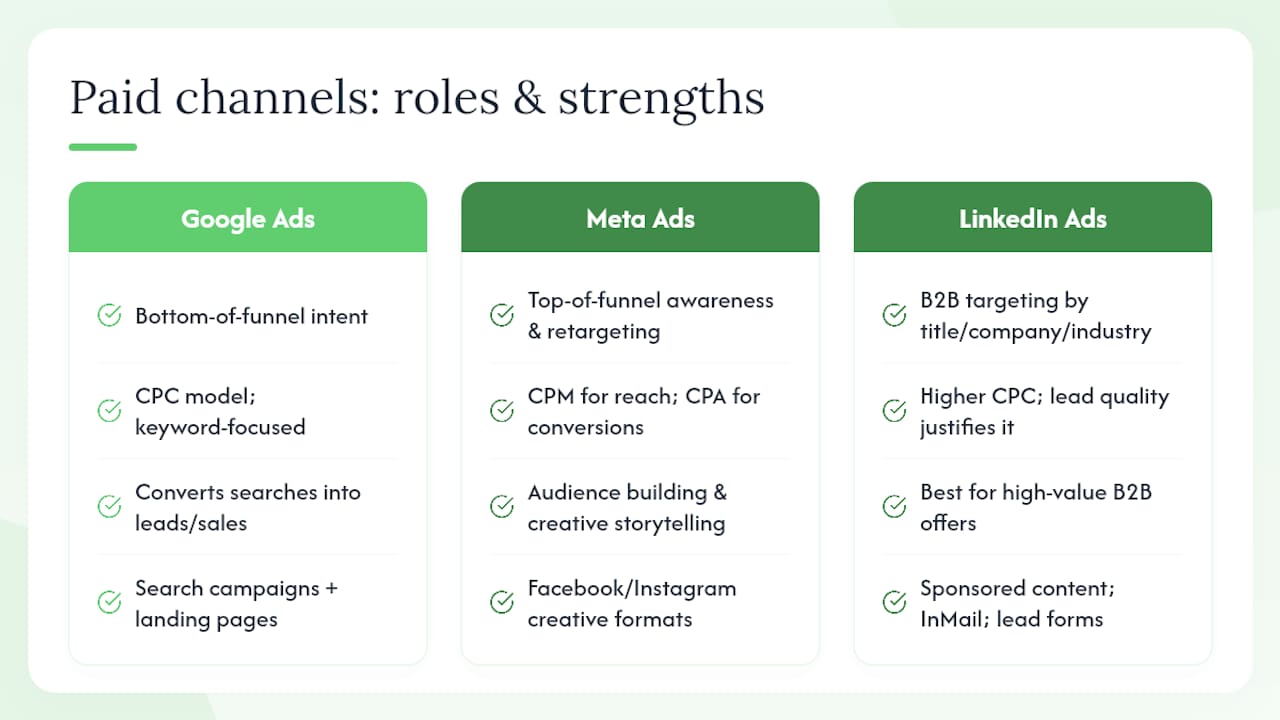
Paid channels buy speed, precision, and scale. The three platforms that dominate most paid strategies are Google Ads, Meta Ads, and LinkedIn Ads, and each serves a distinct role.
Google Ads captures bottom-of-funnel intent. When a user searches “best CRM software for small business,” they are actively evaluating options. A well-structured search campaign with tightly matched keywords and a strong landing page can convert that intent directly into a lead or sale. Google Ads operates on a CPC model, with costs varying by industry and keyword competitiveness. Punchvirtualmanager’s Google Ads management covers campaign structure, keyword strategy, and conversion tracking for businesses that want to capture this demand without wasting budget on irrelevant clicks.
Meta Ads (Facebook and Instagram) excel at audience building and creative storytelling. They are most effective for top-of-funnel awareness and retargeting. Meta’s audience targeting uses behavioral and demographic data to reach users who match your customer profile, even when those users are not actively searching for your product. CPM pricing makes Meta efficient for reach-based campaigns, while conversion-optimized campaigns use CPA bidding. Meta provides vendor best-practice guidance through its Meta Blueprint certification program, which covers campaign structure, creative formats, and measurement.
LinkedIn Ads serve B2B marketers targeting by job title, company size, industry, or seniority. Cost-per-click on LinkedIn is higher than on Meta or Google, but the lead quality for high-value B2B offers tends to justify the premium. Sponsored content, InMail, and lead generation forms are the most commonly used formats.
All three platforms provide conversion pixels and event tracking that feed into attribution dashboards. Setting up conversion tracking correctly before launching any paid campaign is non-negotiable — without it, you cannot measure ROAS or optimize toward the outcomes that matter.
What do you gain and trade off with each approach?
The core tradeoff is simple: paid buys speed and precision; organic builds durability and trust. Neither is universally superior, and the right balance depends on your timeline, budget, and business stage.
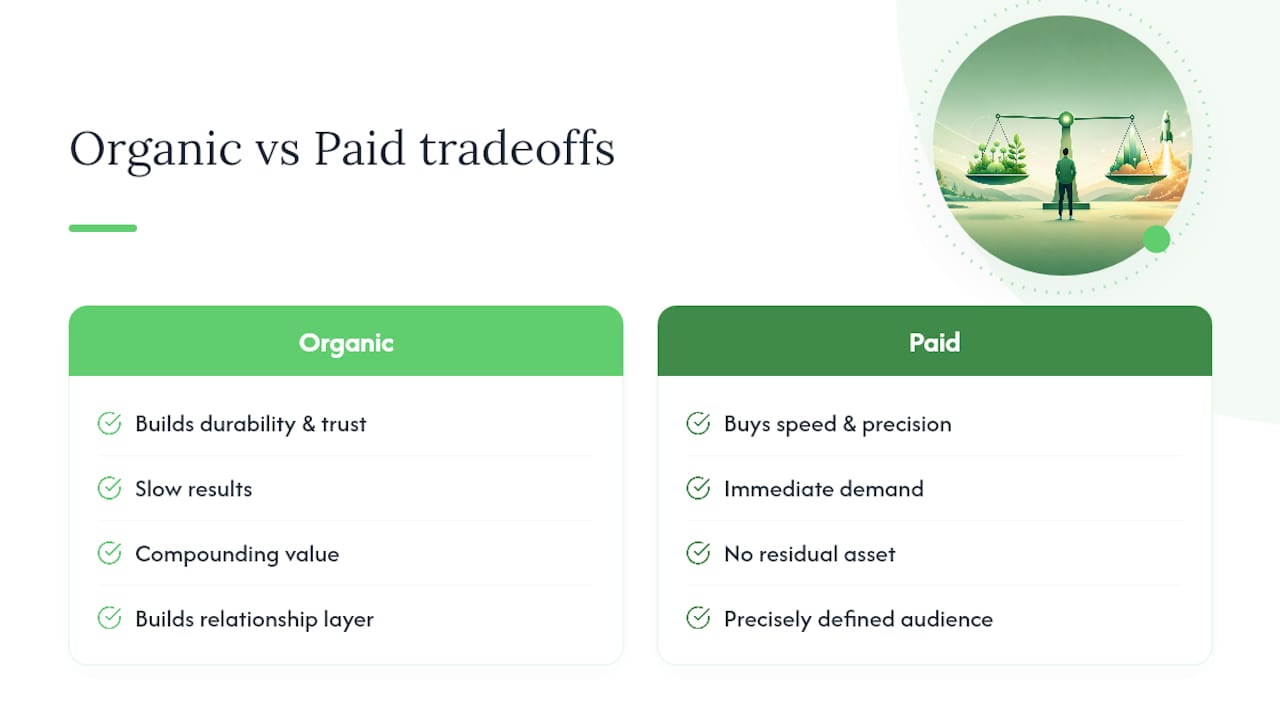
Organic advantages center on compounding value. A blog post that earns 50 backlinks and ranks for a high-volume keyword generates traffic every month without additional spend. Email lists grow in value as they age. Brand communities create word-of-mouth that no ad budget can replicate. For social media marketing, organic posts build the relationship layer that makes paid retargeting more effective.
The challenges with organic are real. SEO rankings can shift with algorithm updates, requiring ongoing maintenance. Content production demands skilled writers, editors, and sometimes developers. Results are slow, which creates pressure on teams to show early ROI. And organic social reach on most platforms has declined as algorithms prioritize paid content.
Paid advantages are equally clear. You can reach a precisely defined audience within hours. You can test five different ad creatives simultaneously and know within a week which one converts. Retargeting lets you re-engage users who visited your site but did not convert. For a new product launch or a time-sensitive promotion, paid is often the only viable channel for generating immediate demand.
The challenges with paid are cost and sustainability. Audience fatigue is a genuine operational problem: the same creative shown to the same audience too many times sees diminishing click-through rates and rising CPMs. Creative production becomes a bottleneck as campaigns scale. And when the budget runs out, the traffic stops — there is no residual asset left behind.
One practical note: paid campaigns consistently perform better when a credible organic presence already exists. A user who clicks a Google Ad and lands on a site with no blog, thin content, and no social proof is far less likely to convert than one who lands on a site with authoritative content and genuine reviews. Organic builds the relationships; paid accelerates the reach.
What do organic and paid actually cost, and how long until you see results?
Organic requires upfront time and skill investment with delayed financial return. Paid requires ongoing media spend with near-immediate measurable output. Both have a place in a well-structured budget.
| Channel | Typical monthly cost range | Time to meaningful results | Primary KPI |
|---|---|---|---|
| SEO (on-page + technical) | $1,000+ (agency or in-house) | 3–6 months | Organic sessions, keyword rankings |
| Long-form content production | $500+ per month | 4–12 months | Organic traffic, backlinks, time on page |
| Google Ads (search) | $500+ in ad spend | Days to 2 weeks | Clicks, conversions, ROAS |
| Meta Ads (social) | $300+ in ad spend | Several weeks | CPM, CTR, CPA |
| LinkedIn Ads (B2B) | $1,000+ in ad spend | A few weeks | Lead volume, CPL, pipeline value |
| Email marketing | — | 1–3 months | Open rate, CTR, conversion rate |
Cost ranges reflect typical U.S. market rates and vary by industry, competition, and campaign complexity. The SBA’s guidance on marketing budgets recommends that small businesses treat marketing spend as a testable investment rather than a fixed overhead line, adjusting allocation based on measured results.
For established brands, a practical budget heuristic is the 70/20/10 rule: allocate 70% to proven channels, 20% to scaling channels, and 10% to new tests. B2B businesses often skew more of that allocation toward brand-building and organic activity, given longer sales cycles and higher deal values.
Track these KPIs first when starting out: organic sessions and keyword position movement for SEO; cost-per-acquisition (CPA) and ROAS for paid; and customer lifetime value (CLTV) to assess whether the CAC from any channel is sustainable. For a more detailed breakdown of which digital marketing metrics to prioritize, the measurement framework matters as much as the channel choice.
When should you choose paid, organic, or both?
A hybrid strategy is the right answer for most businesses past the early traction stage. The sequencing rule is consistent across industries: build your organic foundation first, then use paid to amplify, test, and launch.
A practical decision sequence:
- Use paid to amplify organic content. Boost organic posts or articles that already show strong engagement or SERP traction. Combining organic posts with paid amplification on social platforms consistently improves campaign performance compared to running either in isolation.
Use-case examples:
Pro Tip: Before increasing paid spend, check three things: your landing page conversion rate (aim for 2–5% minimum for most B2B offers), your organic credibility signals (reviews, domain authority, content depth), and your attribution setup. Scaling paid without these in place is one of the most common digital marketing mistakes small businesses make.
For early-stage companies deciding where to spend first, a channel priority matrix approach helps rank channels by acquisition efficiency and strategic fit before committing budget.
How do you measure success across organic and paid channels?
The primary KPIs to track are organic sessions, keyword rankings, click-through rate (CTR), conversion rate, customer acquisition cost (CAC), customer lifetime value (CLTV), and return on ad spend (ROAS). Each channel reports these differently, which is where attribution becomes the central challenge.
Attribution models and when to use them:
For most small and mid-size businesses, a data-driven attribution model in GA4 provides the most practical starting point. GA4’s cross-channel reporting allows you to see how organic and paid channels interact across the full customer journey, not just at the final click.
A practical testing checklist for measuring incremental lift:
- Organic content experiment: — Publish two versions of a landing page or blog post targeting similar keywords. Track which earns more backlinks, longer session duration, and higher conversion rate.
Platform-specific reporting (Google Ads dashboard, Meta Ads Manager, LinkedIn Campaign Manager) provides channel-level ROAS and CPA data. SEMrush and Sprout Social add organic search and social performance layers that platform dashboards do not cover. Together, these tools give a complete picture of where each channel contributes to growth.
Paid campaigns deliver fast, measurable visibility while organic creates long-term brand recognition and trust. Measuring both with the right attribution model is what allows you to optimize the mix rather than defaulting to one or the other based on gut feel.
Key Takeaways
A hybrid strategy that builds organic first and uses paid to amplify proven content consistently outperforms either channel used in isolation, regardless of business size or industry.
| Point | Details |
|---|---|
| Organic builds durable growth | SEO and content compound over time, generating traffic long after production costs are absorbed. |
| Paid delivers speed and precision | Google Ads, Meta Ads, and LinkedIn Ads provide immediate visibility with precise audience targeting. |
| Sequence matters | Fix organic fundamentals and conversion rates before scaling paid spend to avoid wasting budget. |
| Attribution shapes decisions | Use multi-touch attribution in GA4 to understand how organic and paid channels work together across the full funnel. |
| Budget with the 70/20/10 rule | Allocate 70% to proven channels, 20% to scaling channels, and 10% to new tests for sustainable growth. |
The approach Punchvirtualmanager uses when combining organic and paid
The most consistent mistake businesses make is treating organic and paid as separate workstreams managed by separate teams with separate goals. The organic vs paid marketing differences matter less than the integration between them.
At Punchvirtualmanager, the sequencing is organic-first, paid-to-scale. Every new client engagement starts with an audit of existing organic assets before a single dollar goes into paid media. The reasoning is straightforward: paid campaigns sent to weak landing pages, thin content, and low-trust brand signals produce poor conversion rates regardless of how well the targeting is configured. Fixing the foundation first makes every paid dollar more efficient.
The sequencing checklist:
- Audit organic assets: Review existing content, keyword rankings, backlink profile, technical SEO health, and site conversion rates. Use SEMrush for competitive gap analysis.
- Prioritize content and landing page fixes: Address technical SEO issues, improve page speed, and publish or update content targeting high-intent keywords before launching paid campaigns.
- Run small paid tests: Start with a defined test budget on one platform. Google Ads for search intent capture or Meta Ads for audience testing are typical starting points.
- Measure incremental lift: Compare conversion rates and CAC between paid and organic traffic. Use GA4 for cross-channel attribution.
- Scale winners: Increase budget on campaigns that demonstrate sustainable CPA. Use paid performance data to inform the next round of organic content priorities.
- Amplify organic content with paid: Identify organic posts and articles with strong engagement or SERP traction. Promote them via paid social to extend reach to net-new audiences.
Operational tips for cross-team collaboration:
- Content, SEO, and paid teams should share a unified brief template that aligns keyword targets, audience definitions, and conversion goals.
- Paid teams should review organic content performance weekly to identify amplification candidates.
- SEO teams should review paid search query reports monthly to identify organic content gaps.
- A common pitfall is launching paid campaigns before landing pages are conversion-ready. A well-developed website with clear calls to action is a prerequisite for paid efficiency.
The digital marketing strategy that works is not the one that spends the most on paid or produces the most organic content. It is the one that sequences both channels deliberately, measures the right KPIs, and adjusts allocation based on what the data actually shows.
If you want to build a channel mix that compounds rather than just burns budget, Punchvirtualmanager’s digital marketing services cover the full spectrum: SEO, Google Ads management, social media marketing, and content strategy, structured around the hybrid approach described in this article.
Further reading and useful sources
These sources informed this article and are worth bookmarking for deeper research on specific channels and strategies.
Salesforce: Your Guide to Organic Marketing — A practical overview of organic marketing principles, including how organic and paid complement each other. Useful for understanding the compounding value argument.
Forbes Business Council: Why Start With Organic Marketing vs. Paid Ads? — Expert perspective on the sequencing logic behind organic-first strategy. Useful for the hybrid strategy and budget allocation sections.
HubSpot: Organic Marketing Secrets — Covers organic channel definitions, typical timelines, and how paid acts as a speed lever. A solid reference for channel planning.
Statista: Social Media Advertising Spending in the United States — The benchmark data source for U.S. paid social scale and competitive pressure. Use for context when setting paid social budgets.
MarketerHire: Paid Acquisition Strategy — Covers the 70/20/10 budget heuristic, channel selection frameworks, and scaling rules for paid acquisition. Useful for budget planning and channel prioritization.
Sprout Social: Organic vs. Paid Social Media — Platform-specific guidance on combining organic and paid social. Covers cost, targeting, reach, and analytics differences in detail.
SBA: How to Get the Most From Your Marketing Budget — Small-business budgeting guidance from the U.S. Small Business Administration. Useful for setting realistic spend expectations and testing frameworks.
Ironhack: What’s the Difference Between Paid and Organic Marketing? — A clear introductory comparison covering speed, cost, measurability, and trust. A good starting point for readers new to the topic.
For platform-specific best practices, Google’s official Google Ads Help Center and Meta’s Meta Blueprint provide up-to-date guidance on campaign structure, bidding, and measurement. SEMrush and Sprout Social both publish regularly updated benchmark reports that are worth reviewing when setting channel-specific KPI targets.
Why the “organic vs. paid” debate misses the real question
Most articles frame this as a choice. The more useful frame is sequencing. The question is not whether to use organic or paid — it is which one to invest in first, and how to connect them once both are running.
The conventional wisdom tends to favor paid for early-stage businesses because the results are visible and attributable. That logic has a flaw. A business that scales paid before establishing organic credibility is essentially paying a premium to send traffic to an unconvincing destination. Conversion rates stay low, CAC stays high, and the business becomes dependent on ad spend to sustain any revenue at all.
The businesses that build the most durable growth tend to do the opposite. They invest in content, SEO, and brand-building first, even when the results are slow. By the time they scale paid, they have a site that converts, a brand that users recognize, and organic content that paid campaigns can amplify rather than replace. The paid spend goes further because the foundation is already there.
There is also a risk dimension that rarely gets discussed. Paid channels are subject to platform policy changes, auction dynamics, and rising CPMs. A business that relies entirely on paid for customer acquisition has no buffer when costs spike or a platform changes its targeting rules. Organic assets, by contrast, are owned. A high-ranking article or a loyal email list does not disappear when a platform updates its algorithm for ad delivery.
The practical implication is straightforward: treat organic as infrastructure and paid as fuel. Infrastructure takes time to build, but it makes the fuel burn more efficiently.