
Accounting is the system that converts every transaction your business makes into the facts you need to run it, grow it, and stay compliant. The three essential financial reports produced by accounting, the income statement, balance sheet, and statement of cash flows, form the foundation for IRS filings, lender decisions, and day-to-day management. At its core, accounting in business performs five distinct roles:
- Financial reporting for compliance — producing GAAP-aligned statements for the IRS, lenders, and investors
- Management decision support — giving owners and managers the numbers behind pricing, hiring, and investment calls
- Cash and liquidity control — tracking what is owed, what is due, and what is available right now
- Internal controls — reducing fraud, errors, and unauthorized spending through structured processes
- Performance measurement — quantifying profitability, efficiency, and growth against targets
Table of Contents
- What is the role of accounting in business?
- Main types of accounting and who uses each
- Core accounting functions that support your operations
- What the three financial statements actually tell you
- How small businesses can practically run their accounting
- U.S. compliance essentials every small business needs to know
- Key accounting metrics and KPIs your business should track
- Five steps to get useful accounting outputs in the next 90 days
- Key Takeaways
- Why accounting is a strategic function, not just an administrative one
- Punchvirtualmanager’s finance and accounting services for small businesses
- Useful sources for further reading
What is the role of accounting in business?
Accounting is an information system that collects, records, classifies, summarizes, analyzes, and reports a business’s financial activity. Each step in that sequence has a specific job. Collection means identifying every transaction that has a financial impact, from a customer payment to a vendor invoice. Recording captures those transactions in a journal in chronological order. Classification groups them into categories such as revenue, cost of goods sold, or operating expenses. Summarization produces totals by account. Analysis compares those totals against budgets, prior periods, or benchmarks. Reporting packages the results into statements and management reports that decision-makers can act on.
Many small business owners use the terms bookkeeping and accounting interchangeably, but they describe different work. Bookkeeping is the clerical capture of transactions in chronological order. Accounting is the analytical layer that classifies, summarizes, and interprets that data to guide business action. A bookkeeper records that a $4,200 payment left the bank account. An accountant tells you whether that payment was a capital expense or an operating cost, how it affects your tax position, and whether the cash flow projection still holds.
The practical signal for moving from periodic bookkeeping to proactive accounting analysis is when decisions start costing you money without data to back them. If you are setting prices without knowing your actual cost per unit, or hiring without a cash-flow forecast, you have outgrown bookkeeping alone.
Main types of accounting and who uses each
Accounting is not a single discipline. Different streams serve different users, and knowing which one answers your question saves time and money.
Financial accounting produces GAAP-compliant statements for external users: lenders, investors, the IRS, and regulators. It answers the question “Is this business creditworthy and financially sound?” GAAP, governed by the Financial Accounting Standards Board (FASB), provides the rules that make financial statements consistent and comparable across companies. IFRS serves the same purpose internationally, but U.S. entities must follow GAAP for domestic regulators and lenders.

Managerial accounting delivers tailored reports for internal decision-making. It answers questions like “Which product line is most profitable?” or “Should we add a second shift?” Reports are not bound by GAAP because their audience is internal managers, not outside stakeholders.
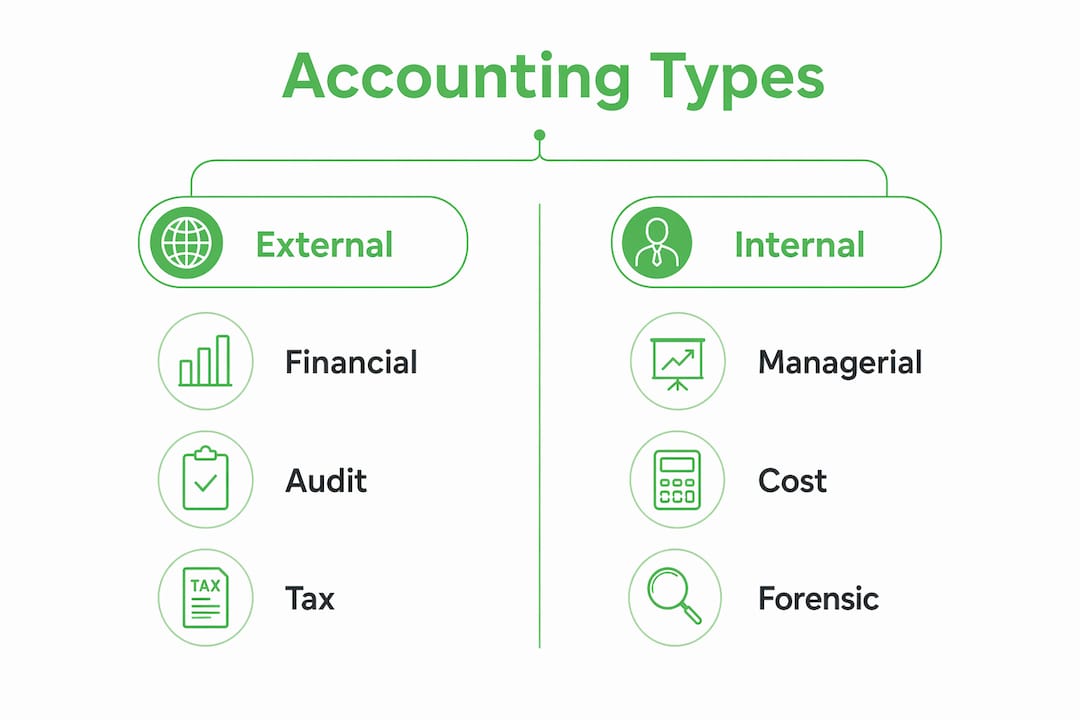
Tax accounting follows IRS rules rather than GAAP, and the two frameworks often produce different income figures. Depreciation schedules, expense timing, and revenue recognition can all differ between a GAAP income statement and a tax return. Both matter, but for different audiences.
Cost accounting breaks down the cost of producing goods or delivering services. It feeds pricing decisions, efficiency analysis, and budget variances. Manufacturing firms rely on it heavily; service businesses use it to price projects accurately.
Audit and forensic accounting provide independent verification. External auditors confirm that financial statements are free from material misstatement. Forensic accountants investigate suspected fraud or financial disputes.
Small businesses typically consolidate these roles. A single CPA may handle financial statements, tax returns, and periodic management reports. Larger firms separate them into dedicated teams or departments. The consolidation is efficient but creates a risk: without clear separation, errors in one stream can flow undetected into another.
Core accounting functions that support your operations
Accounting functions run across every part of a business, not just the finance department. The following functions are the ones that most directly affect daily operations and decision quality:
- Transaction recording — captures every financial event accurately and on time; the foundation for everything else
- Accounts receivable management — tracks customer invoices and collections; directly controls cash inflows
- Accounts payable management — manages vendor invoices and payment timing; protects supplier relationships and cash position
- Payroll processing — calculates wages, withholds taxes, and meets deposit deadlines; errors here trigger IRS penalties
- Bank reconciliations — matches internal records to bank statements; catches errors, fraud, and timing differences
- Budgeting and forecasting — sets financial targets and projects future cash needs; guides hiring and capital decisions
- Cost analysis — identifies the true cost of products, services, and departments; feeds pricing and margin decisions
- Internal controls — segregation of duties, approval workflows, and access restrictions that reduce fraud and errors
- Tax preparation and planning — meets IRS filing obligations and minimizes tax liability through timing and structure
- Financial reporting — produces the income statement, balance sheet, and cash flow statement for stakeholders
Two concrete examples show how these functions connect to real decisions. A restaurant owner using cost accounting discovers that one menu category runs a low food cost while another runs a much higher food cost. That single data point justifies a menu reprice without guesswork. A software startup reviewing its cash-flow forecast sees that future payroll obligations exceed projected collections by a significant amount, giving the owner time to arrange a line of credit rather than scramble. That finding, surfaced two months early, gives the owner time to arrange a line of credit instead of scrambling.
Internal controls deserve particular attention for small businesses. Segregation of duties, where the person who approves a payment is not the same person who processes it, is the single most effective fraud deterrent available at no additional cost. Bank reconciliations completed monthly catch unauthorized transactions before they compound. Approval workflows for expenses above a set threshold prevent budget overruns before they appear on a report.
What the three financial statements actually tell you
Every business produces three primary financial statements, and each answers a different question.
Income statement
The income statement covers a period of time, typically a month, quarter, or year, and answers: “Was the business profitable?” It shows revenue, cost of goods sold, gross profit, operating expenses, and net income. For small businesses, gross margin (gross profit divided by revenue) is the most important line to watch. A declining gross margin signals that costs may be rising faster than prices, or that the sales mix is shifting toward lower-margin products.
Balance sheet
The balance sheet is a snapshot at a single point in time. It answers: “What does the business own, what does it owe, and what is left for the owners?” Assets equal liabilities plus equity. The current ratio (current assets divided by current liabilities) measures short-term liquidity. A ratio below 1.0 means the business cannot cover its near-term obligations from current assets alone.
Statement of cash flows
The cash flow statement explains why the cash balance changed during a period. It separates cash from operations, investing, and financing activities. This is where the gap between profit and cash becomes visible. A business can show net income on its income statement while simultaneously running out of cash because customers are slow to pay or inventory is building up. Watching operating cash flow separately from net income is one of the most practical habits a small business owner can develop.
Cash vs. accrual accounting
The choice between cash and accrual basis affects how income and cash flow are reported in the financial statements. Cash basis records revenue when cash is received and expenses when cash is paid. Accrual basis records revenue when earned and expenses when incurred, regardless of when cash moves. Accrual accounting produces more accurate profit figures and is required for businesses above the IRS gross receipts threshold, but it can obscure immediate cash constraints. Cash basis is simpler and shows exactly what is in the bank, but it can overstate profitability in periods when large receivables are outstanding. Many growing businesses benefit from accrual accounting paired with regular cash-flow review.
How small businesses can practically run their accounting
Small businesses have three realistic implementation models, and the right choice depends on transaction volume, complexity, and budget.
A sole proprietor with low transaction volume can manage with cloud bookkeeping software and a quarterly CPA review. The software handles transaction capture, invoicing, and basic reporting. The CPA reviews the books, prepares tax returns, and flags issues the owner may have missed.
A small team with moderate complexity typically pairs a part-time or full-time bookkeeper with an outsourced CPA. The bookkeeper handles daily entries, reconciliations, and payroll. The CPA prepares financial statements, advises on tax strategy, and supports any financing or audit needs.
A fully outsourced model works for businesses that want to eliminate internal accounting overhead entirely. An outsourced accounting firm handles everything from transaction capture to financial reporting. This model requires strong internal oversight: monthly reconciliations, access controls, and a designated internal owner who reviews reports and approves payments.
Bookkeeper vs. accountant: what each role covers
| Task | Bookkeeper | Accountant (CPA) |
|---|---|---|
| Daily transaction entry | Yes | No |
| Bank reconciliations | Yes | Reviews/approves |
| Accounts payable/receivable | Yes | Oversight |
| Payroll processing | Yes | Oversight |
| Financial statement preparation | No | Yes |
| Tax return preparation | No | Yes |
| Tax strategy and planning | No | Yes |
| Cash flow forecasting | Limited | Yes |
| Audit support | No | Yes |
For outsourcing bookkeeping and payroll specifically, services like bookkeeping and payroll support can handle the routine capture layer while your CPA focuses on analysis and compliance.
Software categories to evaluate
- Cloud bookkeeping apps (general ledger, invoicing, bank feeds)
- Payroll processors (tax calculations, direct deposit, W-2 and 1099 generation)
- Integrated accounting suites (combines bookkeeping, payroll, and reporting)
- Invoicing and billing tools (for service businesses with high invoice volume)
Monthly task timeline
A practical cadence for small businesses: daily transaction entry and expense coding; weekly accounts receivable and payable review; monthly bank reconciliations and financial statement review; quarterly estimated tax payments and cash-flow forecast updates; annual close, tax return preparation, and budget setting.
Pro Tip: Automation handles transaction capture well, but it cannot replace a professional review of your financial statements. Even the best cloud bookkeeping app will not flag a misclassified expense or a missed deduction. Schedule a monthly or quarterly accountant review regardless of how good your software is.
U.S. compliance essentials every small business needs to know
Compliance in the United States extends well beyond filing an annual tax return. The IRS and state agencies impose ongoing obligations that accounting must support throughout the year.
GAAP governs financial reporting for external stakeholders: investors, lenders, and auditors. Tax accounting follows IRS rules, which differ from GAAP in areas like depreciation, revenue recognition, and expense timing. A business may report $200,000 in GAAP net income and a different taxable income figure on its federal return. Both numbers are correct; they just answer different questions for different audiences.
Common U.S. filing and compliance obligations for small businesses include:
- Federal income tax returns — Form 1120 for C corporations, Form 1120-S for S corporations, Schedule C for sole proprietors, Form 1065 for partnerships
- Estimated tax payments — quarterly deposits required for businesses expecting to owe $1,000 or more in federal tax
- Payroll tax deposits — federal income tax withholding, Social Security, and Medicare taxes deposited on a semi-weekly or monthly schedule per IRS guidelines
- Form 941 — quarterly payroll tax return filed with the IRS
- W-2s and 1099s — information returns due to recipients by January 31 and filed with the IRS by the applicable deadline
- Sales tax — collection and remittance obligations vary by state and product/service category; nexus rules have expanded significantly since the 2018 South Dakota v. Wayfair decision
- State and local filings — income, franchise, and gross receipts taxes vary by jurisdiction
Practical compliance habits that reduce audit risk: maintain supporting documentation for every deduction, complete bank reconciliations before each filing deadline, and implement segregation of duties so no single person controls both the recording and approval of transactions. Ongoing recordkeeping and internal controls reduce the risk of penalties during mandatory audits.
Compliance obligations vary significantly by industry. Healthcare, financial services, and government contractors face additional reporting requirements. Consult a CPA familiar with your sector before assuming standard small-business rules apply.
Key accounting metrics and KPIs your business should track
Tracking the right metrics turns financial statements from historical documents into management tools. The following KPIs cover the most important dimensions of financial health for small businesses.
- Gross margin — (Revenue minus cost of goods sold) divided by revenue. Track monthly. A declining trend signals pricing or cost problems before they reach the bottom line.
- Net margin — Net income divided by revenue. Track monthly. Shows what percentage of each dollar of revenue becomes profit after all expenses.
- Current ratio — Current assets divided by current liabilities. Track monthly. Below 1.0 indicates a short-term liquidity risk.
- Quick ratio — (Current assets minus inventory) divided by current liabilities. Track monthly. A more conservative liquidity measure; below 0.8 warrants attention.
- Accounts receivable days (DSO) — Average receivables divided by daily revenue. Track monthly. Rising DSO means customers are paying slower; above 45 days for most industries is a warning sign.
- Accounts payable days — Average payables divided by daily cost of goods sold. Track monthly. Extending payables too far damages supplier relationships.
- Burn rate — Monthly net cash outflow for businesses not yet profitable. Track weekly. Directly determines how long the business can operate without new revenue or funding.
- Cash runway — Cash on hand divided by monthly burn rate. Track weekly. Tells you how many months of operations remain at the current spend rate.
- Operating cash flow — Cash generated by core business operations, before investing and financing. Track monthly. The most reliable indicator of whether the business model is working.
- EBITDA — Earnings before interest, taxes, depreciation, and amortization. Track quarterly. Useful for comparing operating performance across periods and for lender or investor conversations.
For budgeting and cash planning, connecting these KPIs to a rolling 13-week cash forecast gives small business owners the earliest possible warning of a liquidity gap.
A monthly management pack for a small business should include: the income statement versus budget, the balance sheet, the cash flow statement, DSO and current ratio, and a one-page narrative covering variances and the next 90-day outlook. Aligning these financial KPIs with your marketing metrics creates a complete picture of where growth is coming from and what it is costing.
Five steps to get useful accounting outputs in the next 90 days
This checklist gives small business owners a concrete path from scattered records to a functioning accounting system.
Step 1: Centralize transaction capture and separate business from personal finances (Week 1–2, approximately 3–5 hours)
Open a dedicated business checking account and credit card if you have not already. Connect them to a cloud bookkeeping app so transactions feed automatically. This single step eliminates the most common source of accounting errors for small businesses: mixed personal and business expenses. Approximate ongoing time: 1–2 hours per week for coding and review.
Step 2: Choose your accounting basis and align your processes (Week 2–3, approximately 2–4 hours with a CPA)
Decide between cash and accrual basis with input from your CPA, considering your revenue level, industry, and whether you need GAAP-compliant statements for lenders. Set up your chart of accounts to match your business model. This decision affects every report you produce going forward.
Step 3: Produce your first monthly management pack (End of month 1, approximately 4–6 hours)
Pull the income statement, balance sheet, and cash flow statement for the prior month. Calculate gross margin, current ratio, and DSO. Write three sentences explaining the biggest variance from your expectations. This first pack will be rough; the value is in building the habit and identifying gaps in your data. For practical forecasting templates, the financial forecasting guide from Punchvirtualmanager is a useful starting point.
Step 4: Set three KPIs with thresholds and review them weekly (Week 3–4, approximately 1 hour to set up)
Choose gross margin, operating cash flow, and DSO as your starting three. Set a threshold for each that triggers a review: for example, gross margin below 40%, DSO above 45 days, or operating cash flow negative for two consecutive months. Assign one person as the internal owner for each metric.
Step 5: Schedule a quarterly CPA review and tax planning session (Ongoing, approximately 2–3 hours per quarter)
A quarterly review with your CPA covers estimated tax payments, year-to-date performance versus budget, and any compliance deadlines in the next 90 days. This session also surfaces deductions and planning opportunities that bookkeeping software will not identify on its own.
Common challenges and quick fixes:
- Missing receipts: Use a mobile receipt-capture app to photograph and attach receipts at the point of purchase. Reconstruct missing records from bank and credit card statements before year-end.
- Unmanaged accounts receivable: Set automatic invoice reminders at 7, 14, and 30 days past due. Review the AR aging report weekly, not monthly.
- Mixed personal and business accounts: Separate immediately. Retroactive separation is possible but time-consuming; the sooner it happens, the lower the cleanup cost.
Key Takeaways
Accounting functions as a live decision system, not a year-end compliance task, and small businesses that treat it that way gain a measurable advantage in cash management, pricing, and growth planning.
| Point | Details |
|---|---|
| Accounting is a decision system | It converts daily transactions into reports that support pricing, hiring, cash management, and compliance. |
| Three essential financial statements | The income statement, balance sheet, and cash flow statement together show profitability, financial position, and liquidity. |
| Five-step implementation checklist | Separate accounts, choose your basis, produce a monthly pack, set three KPIs, and schedule quarterly CPA reviews. |
| U.S. compliance covers more than taxes | Payroll deposits, quarterly estimates, 1099s, and sales tax obligations run throughout the year, not just at year-end. |
| Punchvirtualmanager supports implementation | Punchvirtualmanager’s finance and accounting services help small businesses set up forecasting and management reporting. |
Why accounting is a strategic function, not just an administrative one
The conventional view of accounting as a back-office function, something that happens after the real business decisions are made, misses the point entirely. Scholar Ray Ball argues that accounting is the premier measurement system in the modern economy, central to how capital markets price assets, how lenders assess creditworthiness, and how performance incentives are structured inside organizations. That framing matters for small business owners because it redefines what accounting is for.
When accounting reports are timely and tied to KPIs, they stop being historical summaries and start driving decisions. A business owner who reviews gross margin weekly can adjust pricing before a bad quarter becomes a bad year. One who tracks DSO monthly can identify a single large customer whose slow payment is distorting the entire cash position. These are not administrative observations; they are strategic interventions made possible by good accounting.
The strategic uses extend further. Capital allocation decisions, which product line gets investment, which gets cut, rest on cost accounting and contribution margin analysis. Pricing strategy requires knowing the true cost structure, not just the invoice total from suppliers. Performance incentives for staff, whether bonuses, commissions, or profit-sharing, need reliable profit figures to be credible and fair. Accurate financial statements are also a precondition for debt financing, investor due diligence, and any future sale or merger of the business.
The businesses that treat accounting as a strategic function rather than a compliance obligation tend to make better decisions faster, attract capital on better terms, and build governance structures that scale. The ones that treat it as a year-end task tend to discover problems only after they have become expensive.
Punchvirtualmanager’s finance and accounting services for small businesses
Getting accounting set up correctly from the start is faster and more accurate with professional support. Punchvirtualmanager offers finance and accounting services designed specifically for small businesses that need more than bookkeeping software but are not ready for a full in-house finance team. The service covers financial reporting, forecasting support, and management pack setup, giving business owners the outputs they need to make confident decisions without building the infrastructure themselves.
The practical advantage is speed. Rather than spending weeks configuring a chart of accounts, choosing an accounting basis, and building a reporting template, you work with a team that has done it before. Punchvirtualmanager’s approach combines financial clarity with the broader operational perspective of a firm that also understands marketing, growth, and digital strategy. To get started, visit the finance and accounting page and request a consultation.
Useful sources for further reading
The following authoritative sources support the claims in this guide and are worth bookmarking for ongoing reference.
- Financial Accounting Standards Board (FASB) — The primary U.S. standard-setter for GAAP. Use this to verify current accounting standards and any updates to financial reporting rules.
- AICPA | CIMA — The American Institute of CPAs provides guidance on accounting standards, professional ethics, and small-business resources. Useful for finding a qualified CPA and understanding professional standards.
- IRS.gov — The authoritative source for all federal tax filing requirements, payroll deposit schedules, form instructions, and compliance deadlines. Always verify current thresholds and deadlines here rather than relying on third-party summaries.
- Committee of Sponsoring Organizations of the Treadway Commission (COSO) — Provides the most widely used framework for internal controls. Relevant for any business building or reviewing its control environment.
- OpenStax — Introduction to Business — A free, peer-reviewed textbook that covers accounting fundamentals, financial statements, and the distinction between bookkeeping and accounting in accessible language.
- Punchvirtualmanager — Financial Forecasting Guide — Practical forecasting templates and guidance for small businesses building their first management pack.
Consult a licensed CPA for industry-specific compliance questions. Tax and regulatory obligations vary by entity type, industry, and state, and a qualified professional can identify obligations that general guides do not cover.