
Auditing gives a small business an independent, verifiable stamp of financial credibility. That single fact changes how lenders evaluate loan applications, how investors assess risk, and how large customers decide whether to award contracts. The role of auditing in small business operations extends well beyond compliance: a well-executed audit improves internal controls, deters financial mismanagement, and positions the company for growth. According to MIA guidance on audit value, audited accounts serve as a primary indicator of financial health for financial institutions and can result in better lending terms compared to unaudited records.
If your business is approaching a financing round, a supplier contract requiring audited statements, or a potential acquisition, the right next step is to contact a licensed CPA and begin organizing your financial records now. The preparation checklist in Section 8 gives you a prioritized starting point.
Quick-start signals that an audit may be overdue:
- A lender or investor has requested audited financial statements
- A large customer or government contract requires independent assurance
- Your business is approaching a sale or merger
- You suspect internal control weaknesses or have experienced unexplained discrepancies
- You are preparing for a significant fundraising round
Table of Contents
- What does a financial audit actually mean for a small business?
- What types of audits do small businesses encounter?
- How does the audit process work, step by step?
- What are the key benefits of auditing for small businesses?
- What U.S. auditing standards should small-business owners know?
- When does a small business actually need an audit?
- How to prepare for an audit: a practical, prioritized checklist
- What does a small-business audit typically cost, and how long does it take?
- How do you choose the right auditor for your small business?
- What do auditors commonly find, and how do you fix it?
- What does research say about the expectations gap and strategic audit use?
- Key Takeaways
- Audits as a scaling tool, not a compliance chore
- Punchvirtualmanager helps you arrive at the audit ready
- Further reading and authoritative U.S. sources
What does a financial audit actually mean for a small business?
A financial audit is an independent examination of a company’s financial statements, conducted by a licensed external auditor, to form a professional opinion on whether those statements present a true and fair view in accordance with applicable standards. In the United States, that means financial statements prepared under Generally Accepted Accounting Principles (GAAP) and audited under Generally Accepted Auditing Standards (GAAS), as established by the American Institute of Certified Public Accountants (AICPA) for private companies.
The auditor does not prepare the financial statements. The business does. The auditor gathers evidence, tests transactions, evaluates internal controls, and then issues one of four opinions: unmodified (clean), qualified, adverse, or disclaimer of opinion. That opinion is what lenders, investors, and counterparties actually read.
How audits differ from reviews and compilations
Small businesses often encounter three levels of financial statement engagement, and the differences matter:
- Compilation: The CPA assembles financial statements from management-provided data with no verification or testing. No assurance is provided. Appropriate for internal use or very basic reporting needs.
- Review: The CPA applies analytical procedures and inquiries to provide limited assurance that no material modifications are needed. Less rigorous than an audit, but accepted by some lenders for smaller credit facilities.
- Audit: Full independent examination with substantive testing, evidence gathering, and a formal opinion. Required by most institutional lenders, investors, and large commercial counterparties.
A service firm preparing for a $2 million bank loan will almost certainly be asked for audited statements, not a review. A vendor awarding a multi-year supply contract to a small manufacturer may require audited financials as a condition of the agreement. Knowing which engagement type fits your situation avoids paying for more than you need, or presenting something that falls short of what a counterparty requires.
What types of audits do small businesses encounter?
Not every audit looks the same. Small businesses face several distinct types, each serving a different audience and producing a different outcome.
| Audit Type | Primary Audience | Common Triggers | Outcome |
|---|---|---|---|
| Financial statement audit | Banks, investors, acquirers | Loan covenants, fundraising, M&A | Auditor’s opinion on financial statements |
| Internal audit | Management, board | Process improvement, fraud prevention | Internal report with control recommendations |
| Operational audit | Management | Efficiency reviews, cost reduction | Operational findings and recommendations |
| Tax audit | IRS or state tax authority | Random selection, discrepancies, large deductions | Adjustment, penalty, or clearance |
| Agreed-upon procedures | Specific counterparty | Contract requirement, grant compliance | Factual findings report (no opinion) |
Financial statement audits are what most people picture: an external CPA firm examines the books and issues a formal opinion. Banks rely on this opinion when underwriting credit. Investors use it during due diligence. Acquirers need it to price a deal.
Internal audits are conducted by staff or an outsourced function reporting to management or a board. They focus on process efficiency, control gaps, and fraud risk rather than producing a public-facing opinion. For a small business without a dedicated finance team, an outsourced internal audit function can surface problems before they become material.
Operational audits examine whether business processes are running efficiently, not just whether the numbers are correct. A distribution company might commission one to identify warehouse inefficiencies or billing errors.
Tax audits are initiated by the IRS or a state revenue authority, not by the business. They examine whether reported figures match supporting documentation. Having clean, audited financials does not prevent a tax audit, but it significantly reduces the risk of unexplained discrepancies.
Agreed-upon procedures engagements are narrower: the auditor performs only the specific tests agreed with the requesting party and reports factual findings without issuing an overall opinion. Grant administrators and government contractors frequently request these.
How does the audit process work, step by step?
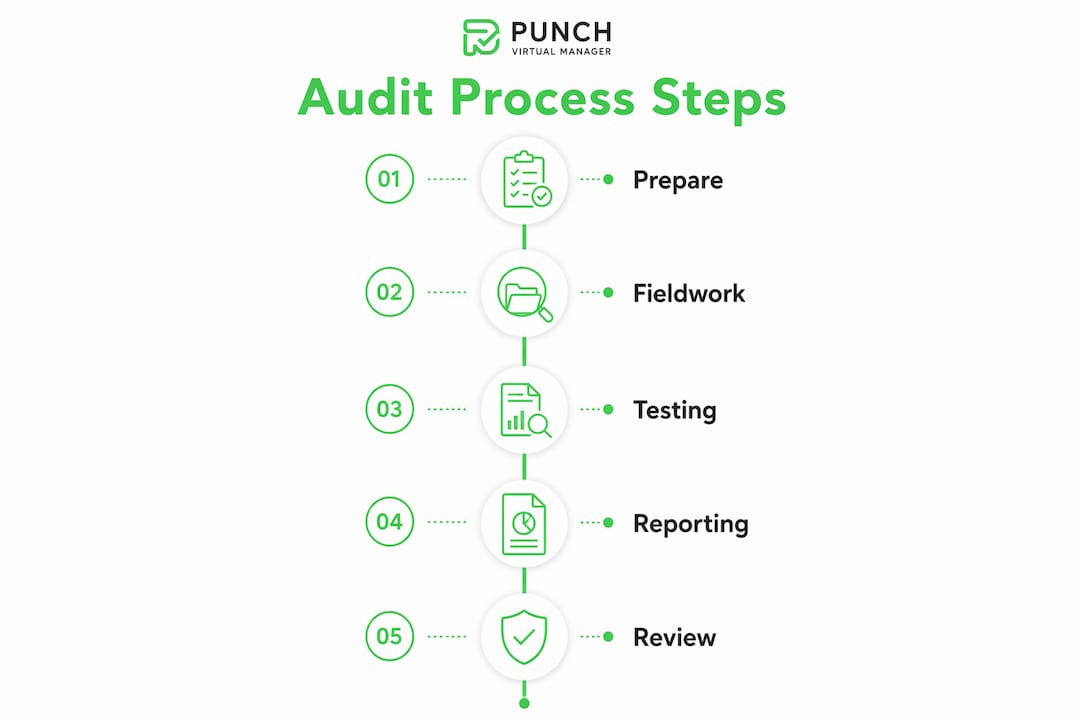
Understanding the sequence of an audit helps owners manage it as a project rather than react to it as an event. The typical process for a small business audit follows five stages.
Engagement and planning. The auditor issues an engagement letter defining scope, timeline, fees, and responsibilities. Both parties sign before any work begins. The auditor then conducts preliminary risk assessment, reviews prior-year financials, and identifies areas of higher audit risk specific to your industry and business model.
Understanding the control environment. The auditor evaluates the internal controls in place: how transactions are authorized, recorded, and reviewed. For most small businesses, formal controls are limited, which means the auditor will rely more heavily on substantive testing of individual transactions rather than on control reliance. ICAEW research on SME audits confirms that auditors of smaller entities often cannot test controls and instead review large samples of transactions to form their opinion.
Evidence gathering and substantive testing. This is the core of fieldwork. The auditor requests a “Provided by Client” (PBC) list of documents, selects transaction samples, confirms balances with third parties (banks, customers, suppliers), and tests key estimates such as depreciation, accruals, and revenue recognition. Auditors use lower materiality thresholds for small entities, which often means reviewing a higher volume of smaller transactions than would be required at a larger company.
Reporting. The auditor drafts findings, discusses any proposed adjustments with management, and issues the audit report with the formal opinion. A management letter or internal control letter typically accompanies the report, listing control deficiencies and recommendations.
Follow-up and remediation. A good auditor will discuss findings in a closing meeting and give management a clear picture of what needs to change before the next audit cycle. Addressing these items promptly reduces the scope of work in subsequent years.
Realistic timeline: For a small business with organized records, fieldwork typically runs two to four weeks. Add two to four weeks for planning and another two to three weeks for report issuance. Starting opening-balance testing early, before the fiscal year closes, can compress the main fieldwork window significantly.

What are the key benefits of auditing for small businesses?
The practical benefits of auditing for small enterprises go well beyond producing a document for the bank.
Access to capital and better lending terms. Audited statements serve as a primary indicator of financial health for financial institutions. A business presenting audited financials to a lender is demonstrating that an independent professional has verified the numbers, which reduces the lender’s perceived risk. That reduced risk often translates into lower interest rates, higher credit limits, or more favorable covenant structures.
Fraud deterrence and early risk detection. Regular audits act as a deterrent against financial mismanagement by identifying internal-control weaknesses before they become costly. Audits are not designed to catch every fraud incident, but their presence changes behavior and surfaces gaps that management might otherwise miss. A small business that discovers a reconciliation gap during an audit is far better positioned than one that discovers it during a lender’s due diligence review.
Improved internal controls. The management letter that accompanies an audit report is often the most operationally valuable output. It identifies specific weaknesses, such as inadequate segregation of duties, missing approval workflows, or unsupported accruals, and recommends fixes. Addressing these items systematically builds a stronger finance function over time.
Supplier and customer confidence. Large customers and government agencies increasingly require audited financials before awarding contracts. SME-focused guidance emphasizes that audits are constructive, collaborative engagements that add operational value beyond the opinion itself. A clean audit opinion signals to counterparties that the business is well-managed and financially stable.
Tax and compliance benefits. A business with audited financials and well-documented transactions is better prepared for a tax audit. The same organized records that satisfy an external auditor also satisfy an IRS examiner, reducing the risk of penalties and the cost of responding to information requests.
The strategic case for auditing: Audited accounts strengthen governance and can reduce financing costs by providing lenders and suppliers independent assurance of solvency and controls. Regulatory and professional guidance highlights audit outputs as a key signal to banks and suppliers when evaluating credit or contract awards.
What U.S. auditing standards should small-business owners know?
Two bodies set the standards that govern audits in the United States, and understanding which one applies to your business matters.
AICPA and GAAS. The American Institute of Certified Public Accountants establishes auditing standards for private companies through its Auditing Standards Board. These standards, collectively called Generally Accepted Auditing Standards (GAAS), govern how a CPA conducts an audit of a privately held small business. GAAS covers everything from planning and risk assessment to evidence gathering and reporting.
PCAOB. The Public Company Accounting Oversight Board sets auditing standards for companies registered with the Securities and Exchange Commission (SEC). Most small businesses are private and therefore fall under AICPA/GAAS, not PCAOB. However, if your business is considering a public offering or has issued publicly traded securities, PCAOB standards become relevant.
GAAP versus GAAS. These two frameworks serve different functions. GAAP (Generally Accepted Accounting Principles) defines how financial statements are prepared and what they must include. GAAS defines how an auditor tests and evaluates those statements. The auditor’s opinion states whether the financial statements comply with GAAP, and the audit itself is conducted in accordance with GAAS.
When regulations trigger an audit. Several situations can make an audit legally or contractually required for a small business:
- Loan covenants in commercial credit agreements often specify audited financials above certain loan thresholds
- Federal grant recipients may be subject to a Single Audit under the Uniform Guidance (2 CFR Part 200) if they expend $750,000 or more in federal awards in a fiscal year
- Government contracts may require audited cost reports or financial statements as a condition of award
- State-specific regulations in certain industries (insurance, financial services, nonprofits) may mandate annual audits regardless of size
When does a small business actually need an audit?
The decision to get an audit is rarely arbitrary. Most small businesses encounter one of three categories of triggers: legal requirements, commercial requirements, or strategic choice.
Legal and regulatory triggers:
- A loan covenant or credit agreement requires audited annual financials
- Federal grant expenditures exceed $750,000 in a fiscal year (Single Audit requirement)
- A state regulatory body or industry regulator mandates an annual audit
- A government contract specifies audited cost or financial reporting
Commercial triggers:
- A large customer or supplier requires audited statements before awarding a contract
- An investor conducting due diligence requests audited financials for the past two to three years
- A potential acquirer needs audited statements to price and structure a deal
- A franchiser or licensing body requires audited financials from franchisees
Strategic triggers (voluntary audits):
- The business is planning a fundraising round in the next 12–18 months and wants clean, audited financials ready
- Management wants to identify and fix internal control weaknesses before they become material
- The business is entering a supply chain where large customers will eventually require audited statements
Many small companies choose a voluntary audit in anticipation of growth, specifically to familiarize finance teams with audit requirements before thresholds or deals force it. Doing so avoids hurried opening-balance work and supports smoother funding or sale processes later.
Quick checklist: Do you need an audit now?
- Does any current loan agreement reference audited financial statements?
- Has a customer, investor, or acquirer requested audited financials in the past 12 months?
- Does your business receive $750,000 or more in federal grant funding annually?
- Are you planning a significant capital raise or sale within 18 months?
- Have you experienced unexplained financial discrepancies or suspected misappropriation?
If you answered yes to any of these, the audit conversation with a CPA should happen this quarter.
How to prepare for an audit: a practical, prioritized checklist
Preparation is the single most controllable variable in an audit. A disorganized finance function extends fieldwork, increases fees, and delays the final report. A prepared one does the opposite.
90 days before fieldwork: organize core financial records. Reconcile all bank and credit card accounts through the prior month. Confirm that the general ledger matches subsidiary ledgers for accounts receivable, accounts payable, and fixed assets. Identify any transactions that lack supporting documentation and resolve them now.
60 days before fieldwork: compile the PBC document package. Gather the items your auditor will request:
- Bank statements and reconciliations for all accounts
- Accounts receivable and accounts payable aging reports
- Payroll records, including W-2s, 941s, and any contractor 1099s
- Signed contracts for significant customer and vendor relationships
- Fixed asset schedules with acquisition dates and depreciation calculations
- Equity records, including capitalization tables and board minutes
- Loan agreements and current amortization schedules
- Prior-year audit report and management letter (if applicable)
30 days before fieldwork: conduct an internal readiness review. Walk through the prior-year management letter and confirm that each finding has been addressed. Assign a single internal point of contact to manage auditor requests during fieldwork. Set up a shared, clearly named document folder so the audit team can access files without repeated follow-up.
During fieldwork: respond to requests within 24 hours. Delayed responses are the primary cause of extended fieldwork and higher fees. Designate someone with authority to answer auditor questions on the spot, including questions about accounting estimates and management judgments.
After fieldwork: review proposed adjustments carefully. The auditor will present any proposed journal entries before issuing the report. Review each one, understand the basis, and discuss any disagreements before the report is finalized.
Pro Tip: Name your document files consistently before the audit begins. Use a format like “YYYY_MM_BankRec_AccountName” so auditors can locate and cross-reference files without asking. This single habit reduces back-and-forth requests more than almost any other preparation step.
Treating audit preparation as a recurring discipline rather than a one-time scramble reduces both direct audit fees and the internal time cost of managing the process.
What does a small-business audit typically cost, and how long does it take?
Audit costs for small businesses vary considerably based on the complexity of the business, the quality of the records, and the geographic market for CPA services.
| Factor | Lower-cost scenario | Higher-cost scenario |
|---|---|---|
| Business complexity | Single revenue stream, simple contracts | Multiple revenue streams, complex recognition |
| Record quality | Reconciled, organized, prior audit | Disorganized, first-year audit |
| Transaction volume | Low volume, manual review feasible | High volume, extensive sampling required |
| Industry | General services | Financial services, construction, healthcare |
| Auditor size | Regional CPA firm | National firm with specialists |
For a straightforward small business with clean records, audit fees from a regional CPA firm typically start in the range of a few thousand dollars and can reach $15,000–$25,000 or more for businesses with higher complexity, multiple entities, or first-year opening-balance work. First-year audits consistently cost more than subsequent years because the auditor must establish opening balances and build an understanding of the business from scratch.
Poor preparation increases total cost in two ways: it extends auditor time (billed at hourly rates), and it consumes internal staff time that could be spent on operations. Advisory guidance for founders recommends treating audits as recurring discipline and preparing before an external request to avoid emergency fees and delays.
Timeline expectations:
- Planning and engagement: 2–4 weeks before fieldwork
- Fieldwork: 2–4 weeks for a small business with organized records
- Report issuance: 2–3 weeks after fieldwork closes
- Total elapsed time: 6–11 weeks from engagement to signed report
Starting opening-balance testing early can shorten the main fieldwork window by identifying areas of complexity before the primary audit begins. Technology, including AI-assisted substantive testing, is also helping audit firms process larger transaction volumes more efficiently, which can reduce fieldwork duration for businesses with high transaction counts.
Cost driver to watch: Auditors use lower materiality thresholds for small entities, which means they often need to review a higher volume of smaller transactions. This is a structural feature of SME audits, not a billing choice, and it is one reason preparation quality has such a direct impact on total fees.
How do you choose the right auditor for your small business?
Selecting an auditor is a business decision, not just a procurement exercise. The wrong choice costs more in time and friction than the fee difference between firms.
Credentials to verify:
- Active CPA license in your state (verify through your state board of accountancy)
- Demonstrated audit experience in your industry or business type
- PCAOB registration if your business has any public reporting obligations
- References from other small businesses of similar size and complexity
Questions to ask during the selection process:
- How do you approach opening-balance testing for a first-year audit?
- What does your standard PBC list look like for a business of our size?
- How do you handle areas requiring specialist input (e.g., complex revenue recognition, business combinations)?
- What is your typical timeline from engagement to report issuance?
- Do you offer a fixed-fee engagement, or is billing hourly?
Red flags to watch for:
- A bid that is significantly lower than all other proposals without a clear explanation
- Resistance to providing a sample engagement letter or client references
- Vague answers about sample sizes, materiality thresholds, or the PBC process
- No clear point of contact for day-to-day fieldwork questions
Fixed-fee versus hourly engagements. Fixed-fee arrangements give the business cost certainty and align the auditor’s incentive toward efficiency. Hourly arrangements can work well when the scope is genuinely uncertain, but they shift cost risk to the client. Either way, the engagement letter should specify scope, deliverables, timeline, and the conditions under which additional fees may apply. Read it carefully before signing.

What do auditors commonly find, and how do you fix it?
Certain findings appear repeatedly in small-business audits. Knowing them in advance allows owners to address them before fieldwork begins, which reduces both audit time and the risk of a qualified opinion.
Missing or incomplete reconciliations. Bank accounts, credit cards, and intercompany balances that are not reconciled monthly create significant audit work. The fix is straightforward: implement a monthly close calendar with reconciliation sign-off as a required step.
Unsupported accruals. Accrued expenses without underlying documentation (vendor invoices, contracts, or calculations) are a frequent finding. Each accrual entry should have a supporting schedule that explains the basis and the amount.
Revenue recognition gaps. Businesses with multi-period contracts, subscription revenue, or milestone-based billing often record revenue at the wrong point in time. Reviewing contracts against ASC 606 (the U.S. revenue recognition standard) before the audit identifies these issues early.
Payroll misclassification. Workers classified as independent contractors who meet the IRS criteria for employees create both audit findings and tax exposure. A pre-audit review of contractor agreements against IRS classification guidance reduces this risk.
Inadequate contract documentation. Significant customer or vendor contracts that exist only as verbal agreements or email chains create audit evidence problems. Formalizing key agreements in signed contracts before the audit closes this gap.
Related-party transactions without disclosure. Loans to or from owners, transactions with affiliated entities, and compensation arrangements with related parties must be disclosed in the financial statements. Auditors will ask about these specifically.
Fixing these items before fieldwork begins does more than reduce fees. It demonstrates to the auditor that management takes financial reporting seriously, which can influence the auditor’s overall risk assessment and the extent of substantive testing required.
What does research say about the expectations gap and strategic audit use?
The expectations gap is one of the most persistent challenges in small-business auditing. It describes the disconnect between what business owners expect an audit to deliver and what auditors are actually engaged to do.
Owners often expect an audit to detect all fraud, guarantee the accuracy of every number, and serve as a management consulting engagement. Auditors are engaged to obtain reasonable assurance that financial statements are free from material misstatement. PCAOB publications on audit expectations note this persistent public expectation gap as a key source of friction in audit communications and perceived outcomes. The gap is not a failure of either party; it is a communication problem that clear upfront scoping can largely resolve.
Narrowing the gap: The expectations gap is often caused by owners treating audits as fault-finding rather than as an assurance and improvement process. Clear upfront communication about scope and materiality narrows the gap significantly. Audit firms that explain what they will and will not test, and why, consistently report smoother engagements and more satisfied clients.
Research on audit deterrence confirms that audits reduce the risk profile of a business by identifying control gaps, even when they do not detect every fraud incident. The presence of a regular audit changes behavior throughout the organization, not just in the finance function.
Policy research recommends that to maintain voluntary audit adoption among small businesses, firms and auditors should offer scalable, transparent pricing and explain the business value beyond mere compliance. Owners who understand what an audit produces are more likely to treat it as a recurring investment rather than a one-time cost.
Technology is also changing the audit process. AI-assisted substantive testing allows auditors to review larger volumes of transactions more efficiently, which benefits small businesses by reducing the time required for high-volume testing. This is the direction the profession is moving, and it is gradually making audits more accessible for smaller entities.
The most practical advice for any small business owner approaching an audit: treat the auditor as a professional advisor, not an adversary. Use the management letter as a roadmap. The findings it contains are a prioritized list of the control improvements most likely to reduce your risk and your next audit’s cost.
Key Takeaways
Auditing gives small businesses an independent verification of financial health that directly improves access to capital, deters fraud, and strengthens the controls needed to scale.
| Point | Details |
|---|---|
| Audits improve capital access | Audited statements signal financial health to lenders, often resulting in better loan terms and higher credit limits. |
| Preparation controls cost | Organized records and a 90-day prep schedule reduce fieldwork time and total audit fees significantly. |
| Voluntary audits pay off early | Businesses that audit before a deal or fundraise avoid costly opening-balance work and present cleaner financials. |
| Standards matter for U.S. firms | Private companies follow AICPA/GAAS; PCAOB applies only to SEC-registered entities. Know which governs your audit. |
| Punchvirtualmanager supports readiness | Punchvirtualmanager’s finance and accounting services help small businesses organize records and reduce audit burden before fieldwork begins. |
Audits as a scaling tool, not a compliance chore
The conventional framing of a small-business audit as a regulatory burden misses the point almost entirely. The businesses that extract the most value from audits are the ones that treat them as a recurring discipline, not a one-time event triggered by a lender’s demand.
The evidence for this is practical, not theoretical. A business that has been through two or three audit cycles has a finance team that understands professional reporting standards, a document management system that works, and a management letter history that shows a clear trajectory of control improvement. When that business approaches a lender, an investor, or a large customer, the audited financials are not just a document. They are evidence of organizational maturity.
The owners who struggle most with audits are those who treat each one as a surprise. They scramble to reconstruct records, pay premium fees for opening-balance work, and spend weeks of internal time on requests that a prepared team would handle in hours. The cost of that scramble, in fees, in delayed transactions, and in management distraction, consistently exceeds the cost of maintaining audit-ready records year-round.
The practical recommendation: schedule a voluntary readiness review with your CPA six months before your first audit. Use the findings to build a monthly close process that produces audit-ready records as a byproduct of normal operations. Budget a predictable, incremental annual cost rather than an emergency fee every few years. That shift in approach changes the audit from a disruption into a competitive advantage.
Punchvirtualmanager helps you arrive at the audit ready
Getting to an audit with clean, organized financials is the part most small businesses underestimate. The audit fee is visible; the internal cost of preparing disorganized records is not. Punchvirtualmanager’s finance and accounting services are built specifically to help small businesses maintain the kind of organized, reconciled books that reduce audit time and fees from the first engagement.

The practical difference is straightforward: when your reconciliations are current, your contracts are filed, and your payroll records are complete, fieldwork runs faster and the auditor spends less time on basic evidence gathering. Punchvirtualmanager handles the ongoing bookkeeping, reconciliation, and financial forecasting work that keeps your records audit-ready throughout the year, not just in the weeks before fieldwork begins. This is a paid service, and the scope is tailored to each client’s size and complexity. To find out whether a readiness review makes sense for your business, visit Punchvirtualmanager’s services page and request a consultation.
Further reading and authoritative U.S. sources
These resources give small-business owners and their advisors direct access to the standards, research, and practical guidance referenced throughout this article.
AICPA: The primary source for U.S. auditing standards (GAAS) for private companies. The AICPA’s website includes guidance on audit engagements, CPA licensing, and the differences between audit, review, and compilation engagements. Use this when speaking with a CPA about which engagement type fits your situation.
PCAOB: Governs auditing standards for SEC-registered companies. Relevant if your business is considering a public offering or has publicly traded securities. The PCAOB’s publications on audit expectations and communications are particularly useful for understanding the expectations gap.
ACFE (Association of Certified Fraud Examiners): The leading authority on fraud risk and deterrence. ACFE research supports the case that regular audits reduce fraud risk by surfacing internal-control weaknesses. Useful when making the business case for a voluntary audit to a board or investors.
ICAEW — Five adjustments when auditing SMEs: Practical guidance from audit practitioners on the specific challenges of applying auditing standards to smaller entities, including materiality thresholds, opening-balance testing, and technology use. Directly applicable to U.S. small-business audits even though the source is UK-based.
MIA — Why Audit Matters to SMEs: Authoritative summary of the business case for auditing small and medium enterprises, with specific reference to access to capital and governance improvements.
Punchvirtualmanager Finance & Accounting: Practical support for small businesses preparing for audits, including bookkeeping, reconciliation, and financial reporting services.
Punchvirtualmanager Financial Forecasting Guide: A resource for small businesses connecting audit-ready financials to forward-looking financial planning.
When speaking with a lender or auditor, referencing AICPA standards and PCAOB distinctions demonstrates that you understand the framework governing your engagement. It signals the kind of financial literacy that builds credibility before the audit even begins.