
“SARS compliance” means two very different things depending on where your business operates. For most U.S. small business owners, the relevant obligation is filing Suspicious Activity Reports (SARs) with the Financial Crimes Enforcement Network (FinCEN) under the Bank Secrecy Act (BSA). If your business has operations, payroll, contracts, or sales in South Africa, then the South African Revenue Service (SARS) also enters the picture. Getting these two regimes confused can lead to missed filings, penalties, or blocked transactions.
Here is a quick triage to identify which path applies to you:
- U.S.-only business, no South African activity: Focus on SARs/FinCEN/BSA obligations.
- Business with South African operations, staff, or revenue: SARS (South African Revenue Service) compliance applies in addition to any U.S. obligations.
- Nonprofit receiving South African donor funds: SARS rules on tax-exempt status and donor receipts apply directly.
- Unsure: Punchvirtualmanager’s finance and accounting consulting can help you map your exposure before it becomes a problem.
Table of Contents
- What does “SARS” actually mean?
- If you do business in South Africa: what SARS requires
- For most U.S. readers: SARs, FinCEN, and the Bank Secrecy Act
- Which U.S. businesses must file SARs or maintain AML controls?
- Core components of a SARs/AML compliance program
- A 30/90/180-day compliance checklist for small businesses
- Penalties and business impacts of noncompliance
- How automation changes compliance for small businesses
- When should you hire a compliance professional?
- Key Takeaways
- Why compliance is a commercial asset, not just a legal box
- Punchvirtualmanager supports your compliance and financial clarity
- Useful official resources
What does “SARS” actually mean?
The acronym appears in several contexts. Here are the three you are most likely to encounter:
- South African Revenue Service (SARS): South Africa’s national tax and customs authority, established under the SARS Act 34 of 1997. It collects taxes, administers customs, and enforces compliance with South African tax law.
- Suspicious Activity Reports (SARs): Formal reports filed with FinCEN by financial institutions and certain businesses in the United States under the BSA. These flag transactions that may indicate money laundering, fraud, or other criminal activity.
- Other uses: The acronym also appeared in the name of a respiratory illness (SARS-CoV). For U.S. small business owners, that usage has no compliance relevance.
If your search brought you here, one of the first two definitions almost certainly applies.
If you do business in South Africa: what SARS requires
The South African Revenue Service administers South Africa’s tax and customs system, focusing on voluntary compliance while enforcing non-compliance to protect public services. Its mandate covers personal income tax, corporate income tax, VAT, customs and excise duties, and more.
For a business with South African exposure, the practical triggers are specific. A valid Tax Compliance Status (TCS) and its associated PIN are commonly required for government tenders, international transfers, and maintaining positive banking relationships. Nonprofits operating in South Africa must meet SARS rules under Section 18A and Public Benefit Organization (PBO) regulations to retain donor trust and tax-exempt status.
The TCS system on eFiling is dynamic. A single outstanding return or small unpaid debt can flip your status from compliant to non-compliant, blocking tenders or international transfers almost immediately. Entities registered for multiple tax types must complete the “Merge Entities” function on eFiling to see a complete compliance profile, as described in the TCS eFiling guide.
Pro Tip: If you suspect SARS rules apply to your business, check your “My Compliance Profile” (MCP) on SARS eFiling first. It shows your registration status, outstanding returns, and any debt in one color-coded dashboard. Address red indicators before applying for a TCS PIN.
For most U.S. readers: SARs, FinCEN, and the Bank Secrecy Act
For U.S.-based businesses, the role of SARs compliance centers on the BSA framework. SARs are formal reports submitted to FinCEN that alert federal authorities to transactions suggesting money laundering, fraud, terrorist financing, or other financial crimes. The BSA, codified in part at 31 CFR Chapter X, is the legal foundation for this reporting system.
The objectives behind SAR filing are straightforward: detect and disrupt money laundering, support law enforcement investigations, and create an auditable record of suspicious financial activity. For small businesses, the key question is whether your payment flows, customer base, or service type puts you inside the BSA’s covered categories.

Which U.S. businesses must file SARs or maintain AML controls?
Not every small business has a SAR filing obligation, but more do than most owners realize. The BSA directly covers:
- Banks, credit unions, and savings associations
- Money services businesses (MSBs): check cashers, currency exchangers, money transmitters, prepaid card issuers
- Broker-dealers in securities
- Casinos and card clubs
- Certain insurance companies
- Futures commission merchants
Beyond those categories, non-bank small businesses can still face AML obligations through specific activities:
- High-value cash transactions (generally at or above $10,000 trigger Currency Transaction Report requirements)
- Escrow or settlement services
- Cryptocurrency exchange or custody services
- Real estate professionals handling large cash closings
Self-assessment in 15 minutes. Answer these three questions: (1) Do you accept cash, crypto, or wire transfers above $5,000 from customers you cannot fully identify? (2) Do you use a payment processor, escrow agent, or money transmitter as part of your service? (3) Does your business model involve moving funds on behalf of clients? If you answered yes to any of these, a formal AML review is worth scheduling.
Core components of a SARs/AML compliance program
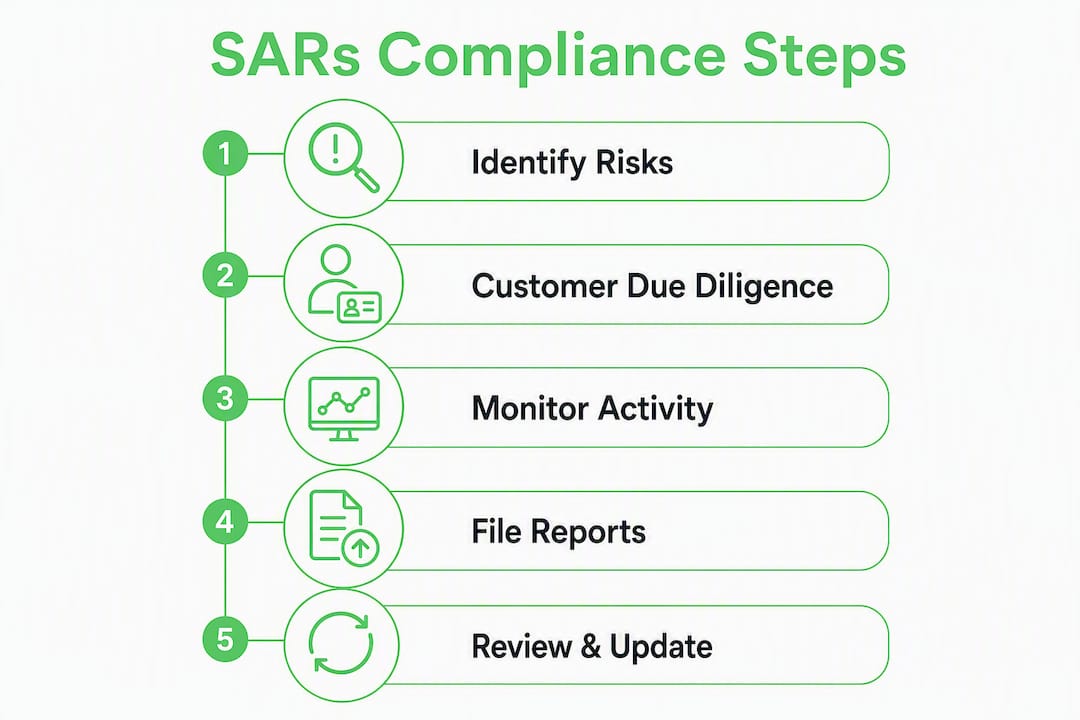
A proportionate compliance program for a small business does not need to mirror a large bank’s setup. Regulators expect the following elements, scaled to your size and risk profile:
- Written policies and procedures: Document how your business identifies, escalates, and reports suspicious activity.
- Customer due diligence (CDD): Collect and verify customer identity information at onboarding. Know who you are doing business with.
- Transaction monitoring: Set thresholds and rules that flag unusual patterns, such as structuring (breaking large transactions into smaller ones to avoid reporting).
- Internal escalation path: Employee flags a concern → compliance lead reviews → legal or CPA consulted → SAR filed with FinCEN if warranted.
- SAR filing and recordkeeping: File within 30 days of detecting suspicious activity (60 days if no suspect is identified). Retain SAR records for five years.
- Staff training: Annual training at minimum, covering red flags, escalation steps, and confidentiality rules around SAR filings.
Pro Tip: Start with the escalation path and CDD checklist. These two controls catch the most common compliance gaps and take less than a day to draft for most small businesses. Build the rest of the program around them.
A 30/90/180-day compliance checklist for small businesses
- Days 1–30 (Owner): Map all payment flows and identify which, if any, fall under BSA-covered categories. Designate a compliance responsible person. Draft a basic CDD checklist for new customers. Verify that your payment processors and escrow agents have their own AML programs.
- Days 31–90 (Owner + Finance Lead): Implement transaction monitoring rules or thresholds. Conduct initial staff training on red flags and escalation. Draft written AML policies. Set up a recordkeeping process for suspicious-activity decisions.
- Days 91–180 (Owner + External Consultant): Run a tabletop scenario to test your escalation path. Engage a CPA or AML consultant for a gap assessment. Finalize SAR filing procedures with FinCEN if your business is a covered entity. Review and update CDD documentation.
Penalties and business impacts of noncompliance
The consequences of ignoring BSA/SAR obligations are serious. Civil penalties for willful violations can reach significant amounts per day, and criminal liability applies when violations are intentional. Operationally, noncompliance can result in frozen accounts, loss of banking relationships, and blocked international transfers.
For businesses with South African exposure, SARS’s online systems can automate penalty assessments when deadlines are missed. A missed filing deadline does not wait for a phone call. The system flags it, generates a penalty notice, and the debt compounds. A Tax Clearance Certificate is required for tenders and financing in South Africa, and losing good standing blocks those opportunities immediately.
Pro Tip: If you suspect noncompliance, stop and document everything before taking further action. Engage legal counsel or a CPA before filing anything retroactively. Voluntary disclosure programs exist for both FinCEN and SARS, and early engagement typically produces better outcomes than waiting for enforcement.
How automation changes compliance for small businesses
Automation reduces the manual burden of compliance monitoring, but only when the underlying data is accurate. Real-time alerts, consolidated dashboards, and automated audit trails make it far easier to catch suspicious patterns before they become regulatory problems.
Small businesses can adopt category-level tools without enterprise budgets:
- Transaction-flagging rules in accounting software that alert when amounts exceed set thresholds
- Reconciliation automation that surfaces discrepancies between expected and actual payment patterns
- Secure email and portal monitoring to ensure regulatory notices are received and acted on promptly
The SARS shift to digital-only correspondence as of late May 2025 is a direct illustration of why contact hygiene matters. Paper notices no longer arrive. If your registered email address is outdated or your eFiling inbox is unmonitored, you will miss enforcement notices and face automated penalties with no warning. The same logic applies to FinCEN communications.
AI and automation are also transforming tax and customs operations more broadly, though infrastructure and governance gaps can limit full adoption in some jurisdictions. For most small businesses, the practical win is simpler: automate the alerts, keep contact data current, and monitor your compliance dashboards weekly. A useful starting point is reviewing your marketing automation workflow to see where similar monitoring logic already exists in your operations.
Pro Tip: Automate critical threshold alerts and contact data verification first. These two steps prevent the most common compliance failures: missed notices and undetected suspicious transactions.
When should you hire a compliance professional?
Some situations call for outside help immediately. Hire a CPA, AML consultant, or compliance attorney when you face:
- Suspected criminal exposure or a government inquiry
- Frozen accounts or blocked transactions
- Complex cross-border activity involving multiple jurisdictions
- An inability to establish basic CDD for your customer base
- A retroactive filing need (missed SARs or SARS returns)
What professionals deliver: a gap assessment against your current controls, policy drafting, system configuration, SAR filing support, and representation in disputes. For SARS disputes, the eFiling dispute submission process requires specific documentation and timelines that a tax professional can navigate efficiently.
Timeline and cost vary by scope. An entry-level AML consultation typically runs a few hours with a CPA or compliance consultant. A full remediation engagement, covering policy drafting, system setup, and filing support, can extend over several weeks. Engage early; remediation after enforcement action is always more expensive than prevention.
Key Takeaways
The role of SARs compliance for U.S. small businesses is to detect and report suspicious financial activity to FinCEN under the Bank Secrecy Act, while SARS compliance applies separately to any business operating in South Africa.
| Point | Details |
|---|---|
| Two distinct regimes | “SARS” means South Africa’s tax authority; “SARs” means U.S. Suspicious Activity Reports filed with FinCEN under the BSA. |
| Who must comply (U.S.) | Banks, MSBs, broker-dealers, casinos, and businesses with high-value cash or crypto activity face BSA/SAR obligations. |
| South Africa trigger | A valid TCS PIN is required for tenders, international transfers, and banking relationships in South Africa. |
| Automation is essential | SARS moved to digital-only correspondence in May 2025; unmonitored inboxes lead to automated penalties. |
| Punchvirtualmanager | Punchvirtualmanager’s finance and accounting services help small businesses map compliance exposure and build practical controls. |
Why compliance is a commercial asset, not just a legal box
The conventional framing of compliance is purely defensive: avoid fines, stay out of trouble. That framing misses the more important point. A clean compliance record is a commercial credential. Banks approve accounts faster, partners sign contracts with less friction, and government tender evaluators have one fewer reason to disqualify you.
The businesses that treat compliance as a one-time checkbox tend to be the ones caught off guard when a banking relationship is suspended or a tender is blocked. The ones that build even a lightweight, documented program find that the same controls that satisfy regulators also signal financial integrity to every counterparty they deal with. That signal has real commercial value, particularly for small businesses competing against larger, better-resourced firms.
Compliance does not require a compliance department. It requires documented policies, a designated responsible person, and a monitoring habit. Most small businesses can establish that foundation in 30 days.
Punchvirtualmanager supports your compliance and financial clarity
Navigating both SARS (South Africa) and SARs (U.S.) obligations while running a business is a real operational challenge, especially when the rules change, go digital, or cross jurisdictions. Punchvirtualmanager offers finance and accounting consulting specifically designed for small businesses that need practical, expert support without the overhead of a full in-house finance team.

Whether you need help mapping your payment flows, drafting AML policies, or understanding your South African tax exposure, Punchvirtualmanager’s team provides clear guidance and ongoing support. The agency combines financial consulting with digital marketing services so your compliance infrastructure and your business growth strategy stay aligned. Contact Punchvirtualmanager today to schedule a consultation and get a clear picture of where your business stands.
Useful official resources
These are the primary sources to consult for authoritative guidance. U.S.-focused sources apply to SARs/BSA obligations; South Africa-focused sources apply to SARS tax compliance.
U.S.-focused:
- FinCEN — Financial Crimes Enforcement Network: SAR filing portal, BSA guidance, and covered institution definitions.
- 31 CFR Chapter X: The Code of Federal Regulations governing BSA requirements, including SAR filing thresholds and timelines.
South Africa-focused:
- SARS About page: SARS mandate, tax types administered, and compliance framework.
- Manage your Tax Compliance Status: TCS PIN, Good Standing applications, and international transfer approvals.
- Guide to the Tax Compliance Status functionality on eFiling: Step-by-step instructions for MCP, Merge Entities, and TCS requests.
- How to Access My Compliance Profile: Visual walkthrough of the MCP dashboard and how to address non-compliance.
- Guide to submit a dispute via eFiling: Dispute process for automated penalties and non-compliance flags.