
User reviews are a primary driver of trust and conversion in e-commerce. Research from the Spiegel Research Center found that products with as few as five reviews showed purchase likelihood nearly four times higher than products with none, and that the first five reviews generate the largest share of that uplift. The practical implication is immediate: before investing in ad spend or redesigning product pages, prioritize getting a handful of verified reviews on your highest-traffic SKUs. That single action tends to move conversion faster than most other page-level changes.
Key Takeaways
User reviews are a measurable conversion lever, and the first five verified reviews on a product page generate the largest share of purchase-likelihood uplift.
| Point | Details |
|---|---|
| First-five reviews drive the most lift | Prioritize seeding verified reviews on top SKUs before investing in other page-level changes. |
| Match format to product type | Use photo prompts for experience goods; factual prompts for search goods; credibility signals for credence goods. |
| Measure with A/B tests | Track conversion rate, return rate, and add-to-cart rate with and without review widgets to quantify ROI. |
| FTC compliance is mandatory | Incentivized reviews require disclosure; review gating is prohibited under the FTC’s 2024 final rule. |
| Punchvirtualmanager supports execution | The agency implements review collection automation, A/B testing, and measurement reporting for e-commerce teams. |
Table of Contents
- How user reviews shape e-commerce performance
- Why reviews change buyer behavior: the psychology behind it
- Which product categories benefit most from reviews
- What makes a review genuinely helpful to shoppers
- How to collect, manage, and respond to reviews
- How to measure the impact of reviews and test their ROI
- Common pitfalls, abuse, and legal risks in review programs
- What the research says: category and format effects on review impact
- A practical 90-day prioritization plan for e-commerce managers
- When agency support accelerates your review strategy
- Sources
How user reviews shape e-commerce performance
The role of user reviews in e-commerce extends well beyond social proof. Reviews touch conversion rates, organic search visibility, return rates, customer loyalty, and product development simultaneously.
Conversion and revenue lift. The Spiegel data is the clearest benchmark available: five reviews can nearly quadruple purchase likelihood compared to zero reviews, with most of the conversion gain concentrated in those first ten reviews. For high-price items, the effect is even more pronounced.
SEO and organic visibility. Review text is user-generated content that search engines index. Shoppers write naturally in the long-tail phrases they searched for (“waterproof trail shoe for wide feet”), which product descriptions rarely capture. A product page accumulating reviews grows its keyword footprint without any additional content effort. For local e-commerce stores, review content also feeds local search rankings through Google Business Profile signals.
Lower return rates. Reviews set accurate expectations. When a shopper reads that a jacket runs small or that assembly takes 45 minutes, they size up or prepare accordingly. Fewer surprises at delivery means fewer returns, which directly improves margin.
Product intelligence. Review text is a continuous stream of unfiltered customer feedback. Patterns in complaints or praise reveal sizing issues, missing features, or unexpected use cases that internal teams often miss. A literature review published in ScienceDirect highlights that modern AI and text-analysis methods can extract quantitative product insights from review corpora at scale.
Brand trust and loyalty. Displaying reviews, including negative ones, signals confidence. Shoppers who see a brand respond thoughtfully to a one-star review often trust that brand more than one with only five-star ratings and no responses.
| Benefit | Primary KPI affected | Typical mechanism |
|---|---|---|
| Conversion lift | Product page conversion rate | Social proof reduces perceived risk |
| SEO growth | Organic traffic to product pages | Long-tail UGC keywords indexed by search engines |
| Lower returns | Return rate, net margin | Accurate expectations reduce mismatch |
| Product insight | NPS, defect rate, feature roadmap | Text analysis of review patterns |
| Brand trust | Repeat purchase rate, NPS | Transparent display of mixed feedback |
Why reviews change buyer behavior: the psychology behind it
Three mechanisms explain most of the influence reviews have on purchase decisions.
Social proof and normative influence. When shoppers are uncertain, they look at what others did. A product with 400 reviews signals that hundreds of people made this decision before you and most found it worthwhile. This is especially powerful in categories where the shopper has limited prior experience. Crowd ratings can have a larger aggregate effect on consumer demand than traditional professional critics in some product categories, which underscores how much weight peer opinion now carries.
Information asymmetry reduction. Sellers know their products; buyers do not. Reviews fill that gap. A shopper cannot feel fabric weight or test battery life before buying, but a reviewer who has used the product for three months can describe both. Research in Cyberpsychology identifies reviewer integrity, argument quality, and consistency with other reviews as the three most consistent drivers of trust in online reviews. When those signals are present, buyers treat review content as a reliable substitute for physical inspection.
Verified-purchase badges and credibility signals. Not all reviews carry equal weight. The Spiegel Research Center found that verified-buyer badges increase purchase likelihood compared to anonymous reviews. Photos, reviewer history, and helpfulness votes compound that effect. A review from someone who bought the product, posted a photo, and has reviewed 20 other items reads as far more credible than a single sentence from an anonymous account.
Pro Tip: A perfect 5.0 average rating can actually reduce conversions. The Spiegel Research Center found that ratings between roughly 4.2 and 4.5 often convert better because they appear more credible. Displaying a small number of critical reviews alongside positive ones tends to build more durable trust than a suspiciously perfect score.
Which product categories benefit most from reviews
Not every product gains equally from customer feedback, and knowing where to focus collection effort matters.
- High-consideration and higher-priced items show the largest conversion lifts from reviews. A shopper buying a $400 standing desk or a $150 skincare kit will read reviews carefully; one buying a $6 phone cable may glance at the star rating and move on. Prioritize review collection on your highest-margin, highest-price SKUs first.
- Experience goods (clothing, food, cosmetics, furniture) are products whose quality can only be judged after use. Shoppers rely heavily on narrative reviews and photos because the product cannot be evaluated from a spec sheet. Research published in MDPI confirms that photos boost perceived review helpfulness for experience goods specifically.
- Search goods (electronics, tools, appliances) have attributes that can be described objectively. Longer, factual reviews that confirm or correct spec-sheet claims are most useful here. The same MDPI study found that factual length helps search goods more than visual content does.
- Credence goods (supplements, professional services, financial products) are items whose quality is difficult to verify even after purchase. These categories need credibility signals most: verified-purchase badges, reviewer credentials, and third-party validation carry disproportionate weight.
- New product launches benefit from early reviews regardless of category. The first five reviews on a new SKU generate outsized lift, so seeding verified reviews at launch should be part of every product introduction plan.
What makes a review genuinely helpful to shoppers
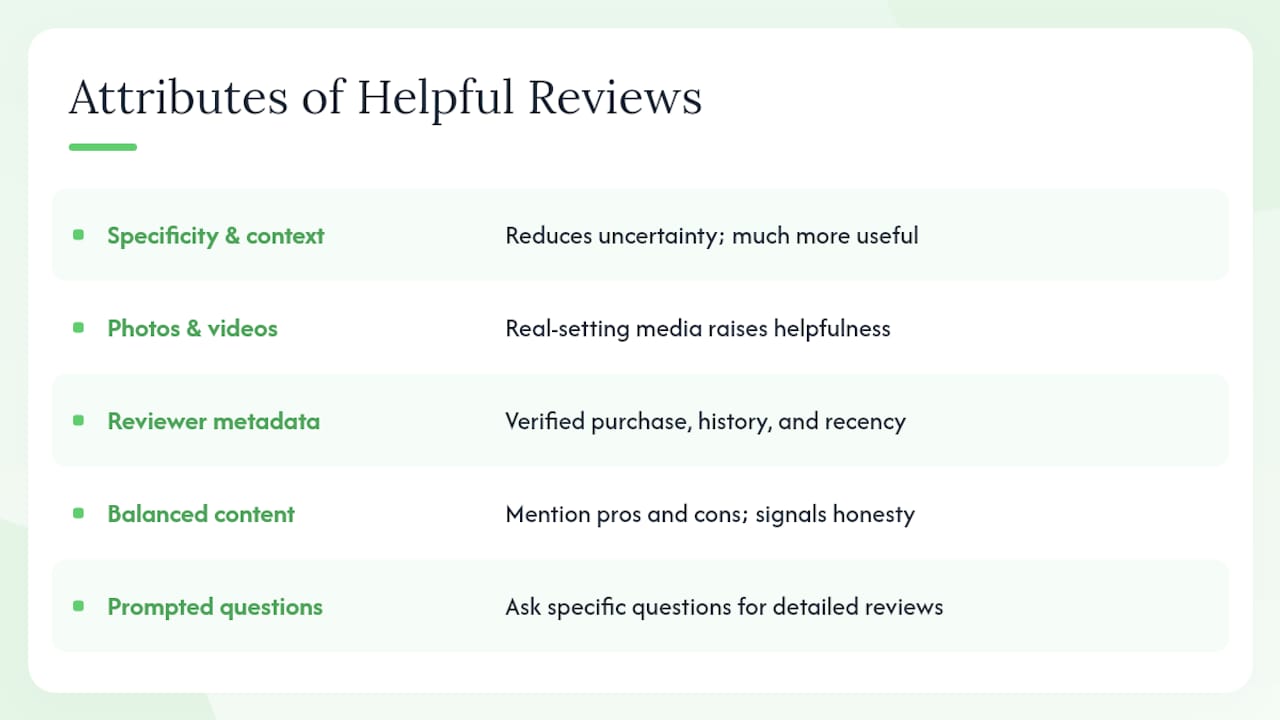
The presence of reviews matters, but their quality determines how much conversion lift they deliver. Helpful reviews share several consistent attributes.
Specificity and usage context are the most valuable elements. A review that says “I wore this jacket hiking in 35°F rain for six hours and stayed dry” is far more useful than “Great jacket, love it.” Specificity reduces uncertainty, which is the core job a review does.
Photos and videos raise perceived helpfulness for experience goods. A photo of the actual product in a real setting answers questions that product photography cannot. Platforms that surface photo-rich reviews prominently tend to see higher engagement with review content.
Reviewer metadata adds credibility. Verified-purchase status, the reviewer’s history, and the date of the review all affect how much weight a shopper places on it. Recency matters too: a review from three years ago carries less weight for a product that may have changed.
Balanced content. Reviews that mention both pros and cons read as more honest. Displaying a mix of ratings rather than filtering for only positive feedback signals transparency, which research on review trust consistently links to higher purchase confidence.
Pro Tip: When prompting customers for reviews, ask specific questions rather than open-ended ones. “How did the fit compare to your usual size?” or “What would you use this product for?” produces more specific, helpful content than “Tell us what you think.” Specific prompts also generate the long-tail keyword phrases that improve SEO.
Display tactics that surface the best content include: pinning photo-first reviews at the top of the review widget, showing a structured pros/cons summary above the full review list, and surfacing the most helpful-voted review prominently. These are UX decisions tied directly to your site’s design and worth testing systematically.
How to collect, manage, and respond to reviews
Getting reviews requires a deliberate process. Most satisfied customers do not leave reviews unprompted; most dissatisfied ones do. That asymmetry creates a biased sample unless you actively solicit feedback.
Collection tactics, in order of ROI:
- Post-purchase email: send a review request 7–14 days after confirmed delivery, when satisfaction is highest and the product has been used. A single well-timed email outperforms most other channels.
- SMS or push notification: higher open rates than email for mobile-first shoppers; keep the message short and link directly to the review form.
- In-app prompts: for brands with a mobile app, trigger a review request after a key usage milestone, not immediately after download.
- Packaging inserts: a card with a QR code linking to the review page works well for physical products; it reaches customers who may not open post-purchase emails.
- Review platforms: tools like Yotpo, Okendo, and Stamped.io automate the request cadence and integrate with Shopify, WooCommerce, and other major platforms.
FTC compliance. The Federal Trade Commission finalized rules in 2024 that prohibit fake or misleading reviews and require clear disclosure when reviews are incentivized. If you offer a discount or free product in exchange for a review, that relationship must be disclosed. Review gating, the practice of only asking satisfied customers to leave public reviews, is also prohibited. Every customer must have an equal opportunity to review, regardless of their likely sentiment.
Responding to reviews is as important as collecting them. A response to a negative review that acknowledges the issue and offers a resolution shows prospective buyers that the brand takes quality seriously. For positive reviews, a brief, specific acknowledgment reinforces loyalty. Keep responses under 100 words, avoid defensive language, and never argue with a reviewer publicly.
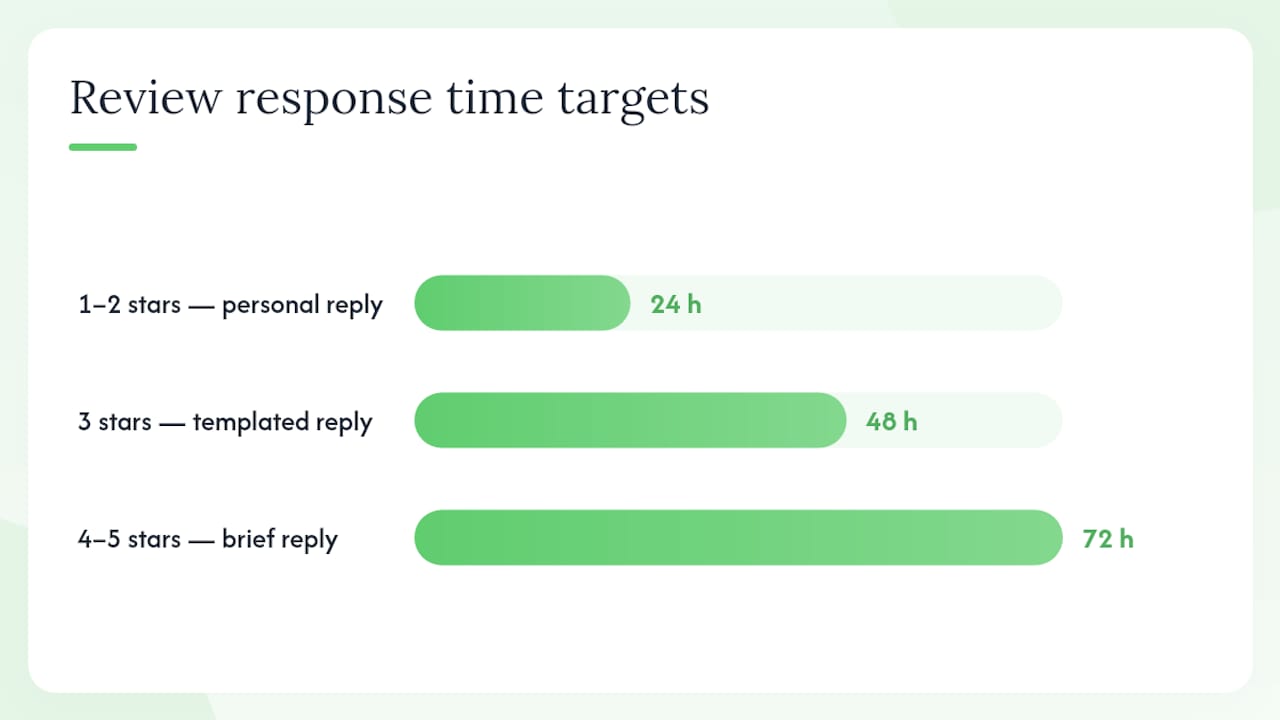
Pro Tip: For e-commerce customer support teams managing high review volume, build a triage rule: any review with two stars or fewer gets a personal response within 24 hours; three-star reviews get a templated response within 48 hours; four- and five-star reviews get a brief acknowledgment within 72 hours. This keeps response times manageable without letting critical feedback go unanswered.
How to measure the impact of reviews and test their ROI
Reviews are a growth lever, but only if you measure them like one. Most e-commerce teams track star ratings without connecting review activity to revenue metrics.
Primary KPIs to track:
- Product page conversion rate, segmented by products with reviews versus without
- Add-to-cart rate on pages where review widgets are visible above the fold
- Average order value on transactions where a shopper engaged with review content
- Return rate by product, correlated with review volume and average rating
- Organic search traffic to product pages, tracked over time as review volume grows
Secondary signals worth monitoring include time-on-page for product pages with active review sections, the volume of photo reviews submitted per month, and sentiment trends in review text (positive/negative ratio over time). Connecting these to your digital marketing metrics dashboard gives a cleaner picture of review ROI.
A/B test ideas that generate clear signal:
| Test | Variable | Primary metric |
|---|---|---|
| Review presence vs. none | Show/hide review widget on product page | Conversion rate |
| Verified badge emphasis | Prominent vs. subtle verified-purchase label | Add-to-cart rate |
| Photo-first vs. text-first layout | Sort order of review display | Time on page, conversion |
| First-five seeding | Seed 5 reviews at launch vs. organic accumulation | Conversion rate in first 30 days |
Run each test for at least two to four weeks to account for weekly traffic patterns. For low-traffic SKUs, pool similar products into a single test rather than running product-level experiments that will never reach statistical significance. Retargeting signals from review engagement can also feed audience segmentation for paid campaigns, giving review data a second conversion use.
Common pitfalls, abuse, and legal risks in review programs
A review program that lacks governance creates as many problems as it solves.
Key risks to monitor:
- Fake reviews: Purchased or fabricated reviews inflate ratings temporarily but erode trust when detected. The FTC’s 2024 rule makes fake reviews a legal liability, not just a reputational one.
- Review gating: Filtering out negative reviewers before they reach a public platform violates FTC guidelines and skews your data, making product problems invisible until they show up as returns.
- Review bombing: Coordinated negative campaigns, often from competitors or bad actors, can distort ratings overnight. Platforms like Google and Amazon have detection systems, but smaller e-commerce sites need their own moderation layer.
- Self-selection bias: Customers who review voluntarily skew toward strong opinions (very satisfied or very dissatisfied). This makes your average rating a biased sample of actual customer sentiment.
- Moderation errors: Removing legitimate negative reviews to protect ratings is both an FTC violation and a trust risk if discovered.
Mitigation steps:
- Require verified-purchase status before a review is displayed publicly.
- Use third-party moderation tools (Bazaarvoice, PowerReviews, or platform-native tools) to flag suspicious review patterns.
- Publish a clear review policy on your site explaining what gets removed and why.
- Weight your internal metrics by verified-purchase reviews separately from all reviews, so you can spot discrepancies.
Pro Tip: If you suspect a coordinated negative campaign, document the pattern (timestamps, reviewer account ages, IP clustering if accessible) before contacting the platform. Platforms respond faster to structured evidence than to general complaints. For severe cases involving defamation or competitor misconduct, the FTC and relevant platform trust-and-safety teams both have formal reporting channels.
What the research says: category and format effects on review impact
A literature review published in ScienceDirect identifies four stages in the review lifecycle: creation, engagement, impact, and insight extraction. Each stage offers a different lever for e-commerce managers.
The most actionable academic finding for most teams is the first-five-reviews effect. The Spiegel Research Center data shows that conversion lift is steepest between zero and five reviews, then flattens. This means the marginal value of review 200 is far lower than the marginal value of review 1. Budget your collection effort accordingly.
Format effects vary by product class. MDPI research on product type and review perception found that photos increase perceived helpfulness for experience goods, while factual length matters more for search goods. The practical implication: tailor your review prompt by category. Ask clothing buyers to upload a photo and describe fit; ask electronics buyers to confirm specs and describe their use case.
| Product type | Most helpful review format | Collection prompt focus |
|---|---|---|
| Experience goods (apparel, cosmetics) | Photos, narrative, fit/feel details | “Upload a photo and describe how it fits or feels” |
| Search goods (electronics, tools) | Factual length, spec confirmation | “Did the specs match the description? How do you use it?” |
| Credence goods (supplements, services) | Verified-purchase badge, outcome description | “What result did you experience after 30 days?” |
Platform design choices also shape perceived credibility. Displaying reviews in chronological order with recency visible, showing verified-purchase status prominently, and surfacing mixed ratings rather than filtering for positivity all contribute to the kind of authentic presentation that research on review trust links to higher consumer confidence.
A practical 90-day prioritization plan for e-commerce managers
Most teams have more review opportunities than bandwidth. The right approach is to sequence actions by expected ROI rather than trying to build a complete review program in week one.
Priority 1 (Days 1–30): Seed verified reviews on top SKUs.
Identify your five to ten highest-traffic or highest-margin products with fewer than five reviews. Send a targeted post-purchase email to recent buyers of those specific products, asking for a verified review. Add verified-purchase capture to your checkout flow if it is not already active. Display verified-buyer badges prominently on product pages. This single step tends to deliver the fastest measurable conversion lift.
Priority 2 (Days 31–60): Add photo prompts and automate review requests.
Update your post-purchase email template to include a photo upload prompt. Integrate an automated review request tool (Yotpo, Okendo, or a native platform tool) into your order management workflow so every completed order triggers a timed review request. For experience goods, make the photo prompt the primary call to action in the email. Connecting this to your social commerce strategy lets photo reviews do double duty as social content.
Priority 3 (Days 61–90): Set up measurement and a moderation workflow.
Launch a simple A/B test: show the review widget versus hide it on a matched set of product pages and measure conversion rate over 30 days. Set up a weekly moderation review: flag reviews below two stars for a personal response within 24 hours. Build a sentiment tracking report using your review platform’s export or a text analysis tool. By day 90, you should have a baseline conversion lift figure tied to review presence and a repeatable collection and moderation process.
When agency support accelerates your review strategy
Managing a review program well requires time, technical integrations, and measurement expertise that many e-commerce teams simply do not have in-house. Punchvirtualmanager’s digital marketing services are built for exactly this situation: teams that understand the value of reviews but need a partner to implement collection automation, run A/B tests, and report on conversion impact without adding headcount.

Where Punchvirtualmanager adds the most concrete value is in connecting review strategy to measurable revenue outcomes. That means setting up the right KPIs from day one, integrating review platforms with your existing analytics stack, and running the kind of structured experiments that turn review data into decisions. For teams that also need outsourced conversion support, pairing review optimization with broader conversion work compounds the return. The next step is straightforward: review the digital marketing packages and request a scoped proposal tied to your specific SKU priorities and traffic levels.
Sources
The following sources informed this article and are worth consulting directly for deeper research.
- Federal Trade Commission announces final rule banning fake reviews, testimonials (FTC)
- How Online Reviews Influence Sales (Spiegel Research Center)
- Online reviews: A literature review and roadmap for future research (ScienceDirect)
- Why do we trust in online reviews? Integrative literature review and future research directions | Cyberpsychology
- The Role of Product Type in Online Review Generation and Perception: Implications for Consumer Decision-Making (MDPI)