
Startup competitor branding analysis is the strategic process of evaluating rivals’ brand positioning, visual identity, and messaging to uncover gaps your brand can own. The U.S. Small Business Administration defines competitive analysis as a tool for forming a unique business identity by learning from others in your target market. Done well, this process reveals not just what competitors are doing, but what they are failing to say. That gap is where your brand’s strongest positioning lives. Frameworks like SWOT analysis and the 4Ps marketing mix give structure to what can otherwise feel like an overwhelming pile of data.
What key components should you examine in a startup competitor branding analysis?
A thorough competitor brand assessment covers seven distinct dimensions. Each one reveals a different layer of how a competitor positions itself and where it falls short.
Brand positioning and messaging
Positioning is the single claim a brand makes about why customers should choose it. Examine each competitor’s unique value proposition, core messaging pillars, and the audience segments they speak to. Read their homepage headline, their “About” page, and their paid ad copy. These three sources reveal the positioning they are willing to pay to defend.
Visual identity

Visual identity includes colors, typography, logo style, imagery, and UI design patterns. These elements signal trust, personality, and category membership before a customer reads a single word. Collect screenshots of competitor websites, social profiles, and ads to build a visual reference library.
Customer perception
Reviews on Google, Trustpilot, and social media tell you how customers actually experience a brand versus how it presents itself. Ongoing sentiment analysis often reveals competitor shortcomings that no marketing audit can surface. That gap between promise and delivery is a direct opportunity for your brand.
Competitor selection
The U.S. SBA recommends evaluating market share, strengths, weaknesses, and indirect competitors when building a complete picture. Experts also advise including indirect competitors to understand the full market landscape. Structure your competitor list across three tiers:
- Direct competitors: Brands solving the same problem for the same audience
- Indirect competitors: Brands solving the same problem with a different approach or format
- Aspirational competitors: Brands your target customers also consider, even if they operate in adjacent categories
This three-tier structure prevents the common mistake of analyzing only the most obvious rivals while missing the brands that actually shape customer expectations.
How to efficiently conduct competitor branding research with modern tools
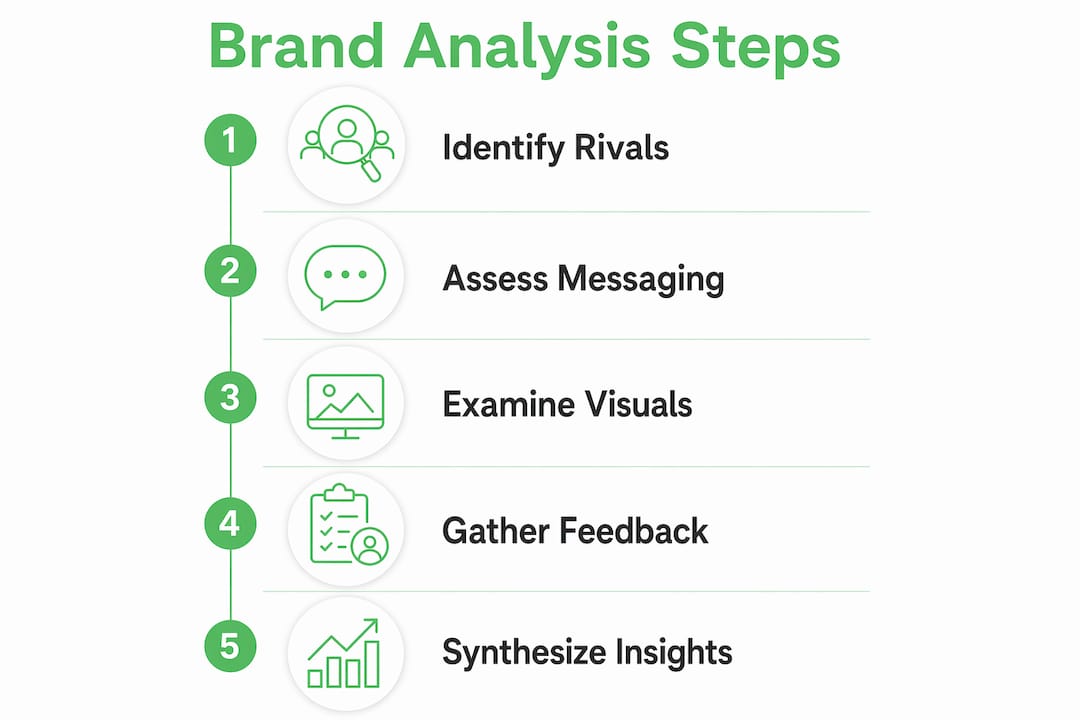
Speed matters for startups. Manual research methods are thorough but slow. AI-powered tools now compress that timeline significantly.
AI-powered research methods
AI-Radar tools reduce competitive brand positioning analysis from roughly four hours to about five minutes. These tools scan competitor ads, landing pages, and storefronts to synthesize messaging patterns and positioning gaps automatically. That time saving is not just convenient. It means founders can run a competitor brand assessment weekly rather than quarterly, keeping strategy current.
The most valuable output from AI tools is not a feature list. True positioning opportunities live in what competitors are not saying, the white space in messaging, rather than in mapped feature comparisons. AI tools surface that white space by analyzing what language appears consistently across all competitors and what language is conspicuously absent.
Manual research methods
Manual research fills gaps that automated tools miss. Test competitor products or services yourself. Walk through their customer journey from ad click to post-purchase email. Note every friction point and every moment of delight. Those observations reveal brand experience gaps that no ad scan can detect.
Social listening on platforms like LinkedIn, Reddit, and X (formerly Twitter) surfaces unfiltered customer language. The exact words customers use to describe a competitor’s weakness become the raw material for your own brand messaging.
Research tools summary
| Research method | Best for | Time required |
|---|---|---|
| AI-Radar tools (e.g., Brandsearch AI-Radar) | Messaging and positioning synthesis | ~5 minutes per competitor |
| Social listening platforms | Customer sentiment and language | 1–2 hours per week |
| Manual ad and landing page review | Tone, offer structure, and CTAs | 30–60 minutes per competitor |
| Review site analysis (Google, Trustpilot) | Customer perception and brand promise gaps | 1–2 hours per competitor |
| Customer journey testing | Experience gaps and friction points | 2–4 hours per competitor |
Pro Tip: Run your AI tool analysis first to identify the two or three competitors worth deep manual research. This prevents spending hours on brands that turn out to be peripheral players.
How to analyze competitors’ visual branding for differentiation opportunities
Visual branding analysis is where most startups find the fastest differentiation wins. Category conventions in color, typography, and layout are often so consistent that breaking one rule signals instant distinction.
Identifying visual category conventions
Analyzing at least five competitors for visual patterns helps identify dominant choices. When four out of five competitors use the same primary color, that color becomes the category default for trust signaling. Knowing this gives you a deliberate choice: conform to signal credibility, or break the pattern to signal disruption.
Collect visual samples from each competitor’s website header, primary call-to-action button, and social media profile. These three zones carry the highest visual weight and reflect intentional brand decisions rather than incidental design choices.
What to examine in each visual element
- Color palette: Primary and secondary colors, and the emotional associations they carry in your specific market
- Typography: Serif versus sans-serif, weight, and whether the type feels formal, friendly, or technical
- Logo style: Wordmark, icon, or combination mark, and the level of visual complexity
- Imagery style: Photography versus illustration, lifestyle versus product-focused, and the diversity of people shown
- UI patterns: Button shapes, spacing density, and whether the overall layout feels minimal or content-heavy
Pro Tip: When analyzing competitor websites, focus on headers and primary CTAs rather than background areas. Background elements are often designer-neutral choices, not brand signals. The high-frequency elements reveal the real category conventions.
Examining omnichannel branding patterns across competitor touchpoints also shows whether their visual identity holds up consistently or fragments across channels. Inconsistency in a competitor’s visual system is a gap your brand can exploit through disciplined consistency.
How to synthesize competitor branding insights into strategic decisions
Collecting data is only half the work. The real value comes from organizing findings into a framework that drives brand decisions.
Step 1: Build a SWOT and positioning matrix
A structured competitor brand analysis report covers brand positioning, visual identity, products, pricing, marketing, customer experience, and sentiment. Map each competitor across these dimensions in a positioning matrix. Place competitors on axes that reflect the two most important decision factors in your category, such as price versus quality or specialist versus generalist. Your goal is to find the open quadrant.
Step 2: Identify gaps in customer experience
Review competitor weaknesses from customer reviews and social media. Group complaints into themes. Recurring themes reveal systemic gaps in how competitors deliver on their brand promise. These gaps are not just product problems. They are messaging opportunities. If three competitors promise “fast delivery” but consistently receive complaints about communication, your brand can own “transparent delivery updates” as a differentiator.
Step 3: Refine your brand purpose and value proposition
Use the white space you have identified to sharpen your brand’s core claim. Your value proposition should directly address the gap competitors leave open. Consistent brand messaging across all channels then locks that positioning in place so customers encounter the same clear claim at every touchpoint.
Step 4: Adjust product, pricing, and marketing strategy
Reposition your offer based on the white space. This does not always mean changing the product. It often means changing the story around it. If competitors all lead with features, lead with outcomes. If they all target enterprise buyers, make your startup-friendly positioning explicit. The role of content marketing in reinforcing this repositioning is significant. Content that speaks directly to the gap competitors leave open builds authority faster than generic category content.
Common challenges and mistakes in competitor branding analysis
Most founders make the same set of errors when they first run a competitor brand assessment. Recognizing these patterns saves significant time and prevents misdirected strategy.
- Focusing on pricing and features instead of positioning: Pricing data is easy to collect, so founders over-index on it. The more valuable question is what story a competitor tells, not what they charge.
- Ignoring indirect competitors: Customers often consider indirect alternatives before choosing your category. Missing these brands means missing a large portion of the customer’s decision-making context.
- Treating analysis as a one-time exercise: Effective competitor brand analysis is a recurring practice, not a launch-phase task. Brands reposition, messaging shifts, and new entrants arrive. Monthly or quarterly reviews keep your strategy current.
- Skipping validation of AI tool outputs: AI tools synthesize patterns quickly, but they can miss nuance. Cross-check AI-generated positioning summaries against actual competitor ads and landing pages before making brand decisions.
- Ignoring customer review data: The most valuable competitive intelligence often comes from one-star reviews. Customers describe exactly what a brand promised and failed to deliver.
Pro Tip: Search competitor brand names alongside words like “disappointed,” “switched,” or “wish” on Reddit and review platforms. Customer review language in these searches reveals unmet needs that competitors have not addressed in their messaging.
Key Takeaways
Startup competitor branding analysis is most effective when it combines AI-powered messaging synthesis, visual identity mapping, and ongoing customer sentiment review to identify the white space your brand can own.
| Point | Details |
|---|---|
| Start with white space, not features | Map what competitors are not saying to find the strongest positioning opportunities. |
| Analyze at least five competitors visually | Surveying five or more brands reveals category color and design conventions clearly. |
| Use AI tools for speed | AI-Radar tools compress four hours of research into roughly five minutes per competitor. |
| Make analysis a recurring practice | Monthly or quarterly reviews keep brand strategy aligned with market shifts. |
| Validate AI outputs manually | Cross-check synthesized positioning summaries against real ads and landing pages before acting. |
Why most startups are looking at competitor branding the wrong way
After working with dozens of early-stage brands, I keep seeing the same pattern. Founders pull together a spreadsheet of competitor pricing, list out features side by side, and call it a competitive analysis. That exercise tells you almost nothing useful about brand positioning.
The real question is not “what do competitors offer?” It is “what story are they telling, and who are they leaving out?” I have seen startups completely reframe their positioning after spending 30 minutes reading one-star reviews of their top three competitors. The complaints were consistent, the unmet need was obvious, and no one in the category was addressing it in their messaging.
The shift from manual to AI-assisted research has made this kind of analysis accessible to founders who do not have a dedicated marketing team. Tools like Brandsearch AI-Radar now surface messaging gaps in minutes. But the insight still requires a human to interpret it. Data tells you what the gap is. Judgment tells you whether your brand can credibly own it.
The startups that treat competitor branding analysis as a continuous practice, not a launch-phase checkbox, are the ones that catch repositioning opportunities early. A competitor’s rebrand, a new entrant’s messaging, or a shift in customer language on social media can all signal that the market is moving. Catching that signal six months before your competitors do is a real advantage.
— Steel
How Punchvirtualmanager can help you act on your competitor branding insights
Running a thorough competitor brand assessment is only valuable if you can act on what you find. Translating positioning insights into live marketing campaigns, a differentiated website, and consistent social media presence requires both strategic clarity and execution capability.
Punchvirtualmanager is a Johannesburg-based digital marketing agency with a 99% advertising success rate. The team specializes in data-driven digital marketing that connects brand positioning strategy to measurable growth. From SEO and social media management to web design and content, Punchvirtualmanager builds the execution layer that turns competitor analysis into market traction. Explore the full range of digital marketing packages to find the right fit for your startup’s stage and goals.
FAQ
What is startup competitor branding analysis?
Startup competitor branding analysis is the structured evaluation of rivals’ brand positioning, visual identity, messaging, and customer perception to identify market gaps. The goal is to find white space your brand can own, not just to track what competitors are doing.
How many competitors should I include in a brand analysis?
Analyze at least five competitors to identify reliable visual and messaging patterns. Include direct, indirect, and aspirational competitors to get a complete picture of the market.
How often should a startup run a competitor brand assessment?
Competitor brand analysis works best as a recurring practice, reviewed monthly or quarterly. Markets shift, competitors reposition, and new entrants arrive frequently enough that a one-time analysis becomes outdated quickly.
What frameworks work best for synthesizing competitor branding insights?
SWOT analysis and positioning matrices are the most widely used frameworks. A structured analysis report covers brand positioning, visual identity, pricing, marketing, customer experience, and sentiment across all competitors.
Can AI tools replace manual competitor branding research?
AI tools compress research time significantly but do not replace manual validation. Use AI to identify which competitors to study deeply, then validate positioning summaries against real ads and landing pages before making brand decisions.