
Content marketing is defined as the strategic creation and sharing of valuable, relevant content to attract, engage, and nurture a target audience toward profitable action. The role of content marketing in business growth is well documented: 87% of marketers report that it has successfully increased brand awareness. That figure alone signals why content has moved from optional tactic to core business function. For small business owners and marketers, understanding how content marketing works is the first step toward building a brand that earns trust and generates consistent leads.
How does content marketing build brand awareness and trust?
Content marketing builds brand awareness by putting useful information in front of the right people before they are ready to buy. Unlike paid advertising, which interrupts, content earns attention by solving problems. A blog post that answers a common customer question, a video that explains a product, or a guide that simplifies a complex decision all create positive associations with your brand. Consistent content publishing builds trust and credibility faster than most other channels.
The role of content in brand building goes beyond visibility. When a business consistently publishes helpful, accurate content, it positions itself as an authority in its field. Customers begin to associate the brand with expertise. That perception directly influences purchasing decisions and long-term loyalty.
Trust is built through three specific content behaviors:
- Transparency: Sharing honest information, including limitations, builds credibility with readers who are skeptical of marketing claims.
- Consistency: Publishing on a regular schedule signals reliability. Brands that disappear for months and reappear with sporadic posts lose the trust they worked to build.
- Thought leadership: Publishing original analysis, case studies, or expert opinions positions a brand above competitors who only share generic information.
Pro Tip: Repurpose one well-researched blog post into a short video, a social media carousel, and an email newsletter. You reach more people with the same core message without creating entirely new content each time.
The long-term payoff of brand trust is measurable. Customers who trust a brand spend more, refer others, and are less price-sensitive. Content marketing is the most cost-effective method to build that trust at scale.
Why does content marketing drive engagement and lead generation?
Content marketing drives customer engagement by meeting people where they are in the buying process. A first-time visitor to your website needs different content than someone comparing options before a purchase. Matching content to the moment is what separates effective content strategies from generic publishing.

Content distribution across the buyer journey follows a practical split: roughly 40% of content targets the awareness stage, 30% targets consideration, and 30% targets the decision stage. That balance matters because most businesses over-invest in awareness content and neglect the consideration and decision stages where leads actually convert.
The most effective content types for each stage include:
- Awareness stage: Blog posts, social media content, short videos, and infographics that introduce your brand and address broad questions your audience is already asking.
- Consideration stage: Buying guides, comparison articles, webinars, and detailed how-to content that help prospects evaluate their options.
- Decision stage: Case studies, testimonials, free trials, product demos, and FAQ pages that remove final objections and push prospects toward action.
Lead generation through content works because educated prospects convert at higher rates. A buyer who has read your guide, watched your video, and subscribed to your newsletter already trusts your brand before they speak to your sales team. The role of content marketing in e-commerce is especially clear here: product guides and comparison content directly influence purchase decisions.
Pro Tip: Every piece of content should include one clear call-to-action. Even an informational blog post can invite readers to download a related guide, subscribe to a newsletter, or book a consultation. Missing this step is one of the most common reasons content fails to generate leads.
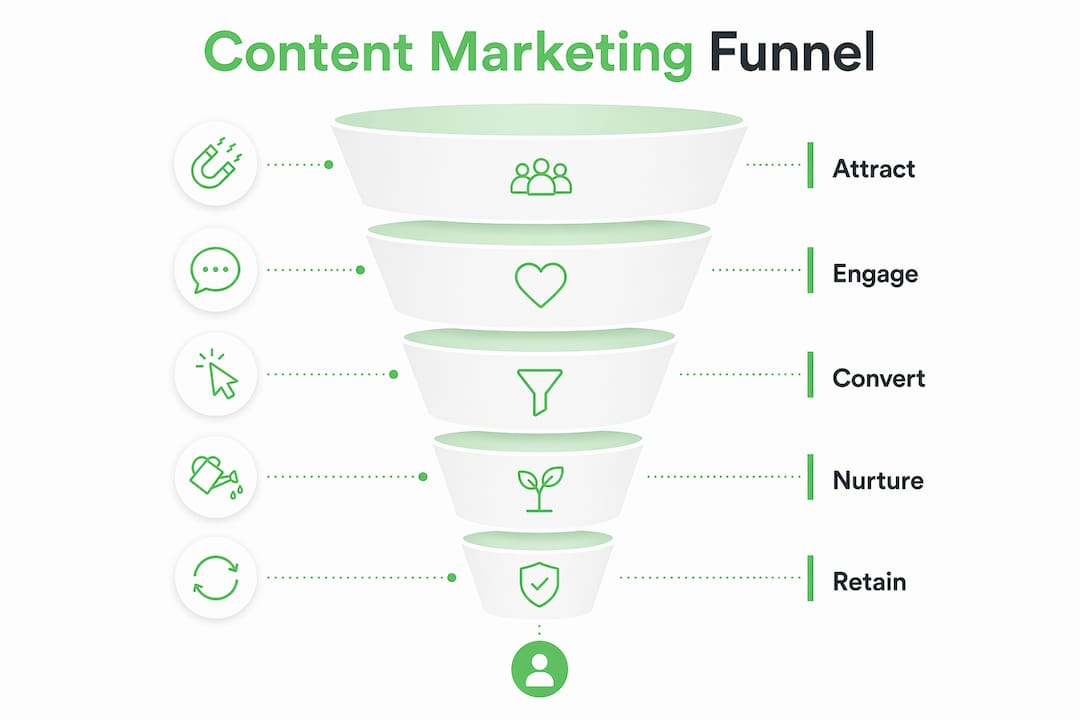
For small businesses managing social media marketing, content is the fuel that keeps engagement alive between promotions. Consistent, helpful posts build an audience that is already warm when you make an offer.
How does content marketing compare to paid advertising?
Content marketing and paid advertising serve different functions, and the most profitable businesses use both. Understanding the trade-offs helps you allocate budget and effort more effectively.
Content marketing costs 62% less than traditional outbound marketing and generates approximately three times as many leads per dollar spent. That cost advantage compounds over time because content continues to attract traffic long after it is published.
| Factor | Paid advertising | Content marketing |
|---|---|---|
| Speed | Immediate traffic | Slow build, 3–6 months |
| Cost per lead | Higher, ongoing spend | Lower over time |
| Longevity | Stops when budget stops | Compounds over months and years |
| Trust signal | Low (perceived as promotional) | High (perceived as helpful) |
| Scalability | Limited by budget | Limited by content quality |
Paid ads provide immediate visibility. Content marketing creates an appreciating asset. Well-optimized content ranks in search engines for years, lowering customer acquisition cost with every passing month. Paid ads stop generating traffic the moment the budget runs out.
“The most profitable ecommerce brands balance paid and organic channels, targeting 40–60% of revenue from organic and email sources. That balance protects revenue from ad cost volatility and algorithm changes.”
One underappreciated risk in content marketing is content decay. Articles that ranked well two years ago can lose traffic as competitors publish fresher, more detailed content. Refreshing existing content is often faster and more effective than creating new posts from scratch. A quarterly content audit that updates statistics, adds new examples, and improves internal linking can recover lost traffic without the full cost of new content production.
Organic content strategies deliver an average return on investment of 748% for retail and e-commerce businesses. That figure reflects the compounding nature of content: a single well-written article can generate leads for years.
What content marketing strategies work best for small businesses?
Small businesses succeed with content marketing by focusing on consistency and relevance rather than volume. Publishing two well-researched articles per month outperforms publishing eight thin, rushed posts. Quality signals expertise. Thin content signals the opposite.
A practical content strategy for small businesses covers these priorities:
- Map content to the buyer journey. Use the 40/30/30 framework: 40% awareness, 30% consideration, 30% decision. Most small businesses neglect the decision stage, where conversion happens.
- Prioritize search-optimized blog content. Compounding blog posts represent only 10% of all posts but generate 38% of total traffic. These are articles that rank for multiple search queries and attract traffic for years.
- Use video strategically. Video accounts for over 82% of all consumer internet traffic. Product demos, tutorials, and behind-the-scenes content perform well across social media and YouTube.
- Build an email list from day one. Email converts better than social media for most businesses because the audience is self-selected and the channel is owned, not rented.
- Avoid the three most common pitfalls. Neglecting keyword research, skipping content maintenance, and missing calls-to-action are the mistakes that most reduce content marketing return on investment.
| Content type | Best stage | Primary goal |
|---|---|---|
| Blog posts | Awareness | Search traffic and brand visibility |
| Buying guides | Consideration | Educate and qualify leads |
| Case studies | Decision | Build confidence and remove objections |
| Email newsletters | All stages | Nurture and retain audience |
| Videos | Awareness and consideration | Engagement and product education |
Measuring content performance requires tracking the right metrics. Engagement metrics (time on page, scroll depth, social shares) show whether content resonates. Conversion metrics (email signups, form completions, sales) show whether content drives business outcomes. Revenue metrics (customer acquisition cost, lifetime value) show whether the overall strategy is profitable.
Pro Tip: Set a quarterly content review calendar. Identify your top 10 traffic-driving articles and update each one with fresh statistics, improved headings, and stronger calls-to-action. This single habit can recover declining traffic without the cost of creating new content.
A well-structured digital marketing strategy treats content as infrastructure, not a campaign. Campaigns end. Infrastructure compounds.
Key Takeaways
Content marketing is the most cost-effective long-term channel for small businesses to build brand authority, generate qualified leads, and reduce customer acquisition costs over time.
| Point | Details |
|---|---|
| Brand awareness at scale | 87% of marketers confirm content marketing increases brand awareness more reliably than most paid channels. |
| Cost and lead efficiency | Content marketing costs 62% less than outbound marketing and generates three times as many leads per dollar. |
| Buyer journey mapping | Distribute content as 40% awareness, 30% consideration, and 30% decision to cover the full purchase cycle. |
| Content as an asset | Well-optimized content compounds in search rankings for years, lowering acquisition cost over time. |
| Avoid common pitfalls | Skipping keyword research, missing calls-to-action, and ignoring content maintenance are the top ROI killers. |
Content marketing is infrastructure, not a campaign
After working with small businesses across multiple industries, one pattern stands out clearly. Business owners who treat content marketing as a campaign always underperform those who treat it as infrastructure. Campaigns have end dates. Infrastructure compounds.
The businesses that win with content are not the ones publishing the most. They are the ones publishing the most consistently useful content for their specific audience. A local accounting firm that publishes one genuinely helpful tax guide per month will outrank a larger competitor that publishes ten shallow posts per week.
The hybrid approach is where I see the clearest results. Paid advertising fills the pipeline immediately while content builds the long-term foundation. Neither channel alone is enough. Paid ads without content mean you pay for every single customer forever. Content without paid ads means a slow start that tests most business owners’ patience.
The most underrated content marketing move for small businesses is refreshing existing content. Most owners create and forget. The ones who audit and update their top articles every quarter see traffic recover and grow without the full cost of new production. That is where the real efficiency lives.
Quality and user focus are non-negotiable. Search engines in 2026 reward content that genuinely answers questions and keeps readers engaged. Thin, keyword-stuffed articles no longer rank. The standard has risen, and that is good news for small businesses willing to invest in real expertise.
— Steel
Punchvirtualmanager’s digital marketing services for content-driven growth
Small businesses that understand the importance of content marketing still face one practical challenge: execution takes time, skill, and consistency.
Punchvirtualmanager is a Johannesburg-based digital marketing agency that builds and manages content strategies tailored to small business goals. From SEO-optimized blog content to social media management and paid advertising, the agency’s data-driven marketing services cover the full spectrum of what a growing business needs. Punchvirtualmanager backs its work with a 99% advertising success rate and transparent reporting so clients always know what their investment is producing. Explore the agency’s digital marketing packages to find a plan that fits your budget and growth goals.
FAQ
What is the role of content marketing in business growth?
Content marketing attracts, educates, and nurtures potential customers through valuable content, building trust and driving profitable actions over time. It reduces customer acquisition costs and creates compounding organic traffic that paid advertising cannot replicate.
How does content marketing generate leads?
Content marketing generates leads by educating prospects at each stage of the buyer journey and including calls-to-action that move them toward a purchase or inquiry. Buyers who consume content before contacting a business convert at higher rates than cold prospects.
Is content marketing cost-effective for small businesses?
Content marketing costs 62% less than traditional outbound marketing and generates approximately three times as many leads per dollar spent, making it one of the most cost-effective channels available to small businesses with limited budgets.
How long does content marketing take to show results?
Content marketing typically takes 3–6 months to produce measurable traffic and lead generation results. The payoff compounds over time, with well-optimized content continuing to attract visitors and generate leads for years after publication.
What types of content work best for brand building?
Blog posts, video tutorials, buying guides, and email newsletters are the most effective content types for brand building. Video alone accounts for over 82% of consumer internet traffic, making it a high-priority format for businesses targeting broad awareness.