
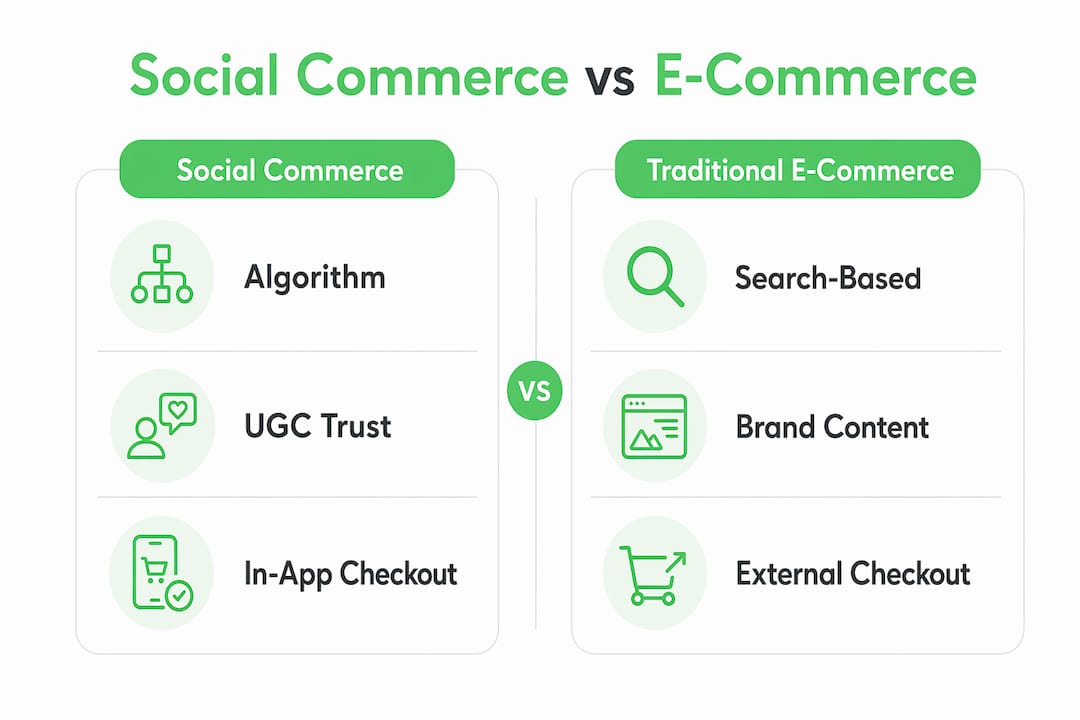
Social commerce is defined as the direct integration of ecommerce functionality into social media platforms, allowing shoppers to browse, discover, and purchase products without leaving apps like TikTok, Instagram, or Facebook. This model differs fundamentally from traditional ecommerce because it replaces search-driven intent with algorithm-driven discovery and impulse. The role of social commerce in 2026 is no longer a side channel. It is a primary sales driver that small business owners and e-commerce marketers can no longer afford to treat as optional. Platforms like TikTok Shop, Instagram Shops, and Pinterest Product Pins have built native checkout experiences that compress the distance between inspiration and transaction to a matter of seconds.
What is the role of social commerce in consumer behavior?
Social commerce reshapes the purchase journey by replacing deliberate search with passive discovery. A shopper scrolling through a TikTok feed does not start with a shopping list. They encounter a creator demonstrating a product, feel an immediate connection, and complete a purchase before the video ends. That behavioral shift is the defining feature of social commerce.
Discovery is powered by algorithmic feeds and creator content. Platforms surface products based on engagement patterns, not search queries. This means a small business selling handmade skincare can reach thousands of relevant buyers without paying for a single keyword. The algorithm does the targeting work, but the content does the persuading.

User-generated content (UGC) is the trust engine behind social commerce conversions. A systematic review of 60 studies confirms that UGC, including reviews, images, and videos, significantly builds trust, reduces purchase risk, and increases loyalty. Shoppers trust content from other people more than they trust brand messaging. A genuine product review from a real customer carries more weight than a polished ad.
Impulse buying is structurally built into the social commerce model. Native in-app checkout removes the friction of redirecting to an external website. Livestream shopping events on TikTok Shop and Instagram Live create urgency through limited-time offers and real-time audience interaction. These features facilitate impulse purchases in ways that traditional ecommerce cannot replicate.
Social commerce also functions as a peer-learning environment. Research shows that behavioral intention to use social platforms promotes community knowledge sharing and influences sustainable consumption behavior. Buyers learn from each other’s choices, which shapes what they buy and how they evaluate products over time.
Pro Tip: Build a content calendar that schedules UGC reposts alongside your own product content. Consistent UGC signals authenticity to both the algorithm and your audience.
How should businesses measure and strategize for social commerce?
Social commerce requires its own measurement framework. Treating it as an extension of social advertising or traditional ecommerce leads to wasted budgets and misleading performance data. The channel has distinct conversion mechanics that demand dedicated investment and tracking.
The most common mistake brands make is measuring social commerce success by likes, followers, or website traffic. These metrics do not reflect sales outcomes. The correct approach connects creator content and ad exposure directly to revenue at the SKU level. That means integrating your social commerce platforms with your inventory and order management systems.
A structured approach to social commerce strategy includes these steps:
- Define your social commerce goal separately from your broader digital marketing objectives. Sales through TikTok Shop are not the same as brand awareness campaigns.
- Set up SKU-level attribution so you can trace exactly which product, creator, or post generated each sale.
- Connect your social platforms to your inventory system to prevent overselling during high-traffic live events.
- Measure creator content ROI by tracking the revenue each creator or post type generates, not just engagement rates.
- Review performance weekly during test phases and monthly during scaling phases to catch underperforming products early.
The table below compares a social commerce approach against a traditional ecommerce approach across key measurement dimensions.
| Dimension | Social commerce | Traditional ecommerce |
|---|---|---|
| Discovery method | Algorithm and creator content | Search intent and paid ads |
| Purchase location | In-app native checkout | External website |
| Attribution model | SKU-level creator attribution | Last-click or multi-touch |
| Trust mechanism | UGC and peer reviews | Brand copy and product pages |
| Conversion trigger | Impulse and live events | Deliberate browsing |
Pro Tip: Shopify recommends testing a single hero product on one platform for two weeks before scaling. This approach protects your budget and generates clean data.
Which social commerce platforms work best for small businesses?
Platform selection is the most consequential early decision in any social commerce strategy. Each platform serves a different audience demographic and product category. Choosing the wrong platform wastes time and budget.
- TikTok Shop excels at product discovery and impulse purchases, particularly among Gen Z and millennial shoppers. Creators drive trend-based promotions, and the algorithmic feed delivers product exposure to highly relevant audiences without requiring a large follower base.
- Instagram Shops suits visually driven product categories like fashion, beauty, and home decor. Product tagging in posts and Stories creates a low-friction path from content to checkout.
- Facebook Marketplace and Facebook Shops reach older demographics and work well for local sellers, second-hand goods, and community-based products.
- Pinterest Product Pins connect with shoppers in the planning and inspiration phase. This platform suits home goods, weddings, and lifestyle products where buyers research before purchasing.
- YouTube Shopping integrates product tags into long-form and short-form video content, making it effective for products that benefit from demonstration or tutorial-style content.
The best platform for your business aligns with where your customers already spend time and what type of content your products support. A food product brand will perform differently on TikTok than on Pinterest. Match the platform to the product and the audience, not to personal preference.
What are the best practices for social commerce success?
Small businesses that succeed in social commerce treat it as a long-term channel, not a one-off campaign. The businesses that fail typically chase short-term viral moments without building the systems to sustain them.
UGC must be an ongoing asset, not a sporadic effort. A systematic review confirms that UGC sustains trust pathways and emotional engagement across the full consumer journey. Encourage customers to post reviews and product videos consistently by making it easy and rewarding to do so.
Reducing purchase friction is the second most important factor. Native shopping surfaces keep the buyer inside the platform ecosystem, which reduces drop-off and improves conversion. Every additional click between discovery and checkout costs you sales.
Avoid these common mistakes:
- Focusing on follower count instead of sales metrics
- Running social commerce as a campaign rather than an always-on channel
- Ignoring platform-specific content formats (vertical video on TikTok vs. curated grids on Instagram)
- Failing to integrate social commerce data with your broader omnichannel retail strategy
- Treating hard-sell brand messaging as effective when authentic creator content consistently outperforms it
Integrating social commerce into your omnichannel strategy means keeping product information, pricing, and inventory consistent across TikTok Shop, Instagram Shops, your website, and any physical retail presence. Inconsistency across channels confuses buyers and erodes trust.
Pro Tip: Assign one team member to monitor social commerce comments and questions in real time during live selling events. Immediate responses increase purchase confidence and reduce cart abandonment.
Key Takeaways
Social commerce succeeds when businesses treat it as a distinct channel with dedicated measurement, consistent UGC, and platform-specific content strategies rather than a simple extension of existing social media or ecommerce efforts.
| Point | Details |
|---|---|
| Social commerce is distinct | Treat it as its own channel with separate goals, budgets, and measurement frameworks. |
| UGC drives trust and sales | Consistently collect and share user reviews and videos to reduce purchase risk. |
| Platform choice matters | Match your platform to your audience demographics and product type before investing. |
| SKU-level attribution is required | Connect creator content directly to revenue data to measure real return on investment. |
| Start small, then scale | Test one product on one platform for two weeks before expanding your social commerce strategy. |
Why social commerce is more than a trend
The businesses I see struggling with social commerce share one pattern: they treat it like a louder version of their existing social media presence. They post more, spend more on ads, and wonder why the sales numbers do not move. The real shift required is structural, not just tactical.
Social commerce demands that you rethink what conversion means. A like is not a conversion. A comment is not a conversion. A completed in-app purchase tied to a specific creator post and a specific product SKU is a conversion. That distinction changes everything about how you plan, execute, and measure campaigns.
The businesses I find most effective are the ones that start with one product, one platform, and one creator relationship. They learn what the data tells them, adjust quickly, and scale only what is proven. That approach is not timid. It is the most resource-efficient path to sustainable growth in a channel that rewards authenticity and punishes guesswork.
Social commerce also creates a community dynamic that traditional ecommerce cannot replicate. When buyers share their purchases, tag brands, and comment on creator videos, they become part of the product story. That community is a long-term asset worth building deliberately. For small businesses in South Africa and globally, the social media marketing opportunity here is significant, but only for those who approach it with discipline and clear metrics.
— Steel
How Punchvirtualmanager can support your social commerce growth
Punchvirtualmanager works with small businesses and e-commerce marketers who need more than a social media presence. They need a system that connects content to sales, tracks performance at the SKU level, and adapts as platforms evolve.
Punchvirtualmanager’s data-driven digital marketing services are built for exactly this kind of work. The team brings platform-specific expertise across TikTok Shop, Instagram Shops, and Facebook, paired with measurement frameworks that connect creator content directly to revenue outcomes. For businesses ready to move beyond likes and followers, Punchvirtualmanager offers digital marketing packages designed to scale social commerce results without wasting budget on untested strategies.
FAQ
What is social commerce and how does it differ from ecommerce?
Social commerce integrates ecommerce checkout directly into social media platforms like TikTok, Instagram, and Facebook, so shoppers never leave the app to complete a purchase. Traditional ecommerce relies on search intent and external websites, but social commerce is driven by discovery, creator content, and impulse.
Which platforms are best for social commerce in 2026?
TikTok Shop leads for product discovery among Gen Z and millennial audiences, while Instagram Shops suits visual product categories like fashion and beauty. Facebook Shops works well for local sellers, and Pinterest Product Pins serve buyers in the planning and inspiration phase.
How does user-generated content affect social commerce sales?
A systematic review of 60 studies confirms that UGC, including reviews, images, and videos, significantly builds trust and reduces purchase risk in social commerce environments. Shoppers consistently trust peer content more than brand-produced messaging.
How should small businesses measure social commerce performance?
Small businesses should measure social commerce at the SKU level, connecting each creator post or ad directly to inventory movement and revenue. Likes and follower counts do not reflect sales outcomes and should not be primary performance indicators.
How do small businesses start with social commerce without overspending?
Shopify recommends testing a single hero product on one platform for two weeks before scaling. This controlled approach generates clean performance data and prevents premature budget commitment to unproven strategies.