
What is a brand mission statement and what does it include?
A brand mission statement is a concise declaration, typically one to three sentences, that defines what a business does, who it serves, and the value it creates. It is present-focused and action-oriented, describing why the organization exists right now rather than where it hopes to be in the future. Think of it as the foundation on which every brand decision rests.
Three core elements make up a well-constructed mission statement:
- What the business does: The core product, service, or activity the brand delivers.
- Who it serves: The specific audience, customer group, or community the brand exists for.
- The value or impact provided: The tangible or meaningful benefit the brand creates for that audience.
A strong mission statement stays under 100 words, uses plain language, and avoids corporate filler. It is not a tagline or a slogan. It is a clear, strategic declaration that guides the brand from the inside out.
How does a mission statement differ from vision, identity, and voice?
Confusing a mission statement with related brand elements is one of the most common mistakes business owners make. Each element serves a distinct purpose, and mixing them up leads to unclear messaging and misaligned strategy.

| Brand Element | Focus | Time Orientation | Primary Audience |
|---|---|---|---|
| Mission statement | What the brand does and for whom | Present | Internal teams and external stakeholders |
| Vision statement | Where the brand aspires to be | Future | Leadership and long-term planning |
| Brand identity | Visual and verbal expression of the brand | Ongoing | Customers and the public |
| Brand voice | Tone and style of communication | Ongoing | Content creators and marketers |
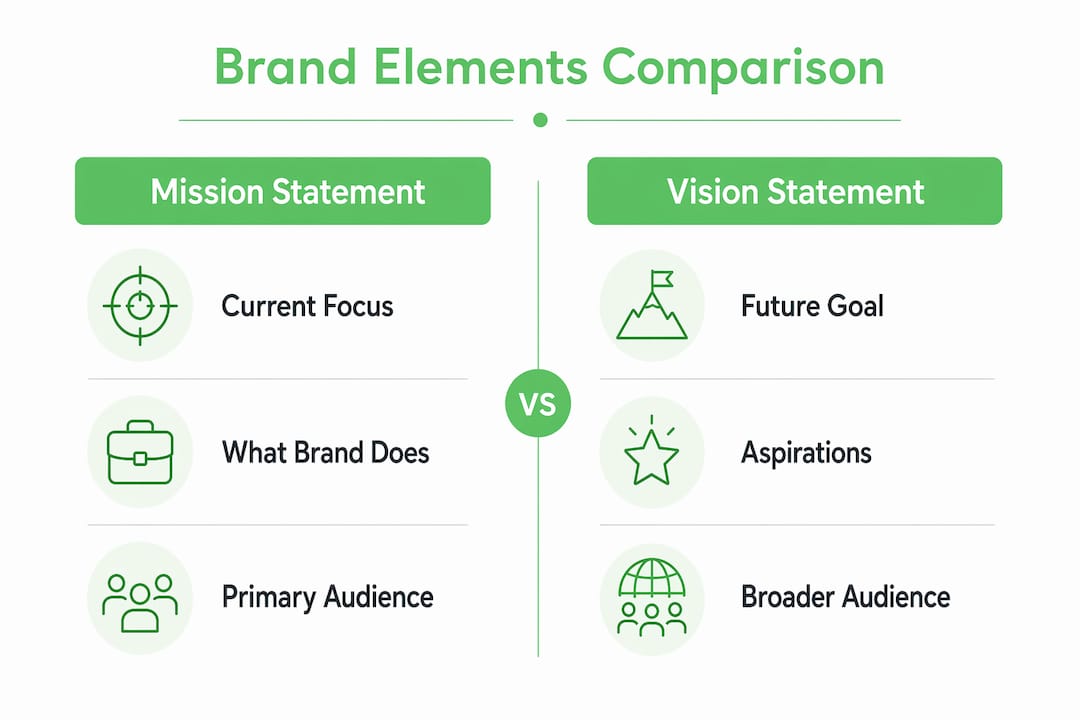
The mission vs. vision distinction is the most critical one to understand. The mission describes current operations and value delivery. The vision outlines the aspirational future the brand is working toward. A business that conflates the two ends up with a statement that is neither grounded enough to guide daily decisions nor inspiring enough to motivate long-term growth.
Brand identity and brand voice are downstream from the mission. Once the mission is clear, identity and voice become expressions of it, not definitions of it. Getting the mission right first makes every other branding decision easier to align.
Why having a clear brand mission statement matters
A well-defined mission statement does more than look good on a website. It functions as an internal compass, shaping how teams make decisions, how the brand communicates externally, and how it attracts the right partners and customers.
The practical benefits are concrete:
- Decision-making clarity: When a new project or opportunity arises, the mission acts as a filter. Teams can ask, “Does this align with our mission?” and get a clear answer. This is especially valuable for small teams avoiding scope creep, where resources are limited and focus is critical.
- Internal alignment: A shared mission gives every team member a common sense of purpose. It reduces ambiguity about priorities and keeps everyone working toward the same objectives.
- Audience connection: A mission statement that speaks directly to a customer’s needs or values creates an emotional connection that generic marketing copy cannot replicate.
- Competitive differentiation: A specific, honest mission sets a brand apart from competitors who rely on vague, interchangeable language.
- Stakeholder confidence: Clear mission statements ease communication with customers, partners, and investors by quickly conveying the brand’s purpose and value.
A mission statement also anchors brand awareness campaigns and content strategy, giving every public-facing message a consistent foundation to build from.
How to write an effective brand mission statement
Writing a mission statement is an exercise in strategic clarity, not copywriting. The goal is to produce a precise declaration of purpose, not a catchy phrase. Avoid the common mistake of producing a marketing slogan instead of a clear strategic statement.
Follow this five-step process:
Answer four foundational questions. Before writing a single sentence, get clear on: What does the business do? Who does it serve? How does it deliver value? What impact does it create? Write out honest, specific answers to each question without worrying about polish yet.
Brainstorm freely. Use the answers from step one to generate multiple rough versions of the mission. Do not edit at this stage. Write five to ten variations, experimenting with different verbs, audiences, and value descriptions. Volume here leads to better options later.
Draft one to three sentences. Combine the strongest elements from your brainstorm into a concise draft. Use active verbs and specific language to communicate what makes the brand distinct. Passive voice and generic business jargon weaken the statement immediately.
Gather feedback. Share the draft with team members, trusted customers, or advisors. Ask whether the statement accurately reflects what the business does and whether it resonates with the intended audience. Revise based on patterns in the feedback, not individual preferences.
Finalize and integrate. Once the statement is clear and agreed upon, embed it across the business: the website, onboarding materials, internal documents, and brand guidelines. A mission statement that lives only in a document has no real influence.
Pro Tip: Treat the mission statement as a living document and review it every two to three years. As the business grows and market conditions shift, the mission may need to evolve to stay relevant and accurate.
Real brand mission statement examples worth studying
Seeing how established brands frame their missions makes the concept concrete. Each of the following examples demonstrates a different approach to communicating purpose clearly.
Nike: “To bring inspiration and innovation to every athlete in the world.” Nike’s mission is notable for its inclusivity. The brand famously adds a footnote: “If you have a body, you are an athlete.” That single qualifier expands the audience from elite sports to everyone, which is a deliberate and powerful strategic choice.
Coca-Cola: “To refresh the world and make a difference.” Short, broad, and emotionally resonant. Coca-Cola’s mission works because it does not try to describe a product. It describes a feeling and an aspiration, which gives the brand room to operate across markets and categories.
Apple: To bring the best user experience to customers through hardware, software, and services. Apple’s approach centers on the customer experience rather than the technology itself. This framing has kept the mission relevant across decades of product evolution, from computers to phones to streaming services.
Allbirds: “To prove that comfort, good design, and sustainability don’t have to be at odds.” Allbirds uses its mission to directly address a tension in the footwear market. The statement positions the brand as a solution to a specific problem, which makes it both differentiated and credible.
Etsy: “To keep commerce human.” Three words that carry significant weight. Etsy’s mission draws a clear line between its marketplace and mass-market retail, appealing directly to buyers and sellers who value craft, individuality, and human connection over convenience and scale.
Each of these missions is specific enough to guide decisions and broad enough to remain relevant as the brand grows. None of them read like advertising copy.
How to align your mission statement with business strategy
A mission statement that sits in isolation from business strategy is decorative, not functional. The real value comes when the mission actively shapes how the business sets goals, allocates resources, and measures success.
Start by mapping the mission to the business’s core objectives. Every major goal the business pursues should connect back to the mission in a traceable way. If a goal cannot be linked to the mission, that is a signal to either reconsider the goal or revisit the mission. This alignment process prevents the kind of strategic drift where a business gradually shifts direction without realizing it.
Product and service decisions are another area where mission alignment pays off. When a brand considers launching a new offering, the mission provides a clear test: does this serve the same audience and deliver the same type of value the mission describes? Brands that skip this check often end up with fragmented portfolios that confuse customers and dilute the brand’s identity. Consistent market positioning depends on this discipline.
Performance metrics should also reflect the mission. A brand whose mission centers on customer experience should track customer satisfaction scores and retention rates, not just revenue. Aligning metrics to the mission keeps the organization honest about whether it is actually delivering on its stated purpose.
How to communicate and implement the mission statement
Writing the mission is only half the work. The other half is making sure it actually influences how the business operates and how it presents itself to the world.

Internally, the mission needs to be more than a line in the employee handbook. Leaders should reference it in meetings, use it to frame strategic decisions, and connect individual team roles back to it. When employees understand how their daily work contributes to the mission, engagement and clarity both improve. New hire onboarding is a natural moment to introduce the mission and explain why it was written the way it was.
Externally, the mission should appear wherever the brand makes a first impression: the website’s About page, social media profiles, pitch decks, and press materials. It does not need to be quoted verbatim in every context, but the ideas it contains should be consistent across all brand messaging channels. Customers and partners should be able to sense the mission in how the brand communicates, even when the statement itself is not on screen.
One practical approach is to create a brief internal document that explains the mission in plain language, including what it means for different departments. Marketing teams use it to shape campaign messaging. Product teams use it to evaluate feature priorities. Customer service teams use it to set the tone for interactions. When each function understands the mission through its own lens, implementation becomes consistent without being rigid.
Putting your mission to work with Punchvirtualmanager

A mission statement is only as strong as the strategy built around it. Punchvirtualmanager helps businesses translate their brand purpose into digital marketing services that reach the right audience and deliver measurable results. From web design to content strategy, every solution is built around what the brand actually stands for.
Key Takeaways
A brand mission statement is a present-focused, one-to-three-sentence declaration that defines what a business does, who it serves, and the value it creates, forming the foundation for every strategic and communication decision.
| Point | Details |
|---|---|
| Core definition | A mission statement covers what the business does, who it serves, and the value it provides. |
| Mission vs. vision | The mission describes current operations; the vision describes the future the brand is working toward. |
| Internal function | A clear mission guides team decisions, prevents scope creep, and aligns daily work with brand purpose. |
| Writing process | Follow five steps: answer foundational questions, brainstorm, draft, gather feedback, then finalize and integrate. |
| Review cadence | Revisit the mission every two to three years to keep it aligned with business growth and market conditions. |