
A digital marketing strategy is a documented plan aligning business objectives with measurable online outcomes, covering audience segmentation, channel selection, and conversion pathways. The industry term is “digital marketing strategy,” and it sits above both a digital marketing plan and individual digital marketing tactics. Without it, marketing activities become disconnected and fail to compound into sustained growth. Business owners and marketing professionals who understand what is a digital marketing strategy gain a clear framework for making budget decisions, prioritizing channels, and measuring real results.
What are the essential components of a digital marketing strategy?
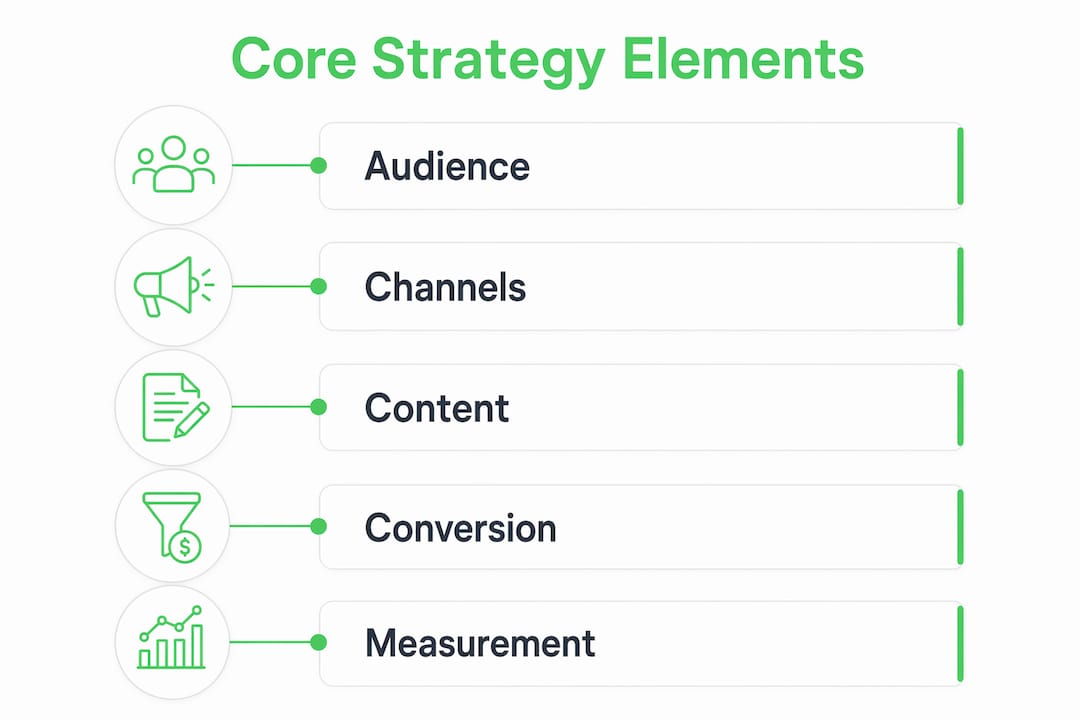
A solid digital marketing strategy includes five interconnected elements: audience segmentation, channel prioritization, content frameworks, conversion pathways, and measurement. Each element must be documented and linked to the others for execution to stay coordinated. Skipping any one of them creates gaps that show up as wasted budget or inconsistent messaging.
Audience segmentation and buyer personas
Audience segmentation defines who you are trying to reach and what motivates their decisions. A buyer persona for a South African B2B software company looks very different from one for a local retail brand. Getting this wrong means every downstream decision, from channel selection to content tone, is built on a shaky foundation.

Channel selection and content frameworks
Channel selection follows directly from audience research. If your buyers spend time on LinkedIn and search Google for solutions, those two channels take priority over Instagram or TikTok. A content framework then defines the message, format, and frequency for each channel, keeping communication consistent across touchpoints.
Conversion pathways and measurement
Conversion pathways map the steps a prospect takes from first awareness to purchase. Customer journey mapping tools like HubSpot or Google Analytics 4 help identify where prospects drop off. The Five Cs framework, covering company strategy, customer experience, content creation, channel promotion, and check-back analysis, gives teams a practical checklist for covering all bases.
Pro Tip: Use a KPI dashboard in Google Looker Studio to connect each channel to a business outcome. Vanity metrics like page views tell you very little. Trial signups, demo requests, and customer acquisition cost tell you everything.
| Component | Role in the strategy |
|---|---|
| Audience segmentation | Defines who to reach and what messaging resonates |
| Channel prioritization | Focuses budget on platforms where the audience is active |
| Content framework | Sets message, format, and publishing cadence per channel |
| Conversion pathways | Maps the steps from awareness to purchase |
| Measurement and KPIs | Tracks performance and guides budget reallocation |
How does a digital marketing strategy differ from tactics and plans?
Strategy defines the what and why; a digital marketing plan defines the how and when; tactics are the individual actions executed within that plan. Confusing these three layers is one of the most common reasons marketing efforts stall. A business that jumps straight to running Google Ads or posting on social media without a strategy is executing tactics with no direction.
The practical difference shows up in decision-making. When a strategy is documented, a team can answer questions like “should we add Pinterest to our channel mix?” without escalating to senior leadership every time. Without documentation, every new idea triggers a debate because there is no agreed framework to test it against.
Common pitfalls of skipping strategy include:
- Fragmented messaging across channels with no consistent brand voice
- Budget spread too thin across too many platforms
- Teams measuring different metrics with no shared definition of success
- Campaigns that perform in isolation but do not contribute to pipeline growth
A digital marketing plan is the operational layer. It contains timelines, assigned owners, content calendars, and quarterly budgets. The strategy sits above it and stays relatively stable, while the plan adapts as results come in.
Pro Tip: Document your strategy in Notion or Google Docs and share it with every team member who touches marketing. A documented strategy that can be summarized in two pages is more useful than a 40-slide deck nobody reads.
How to create a digital marketing strategy step by step
The standard process in 2026 starts with 90-day objective setting using SWOT analysis and SMART goals to direct budget and channel focus. Starting with 90 days rather than an annual plan forces specificity and makes it easier to course-correct. Here is the process in order:
- Run a SWOT analysis. Assess your current digital presence, identify gaps, and note where competitors are winning. This gives you an honest baseline before setting targets.
- Set SMART goals. A SMART goal is specific, measurable, achievable, relevant, and time-bound. Example: increase website traffic by 40% in six months through SEO and content marketing.
- Map your target audience. Build two or three buyer personas based on real customer data. Include demographics, pain points, preferred channels, and buying triggers.
- Select and prioritize channels. Choose two or three channels where your audience is most active. For most South African SMEs, this means Google Search, Facebook or LinkedIn, and email.
- Design your content framework. Define content types, publishing frequency, and the messaging angle for each channel. Align every piece of content to a stage in the customer journey.
- Build your measurement framework. Assign a KPI to each channel and each goal. Strategies must link spending explicitly to measurable KPIs like trial signups and demo requests.
- Set your budget and timeline. Allocate budget by channel based on expected return on investment. Build a 90-day content and campaign calendar with clear ownership.
Pro Tip: When choosing channels, start with the one that has the highest return on investment for your industry before spreading budget further. For most service businesses, local SEO delivers the strongest qualified lead volume at the lowest cost per acquisition.
What are the benefits and challenges of a digital marketing strategy?
A documented digital marketing strategy produces four clear benefits: improved return on investment, aligned team efforts, data-driven decisions, and scalable growth. Each benefit compounds over time when the strategy is reviewed and updated regularly. High-performing strategies are dynamic and evolve with changing technology and market conditions.
Benefits of a documented strategy include:
- Clearer budget allocation tied to measurable outcomes
- Faster decision-making because the framework already exists
- Consistent brand messaging across all digital channels
- Easier onboarding for new team members or agency partners
The challenges are equally real. Many businesses prefer action to planning, which leads to a collection of disconnected tactics that never build momentum. Others document a strategy in january and never revisit it, treating it as a static annual task.
“The biggest mistake is treating digital marketing strategy as a static annual task. Strategy needs quarterly reviews for agility and data-driven decision making.”
Common pitfalls to avoid:
- Measuring success by follower counts or impressions instead of leads and revenue
- Skipping quarterly reviews because the team is busy executing
- Building a strategy around channels the team prefers rather than channels the audience uses
- Failing to document the strategy, which means marketing efforts become disjointed and fail to compound
Pro Tip: Schedule a 90-minute strategy review at the end of every quarter. Block it in the calendar now. Strategies should be revisited quarterly for tactical optimization while keeping a steady strategic foundation.
Which digital marketing tactics fit within a strategic framework?
Digital marketing tactics are the specific actions taken to execute a strategy. SEO, content marketing, social media, email campaigns, paid advertising, and influencer marketing each serve a different role depending on the strategic objective. The key is matching each tactic to a goal and a stage in the customer journey, not running them all at once.
Tactics organized by strategic role:
- SEO and content marketing: Build long-term organic visibility and qualified inbound traffic. Best suited to awareness and consideration stages.
- Social media marketing: Builds brand recognition and community engagement. Platforms like LinkedIn work well for B2B; Facebook and Instagram suit B2C and local service businesses.
- Email campaigns: Nurture leads already in the pipeline. Email delivers one of the highest returns on investment of any digital channel.
- Paid advertising: Google Ads and Meta Ads drive fast, targeted traffic. Best used when organic channels are still building momentum.
- Influencer marketing: Extends reach to new audiences through trusted voices. Works best when the influencer’s audience matches your buyer persona precisely.
| Tactic | Strategic role | Best stage |
|---|---|---|
| SEO | Organic visibility and qualified traffic | Awareness |
| Content marketing | Education and trust building | Consideration |
| Social media | Brand recognition and engagement | Awareness and loyalty |
| Email campaigns | Lead nurturing and conversion | Consideration and decision |
| Paid advertising | Fast, targeted traffic generation | Decision |
| Influencer marketing | Audience expansion and credibility | Awareness |
Every tactic must connect back to a KPI. 2026 marketing is performance-obsessed, and marketers must move beyond vanity metrics toward measurable outcomes for every budget dollar spent.
Key takeaways
A digital marketing strategy is a documented plan that links every marketing activity to a measurable business outcome, and without that documentation, efforts stay fragmented and fail to grow.
| Point | Details |
|---|---|
| Strategy before tactics | Define your goals and audience before choosing channels or running campaigns. |
| Document everything | A strategy that lives in one accessible document drives faster decisions and team alignment. |
| Review quarterly | Revisit your strategy every 90 days to adjust tactics based on real performance data. |
| Match tactics to goals | Each tactic, from SEO to paid ads, must connect to a specific KPI and customer journey stage. |
| Measure what matters | Track trial signups, leads, and customer acquisition cost, not just traffic and impressions. |
Why agility is the real test of a good strategy
Most articles on digital marketing strategy focus on the build. The harder part is keeping the strategy alive after it is built. I have seen businesses invest weeks into a thorough strategy document, then file it away and never reference it again. By the time the next planning cycle arrives, the team is running on instinct and habit rather than documented intent.
The strategies that actually drive growth share one trait: they are treated as working documents, not finished products. In 2026, with AI-driven tools changing channel dynamics and customer behavior shifting faster than annual planning cycles can track, a strategy that is not reviewed regularly is already outdated. Quarterly reviews are not optional. They are the mechanism that keeps the strategy connected to reality.
The other thing I have learned is that most businesses overcomplicate the strategy phase. A two-page document with clear goals, defined audience segments, three prioritized channels, and a KPI for each channel outperforms a 60-slide deck every time. Simplicity makes the strategy usable. Complexity makes it something people avoid.
If you are a business owner or marketing professional starting from scratch, the most valuable thing you can do is write down your top three goals for the next 90 days and the two channels most likely to reach your audience. That is the foundation. Everything else builds from there.
— Steel
How Punchvirtualmanager helps you build a strategy that delivers results
Punchvirtualmanager is a Johannesburg-based digital marketing agency that builds data-driven strategies for businesses ready to grow their online presence with measurable results.

The team at Punchvirtualmanager handles the full process, from audience research and channel prioritization to content creation and KPI tracking. Whether you need a complete digital marketing strategy built from the ground up or a structured set of digital marketing packages tailored to your budget and goals, Punchvirtualmanager delivers transparent communication and ongoing support at every stage. With a 99% advertising success rate, the agency gives South African businesses a proven path from scattered tactics to coordinated, measurable growth.
FAQ
What is a digital marketing strategy in simple terms?
A digital marketing strategy is a documented plan that connects your business goals to specific online marketing activities and measurable outcomes. It defines who you are targeting, which channels you will use, and how you will measure success.
What is the difference between a digital marketing strategy and a digital marketing plan?
The strategy defines what you want to achieve and why. The digital marketing plan defines how and when you will execute, including timelines, budgets, and assigned responsibilities.
What are the main components of a digital marketing strategy?
The core components are audience segmentation, channel prioritization, a content framework, conversion pathways, and a measurement system tied to KPIs. Each component must connect to the others for the strategy to function as a whole.
How often should a digital marketing strategy be updated?
A digital marketing strategy should be reviewed every quarter. Quarterly reviews allow teams to adjust tactics based on performance data while keeping the broader strategic goals intact.
What is a digital brand strategy?
A digital brand strategy defines how a business presents itself across all online channels, including its tone, visual identity, messaging, and positioning. It sits within the broader digital marketing strategy and guides how every piece of content and communication represents the brand.