
A marketing budget is defined as a financial plan that specifies how much a business will spend on marketing activities over a set period to achieve its growth goals. For small business owners, this plan is the difference between reactive spending and deliberate growth. Without one, marketing dollars disappear into channels that produce no measurable return. Industry data confirms that companies allocate an average of 7.7% to 11.4% of total revenue to marketing, a benchmark that gives small businesses a concrete starting point. Understanding what a marketing budget includes, how to size it, and how to manage it is the foundation of any effective growth plan.
What should a marketing budget include?
A marketing budget covers far more than ad spend. A complete budget includes advertising costs, staff salaries, software licenses, content creation, and professional services. Each category represents a real cost that affects your return on investment if left unplanned.
The main spending categories to account for are:
- Paid advertising: Pay-per-click (PPC) campaigns, social media ads on platforms like Meta and Google, and display advertising
- Staff and agency fees: Salaries for in-house marketing staff, freelancer payments, and fees paid to digital marketing agencies
- Software and tools: Email marketing platforms, customer relationship management (CRM) systems, analytics tools, and design software
- Content creation: Blog writing, video production, photography, and graphic design
- SEO and website costs: Search engine optimization work, website maintenance, and hosting fees
- Events and branding: Trade shows, sponsorships, branded materials, and promotional items
- Miscellaneous: Market research, training, and any one-off campaigns
| Budget Category | Examples |
|---|---|
| Paid advertising | Google Ads, Meta Ads, LinkedIn Ads |
| Staff and agency fees | In-house salaries, freelancers, agency retainers |
| Software and tools | CRM, email platforms, analytics dashboards |
| Content creation | Blog posts, videos, social media graphics |
| SEO and website | Technical SEO, hosting, web updates |
| Events and branding | Trade shows, branded merchandise |
Treating each category as a separate line item prevents budget overruns. It also makes it easier to cut or reallocate spending when a channel underperforms.

How much should small businesses spend on marketing in 2026?
The right marketing budget size depends on your revenue, industry, and growth stage. Current benchmarks show that B2B companies allocate 8–11% of revenue to marketing, while B2C companies allocate 9–12%. Mature businesses with established customer bases often spend as low as 3%, while high-growth startups can exceed 20%.
These ranges exist because marketing spend is not a fixed formula. A business entering a competitive market needs more budget to build awareness than one with strong word-of-mouth referrals. Industry competitiveness, average deal size, and customer acquisition cost (CAC) all shift the right number for your business.
| Business Type | Typical Budget Range | Key Driver |
|---|---|---|
| B2B established | 8–11% of revenue | Lead generation, content |
| B2C established | 9–12% of revenue | Brand awareness, social ads |
| High-growth startup | 20%+ of revenue | Customer acquisition |
| Mature, low-growth | 3–5% of revenue | Retention, loyalty |
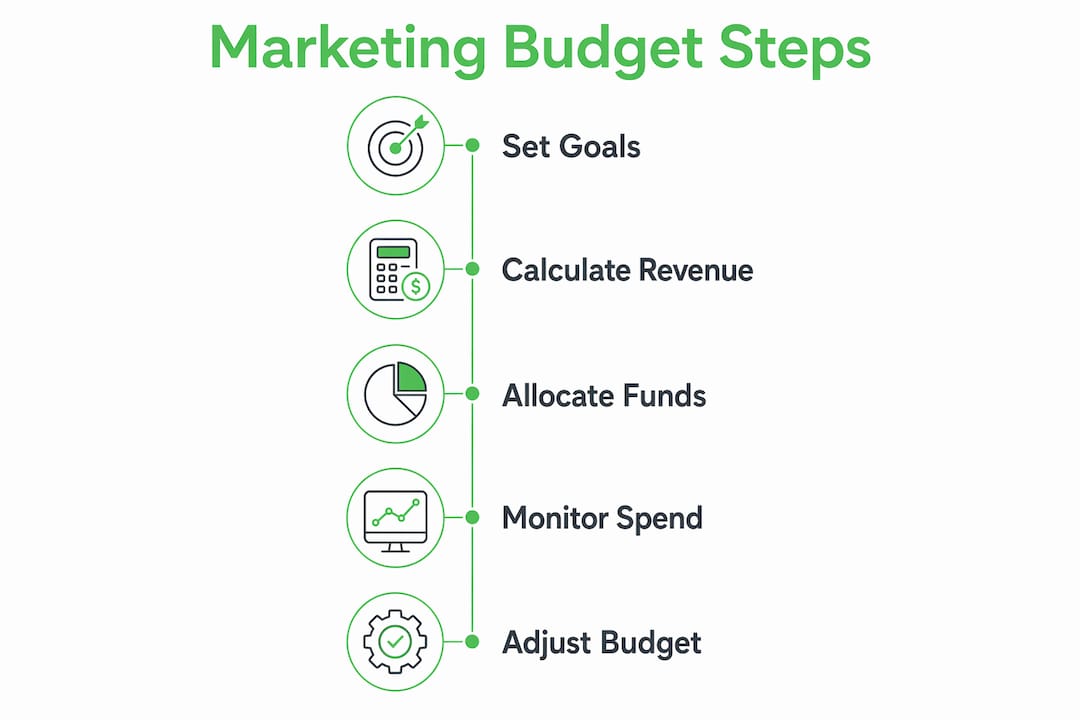
A useful way to think about this: marketing functions as an investment plan tied to specific outcomes, not a spending ceiling. Simon Hodgkins, a recognized voice in marketing strategy, stresses that shifting the perception of marketing from a cost center to a strategic investment is what unlocks growth. That mindset change affects how you size and defend your budget internally.
Pro Tip: If you are unsure where to start, apply the 7–10% of projected revenue rule for your first budget cycle. Adjust after 90 days based on actual channel performance data.
How to create a marketing budget for your business
Building a marketing budget from scratch follows a clear sequence. Skipping steps leads to budgets that look good on paper but collapse under real spending conditions.
Define your marketing goals. Start with specific, measurable objectives. Examples include generating 200 new leads per month, increasing website traffic by 30%, or launching a new product to a defined audience. Goals determine which channels and activities deserve funding.
Audit your current spending. List every marketing expense from the past 12 months. Categorize each one and note the results it produced. This audit reveals which channels delivered return and which consumed budget without output.
Identify fixed and variable costs. Fixed costs include software subscriptions and staff salaries. Variable costs include ad spend, event fees, and freelancer work. Separating them gives you a clear picture of your committed baseline before any discretionary spending begins.
Allocate by channel and priority. Distribute your total budget across channels based on past performance and your current goals. A balanced digital budget typically spans paid search, social media, content marketing, and SEO, weighted by short-term and long-term objectives.
Set performance metrics for each channel. Assign a key performance indicator (KPI) to every budget line. For paid ads, track cost per lead. For content, track organic traffic and time on page. For email, track open rates and conversions.
Build in a contingency reserve. Set aside 10–15% of your total budget for unexpected opportunities or mid-cycle adjustments. Markets shift, and a rigid budget with no flexibility forces you to miss opportunities.
Schedule regular reviews. Review budget performance monthly, not annually. Setting a marketing budget provides clarity on goals and resources, but only if you track actual spend against planned spend in real time.
Pro Tip: Use a simple spreadsheet with three columns: planned spend, actual spend, and results. Review it every four weeks. This habit alone prevents most budget overruns.
Aligning your budget with a broader digital marketing strategy makes each spending decision easier to justify and measure.
Marketing budget best practices and pitfalls to avoid
The most common mistake small business owners make is treating their marketing budget as a static document. Marketing budgets function best as living investment plans that include goals, channel mixes, governance rules, and the flexibility to adapt when conditions change.
Effective budget governance follows these principles:
- Assign clear ownership. One person or team should own each budget line. Shared ownership without accountability leads to overspending and duplicated effort.
- Track spend and performance together. Monitoring spend without tracking results tells you nothing useful. Linking budgets to pipeline growth, CAC, and retention gives you the data to make confident mid-year changes.
- Avoid channel bias. Overfunding popular channels like social media at the expense of high-performing ones like email or local SEO is a common and costly error.
- Maintain alignment with business goals. Every budget decision should connect back to a specific business objective. If a channel cannot be tied to a goal, it should not receive funding.
- Review before cutting. When budgets come under pressure, cut based on performance data, not instinct. The channel that looks expensive may be your highest-converting one.
Amy Kenly notes that a well-defined marketing budget provides real clarity and focus on high-priority goals. That clarity is what separates businesses that grow predictably from those that spend reactively. Applying social media marketing best practices within a governed budget structure, for example, produces far better results than running social campaigns without a spending framework.
Marketing budget examples for small businesses
Concrete examples make abstract percentages easier to apply. The three scenarios below reflect realistic budget structures for different business sizes and focuses.
| Business Profile | Annual Revenue | Total Marketing Budget | Key Allocations |
|---|---|---|---|
| Local service business | $200,000 | $16,000 (8%) | Google Ads 40%, local SEO 25%, social ads 20%, tools 15% |
| E-commerce startup | $500,000 | $60,000 (12%) | Paid social 35%, paid search 30%, content 20%, email 15% |
| B2B consulting firm | $1,000,000 | $90,000 (9%) | Content and SEO 40%, events 20%, paid search 25%, CRM tools 15% |
The local service business prioritizes Google Ads and local SEO because its customers search for services nearby. Ranking on Google Maps and in local search results produces direct revenue with a short sales cycle.
The e-commerce startup leans heavily on paid social and paid search because it needs volume quickly. Practical guidance from Nik Sharma recommends establishing a base ad spend threshold, such as $1,000 per day, to collect enough data before scaling. That principle applies even at smaller budgets: spend enough on a channel to get statistically meaningful results before drawing conclusions.
The B2B consulting firm invests in content and SEO because its buyers research extensively before making decisions. A high-quality content library builds authority over time and reduces reliance on paid channels.
Key Takeaways
A marketing budget is a financial plan that allocates revenue to specific channels and activities, enabling small businesses to grow predictably rather than spend reactively.
| Point | Details |
|---|---|
| Definition and scope | A marketing budget covers advertising, staff, software, content, and events, not just ad spend. |
| Industry benchmarks | Most businesses allocate 7.7–11.4% of revenue; startups often exceed 20% during growth phases. |
| Creation process | Start with goals, audit past spend, separate fixed and variable costs, then allocate by channel performance. |
| Governance matters | Assign ownership, track spend against results monthly, and cut based on data rather than instinct. |
| Mindset shift | Treating marketing as an investment rather than a cost center is what drives consistent, measurable growth. |
Why most small businesses get their marketing budget wrong
The businesses I see struggle most with marketing budgets share one trait: they built the budget around what they could afford, not around what they needed to achieve. That approach produces a budget that feels safe but delivers nothing. Affordability is a constraint, not a strategy.
The second pattern I see constantly is annual budgeting with no mid-cycle review. A budget set in january is already outdated by march. Markets shift, channels change their algorithms, and competitors adjust their spend. A budget that cannot flex is a budget that wastes money.
42.5% of marketers identify securing enough marketing budget as a top challenge. The real problem is not the size of the budget. It is the inability to demonstrate return on investment clearly enough to justify more. When you track CAC, pipeline contribution, and channel-level ROI, the conversation about budget size changes entirely.
The businesses that grow consistently treat their marketing budget as a performance contract, not a spending allowance. They know what each dollar is expected to produce, and they measure it. That discipline is available to any small business owner willing to build the tracking habits alongside the budget itself.
— Steel
How Punchvirtualmanager helps small businesses manage marketing budgets
Punchvirtualmanager works with small businesses across South Africa to build marketing budgets that connect directly to measurable growth outcomes. The agency’s approach combines data-driven planning with transparent reporting, so business owners always know where their money is going and what it is producing.

Punchvirtualmanager’s digital marketing services are built around the same principles covered in this guide: goal-first planning, channel-level tracking, and regular performance reviews. For business owners who want a structured starting point, the agency’s digital marketing packages offer defined scopes at clear price points, making it straightforward to align spend with business goals from day one. With a 99% advertising success rate and a commitment to personalized service, Punchvirtualmanager gives small businesses the expertise to spend smarter, not just more.
FAQ
What is a marketing budget in simple terms?
A marketing budget is a financial plan that outlines how much a business will spend on marketing activities, such as ads, content, and tools, over a specific period to reach its growth goals.
How do I calculate my marketing budget?
Start with 7–10% of your projected annual revenue as a baseline, then adjust up or down based on your industry, growth stage, and the competitiveness of your market.
What should a marketing budget include?
A marketing budget should include paid advertising, staff or agency fees, software subscriptions, content creation costs, SEO expenses, and a contingency reserve for unplanned opportunities.
How often should I review my marketing budget?
Review your marketing budget monthly. Comparing planned spend against actual spend and channel results every four weeks allows you to reallocate funds before underperforming channels drain your resources.
Is marketing a cost or an investment?
Marketing is an investment when tied to measurable outcomes like lead generation, customer acquisition cost, and revenue growth. Treating it as a cost center leads to reactive cuts that damage long-term growth.