
A marketing funnel is defined as a visual model that maps the stages a customer passes through, from first hearing about your business to making a purchase and beyond. The concept, widely used by businesses of all sizes, gives you a structured way to understand and influence customer decisions at every step. Funnel stages typically number three to five, covering Awareness, Consideration, and Conversion, with advanced models adding Loyalty and Advocacy. For small business owners, understanding this model is the first step toward building a customer acquisition process that actually works. Punchvirtualmanager helps South African entrepreneurs apply exactly this kind of structured thinking to their digital marketing strategy.
What is a marketing funnel and why does it matter?
A marketing funnel is the industry term for a framework that organizes your customer’s buying journey into distinct, manageable stages. The word “funnel” reflects a simple truth: many people become aware of your business, but fewer move through each subsequent stage, and only a portion convert into paying customers. This narrowing effect is normal and expected. The value of the model lies in what it tells you about where customers drop off and what you can do about it.
Tailored messaging at each stage increases trust and drives action more effectively than a single, generic pitch. A business that sends the same message to a first-time website visitor and a repeat buyer is leaving money on the table. The funnel gives you a map for sending the right message to the right person at the right time. That precision is what separates businesses that grow from those that stall.

For small business owners, the funnel model also clarifies where to spend your limited budget. If most of your customers drop off at the Consideration stage, you know to invest in content that builds trust rather than more awareness advertising. That kind of clarity is worth more than any single marketing tactic.
What are the typical stages of a marketing funnel?
Funnel stages follow a top-to-bottom structure, with each level representing a different mindset and need in the customer. Understanding each stage helps you design the right content and calls to action for each moment.
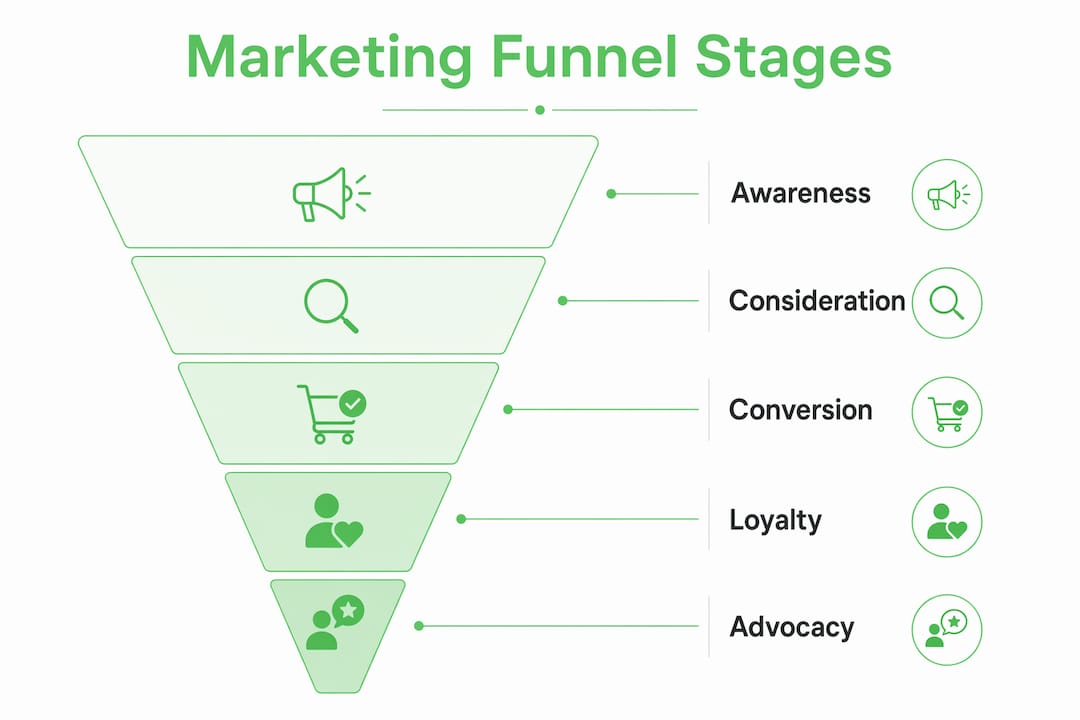
| Stage | Also Called | Customer Mindset | Key Objective |
|---|---|---|---|
| Awareness | Top of Funnel (ToFU) | “I have a problem or need” | Attract attention and educate |
| Consideration | Middle of Funnel (MoFU) | “I am comparing my options” | Build trust and demonstrate value |
| Conversion | Bottom of Funnel (BoFU) | “I am ready to decide” | Remove barriers and close the sale |
| Loyalty | Post-purchase | “I bought, now what?” | Retain and deepen the relationship |
| Advocacy | Post-purchase | “I love this brand” | Generate referrals and word-of-mouth |
The Awareness stage is where customers first encounter your brand, often through a social media post, a Google search result, or a referral. Your goal here is not to sell but to educate and attract. The Consideration stage is where customers compare you against alternatives, read reviews, and look for reasons to trust you. The Conversion stage is where the decision happens, and your job is to make that decision as easy as possible.
Post-purchase stages like Loyalty and Advocacy are often overlooked by small businesses, but they represent the most cost-effective growth available. A customer who returns and refers others costs far less to retain than a new customer costs to acquire. Building these stages into your funnel from the start changes the economics of your entire marketing effort.
How do marketing funnels work to guide customers effectively?
A funnel works by delivering the right message at the right time, meeting customers where they are in their buying process rather than pushing them toward a decision they are not ready to make. The mechanics rely on matching your content format and tone to the customer’s current stage. A first-time visitor needs education, not a hard sell. A customer who has already compared options needs reassurance and a clear path to purchase.
Prospects at different stages need different content types. Tutorials and how-to guides work well during Consideration, while barrier-removing messages like money-back guarantees or free trials work best at Conversion. Getting this match wrong is one of the most common reasons funnels underperform.
Common tactics by stage include:
- Awareness: Blog posts, social media content, search engine optimization, paid ads, and video content that introduce your brand to new audiences. Social media awareness tactics are particularly effective for small businesses with limited budgets.
- Consideration: Case studies, product comparisons, email nurture sequences, webinars, and customer testimonials that build credibility.
- Conversion: Limited-time offers, free consultations, clear pricing pages, and strong calls to action that reduce friction.
- Loyalty: Follow-up emails, loyalty programs, exclusive offers for existing customers, and personalized recommendations.
- Advocacy: Referral programs, review requests, and community-building activities that turn happy customers into vocal supporters.
Pro Tip: Use data from your website analytics to identify which stage loses the most customers. Fix that stage before spending more on awareness advertising.
The funnel also works across multiple channels simultaneously. A customer might first see a social media post, then read a blog article, then receive an email, and finally convert through a retargeting ad. Each touchpoint plays a role, and content marketing ties these touchpoints together into a coherent experience.
What should small businesses consider when designing a funnel?
Marketing funnels for small businesses are not one-size-fits-all. A local service business selling a single offering has a very different funnel than an e-commerce store with hundreds of products. The stages remain consistent, but the content, timing, and channels must reflect your specific product, audience, and buying cycle.
One of the most important design principles is recognizing that customer journeys are non-linear. Customers do not always move neatly from Awareness to Consideration to Conversion in sequence. They revisit earlier stages, pause for weeks, or jump straight to purchase after a single touchpoint. Designing a funnel that accounts for this reality means using micro-conversions, such as newsletter sign-ups, free downloads, or webinar registrations, to keep prospects engaged between buying stages.
Common mistakes small business owners make when building funnels:
- Treating the funnel as a one-time setup rather than an ongoing system that needs regular review.
- Focusing all budget on Awareness while neglecting Consideration and Conversion content.
- Skipping post-purchase stages entirely, which limits repeat business and referrals.
- Using the same message across all stages instead of tailoring content to each customer mindset.
- Failing to track conversion rates at each stage, which makes it impossible to identify where the funnel breaks down. Avoiding these common digital marketing mistakes saves both time and budget.
Pro Tip: Set up a simple email sequence that activates immediately after a purchase. A thank-you message followed by a helpful tip and then a referral request is a three-step Loyalty and Advocacy funnel that most small businesses never build.
Building emotional connection through tailored messaging matters more than volume of outreach. Customers who feel understood are far more likely to convert and return than those who receive generic promotional content.
How can small business owners apply funnel thinking in practice?
Practical funnel implementation starts with mapping your current customer journey before building anything new. Write down every touchpoint a customer has with your business, from the first ad or search result to the post-purchase experience. Identify where customers drop off and what questions they have at each stage. This map becomes the blueprint for your funnel content and channel strategy.
Structured funnel mapping enables data-driven marketing improvements. Once you know your stages and touchpoints, you can assign specific metrics to each one, such as website traffic for Awareness, email open rates for Consideration, and checkout completion rates for Conversion.
| Business Type | Awareness Tactic | Consideration Tactic | Conversion Tactic |
|---|---|---|---|
| Local service business | Google Business Profile, local SEO | Customer testimonials, free consultation | Limited-time offer, easy booking form |
| E-commerce store | Social media ads, influencer content | Product reviews, comparison pages | Free shipping threshold, abandoned cart email |
| Professional services | LinkedIn content, referral network | Case studies, credentials page | Discovery call, proposal with clear ROI |
| Online course creator | YouTube tutorials, podcast appearances | Free mini-course, email nurture sequence | Enrollment deadline, payment plan option |
Metrics worth tracking at each stage include cost per click at Awareness, email click-through rate at Consideration, and conversion rate at the purchase stage. Tracking these numbers consistently shows you where the funnel is healthy and where it needs attention. Small adjustments, such as rewriting a call-to-action button or adding a testimonial to a landing page, often produce measurable improvements within weeks.
Testing is not optional. Run A/B tests on your most important funnel pages, particularly your landing pages and email subject lines. Mobile marketing also plays a growing role in funnel performance, since most customers interact with content on their phones before converting on any device.
Key Takeaways
A marketing funnel works best when each stage delivers content matched to the customer’s mindset, supported by consistent tracking and post-purchase engagement.
| Point | Details |
|---|---|
| Core funnel structure | Most funnels include three to five stages: Awareness, Consideration, Conversion, Loyalty, and Advocacy. |
| Stage-matched content | Each stage requires different content types; tutorials build trust at Consideration, while guarantees close deals at Conversion. |
| Non-linear journeys | Customer paths are rarely straight; micro-conversions like sign-ups keep prospects engaged between stages. |
| Post-purchase stages | Loyalty and Advocacy stages drive repeat business and referrals, making them the most cost-effective growth lever. |
| Continuous measurement | Tracking conversion rates at each stage reveals exactly where the funnel needs improvement. |
What I have learned from watching small businesses use funnels
Most small business owners I have worked with treat the marketing funnel as a one-time project. They build it, launch it, and move on. That is the single biggest mistake I see. A funnel is a living system. Customer behavior shifts, platforms change, and what worked in one quarter may underperform in the next.
The second thing I have noticed is that small businesses consistently underinvest in the middle of the funnel. They spend heavily on ads to drive awareness and then wonder why conversion rates are low. The gap is almost always in Consideration content. Customers need reasons to trust you before they buy, and that trust is built through testimonials, case studies, and clear answers to their most common objections.
The third insight is one that most funnel guides skip entirely: the funnel should reflect your relationship with the customer, not just your sales process. Businesses that treat post-purchase communication as an afterthought miss the compounding value of a loyal customer base. A single referred customer costs nothing to acquire and often has a higher lifetime value than the original buyer.
My honest advice is to start simple. Map three stages, pick one tactic per stage, and measure the results for 60 days. Complexity can come later. What matters first is building the habit of thinking in stages rather than in isolated campaigns.
— Steel
How Punchvirtualmanager supports your funnel strategy
Punchvirtualmanager works with small business owners across South Africa to build and refine digital marketing systems that move customers from first contact to loyal advocates.
The agency’s digital marketing services cover every funnel stage, from search engine optimization and social media content at the Awareness level to conversion-focused web design and email strategy at the bottom. Punchvirtualmanager brings a 99% advertising success rate and a commitment to transparent reporting, so you always know which stage of your funnel is performing and which needs attention. Explore the digital marketing packages to find a plan that fits your business size and growth goals.
FAQ
What is a marketing funnel in simple terms?
A marketing funnel is a model that shows the stages a customer moves through before buying, from first becoming aware of a business to making a purchase and potentially becoming a repeat buyer.
How many stages does a marketing funnel have?
Most funnels include three core stages: Awareness, Consideration, and Conversion. Advanced models add two more, Loyalty and Advocacy, to cover the post-purchase experience.
Why is a marketing funnel important for small businesses?
A funnel gives small business owners a clear framework for allocating budget and creating content. It shows exactly where customers drop off so you can fix the right problem instead of guessing.
Do marketing funnels work for every type of business?
Yes, but funnels must be customized to suit your product, audience, and buying cycle. A local service business and an e-commerce store will use the same stages but very different tactics and timelines.
What is the most overlooked part of a marketing funnel?
The post-purchase stages, Loyalty and Advocacy, are most commonly skipped. Focusing on these stages maximizes customer lifetime value and generates referrals, which are among the lowest-cost sources of new business.