
Brand equity is defined as the value premium a company generates from a recognizable brand name compared to a generic alternative, enabling firms to charge price premiums and earn stronger customer loyalty. This concept goes far beyond logo design or taglines. It captures how consumers perceive, trust, and choose a brand over competing options. The Aaker model breaks brand equity into four measurable dimensions: brand awareness, perceived quality, brand associations, and brand loyalty. Business owners and marketing professionals who understand these dimensions gain a direct advantage in pricing power, customer retention, and long-term market positioning.
What is brand equity made of? The four core dimensions
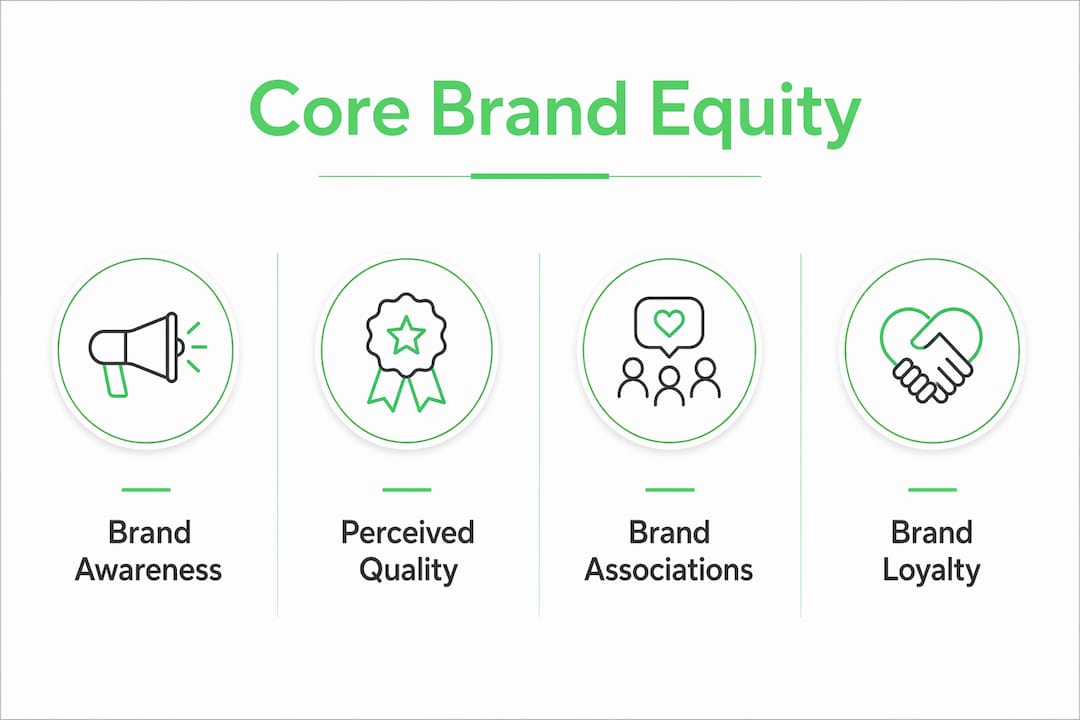
Brand equity is measured across four main dimensions: brand awareness, perceived quality, brand associations, and brand loyalty. Each dimension contributes differently to the total value a brand holds in the market.
Brand awareness
Brand awareness measures how readily consumers recall or recognize a brand without prompting. Unaided recall tests are the standard method. A business owner can track awareness through surveys, search volume trends, and direct traffic data. High awareness reduces the cost of customer acquisition over time.
Perceived quality
Perceived quality reflects the consumer’s overall judgment of a brand’s excellence relative to alternatives. This is not the same as actual product quality. It is shaped by packaging, pricing signals, customer service, and online reviews. A brand that signals quality effectively can command higher prices even when product specifications are similar to lower-priced competitors.

Brand associations
Brand associations are the mental connections consumers make when they encounter a brand name. These include emotions, values, celebrities, colors, and experiences. Associations are tracked through social listening tools and sentiment analysis. Strong, positive associations make a brand easier to extend into new product categories.
Brand loyalty
Brand loyalty measures the degree to which customers repeatedly choose a brand over alternatives. Repeat purchase rates and Net Promoter Score (NPS) are the primary metrics. Loyal customers also generate word-of-mouth referrals, which amplifies brand equity without additional ad spend.
| Dimension | Primary metric | What it signals |
|---|---|---|
| Brand awareness | Unaided recall rate | Market reach and recognition |
| Perceived quality | Review scores, pricing power | Consumer confidence in the brand |
| Brand associations | Sentiment analysis, social mentions | Emotional and cultural resonance |
| Brand loyalty | Repeat purchase rate, NPS | Long-term revenue stability |
Why is brand equity important for businesses?
Strong brand equity delivers measurable financial and competitive advantages. A brand with high equity can price products above market averages because consumers perceive greater value. That pricing power directly improves profit margins without requiring cost cuts elsewhere.
Building brand equity through consistent investment in customer experience and messaging produces compounding returns. Brands with strong equity survive economic downturns better than weaker brands. They also launch new products more successfully because existing trust transfers to new offerings.
The benefits extend beyond pricing:
- Customer retention: Loyal customers cost less to retain than new customers cost to acquire.
- Marketing efficiency: High-awareness brands spend less per conversion because recognition reduces friction.
- Resilience: Strong brands recover faster from negative press or product failures.
- Talent attraction: Recognized brands attract higher-quality job candidates, reducing hiring costs.
“Brand equity is fundamentally multidimensional and cannot be fully captured by financial metrics alone. Emotional prestige and trust are key qualitative factors that lead to an incomplete understanding if overlooked.”
Pro Tip: Track both financial indicators and qualitative signals like customer sentiment and brand perception surveys. A brand that scores well on NPS but poorly on unaided recall has a different problem than one with the reverse pattern. Treating them the same leads to misallocated budget.
Consistent brand messaging across every customer touchpoint is one of the most direct ways to build the trust that drives these benefits.
How is brand equity measured in practical terms?
No single standard metric captures brand equity completely. Leading firms use a blended dashboard of financial data and qualitative inputs like consumer sentiment and NPS to build a complete picture. Relying on one metric produces a distorted view.
The most practical measurement approach combines these inputs:
- Unaided brand recall: Ask consumers to name brands in your category without prompting. Your share of unprompted mentions reflects true awareness strength.
- Net Promoter Score (NPS): Measures how likely customers are to recommend your brand. A rising NPS correlates with growing loyalty and positive associations.
- Sentiment analysis: Monitor social media and review platforms for tone and themes. Negative sentiment spikes often precede drops in repeat purchase rates.
- Repeat purchase rate: Tracks the percentage of customers who buy again within a defined period. This is the most direct financial signal of brand loyalty.
- Price premium index: Compare your average selling price to the category average. A sustained premium indicates strong perceived quality.
Measurement also requires localization. Cultural resonance often outweighs pure functional brand performance in driving loyalty across diverse markets. A metric that works well in one region may underperform as a signal in another.
Pro Tip: Integrate digital marketing metrics such as branded search volume, social share of voice, and electronic word-of-mouth (e-WOM) signals into your brand equity dashboard. These digital indicators often move before traditional survey data catches up, giving you an early warning system.
What strategies build and maintain strong brand equity?
The most effective brand equity strategies combine consistent long-term investment with agile responses to real-time market signals. Brand equity growth is often nonlinear and subject to sudden shifts from viral mentions or public controversies. Reactive reputation management is as important as proactive brand building.
Digital co-creation and influencer-led e-WOM are now central to how brand equity forms. Consumers trust peer recommendations and creator content more than brand broadcasts. Brands that actively participate in online conversations, rather than simply publishing content, build associations faster and more durably.
Key actions to strengthen brand equity over time:
- Invest in customer experience first. Every service interaction either builds or erodes brand associations. Resolve complaints publicly and visibly.
- Maintain message consistency. Inconsistent messaging across channels confuses consumers and weakens recall. An omnichannel branding approach prevents this fragmentation.
- Build a content engine. Content marketing builds brand awareness, associations, and loyalty simultaneously. Publish content that answers real customer questions in your category.
- Engage influencers strategically. Micro-influencers with high audience trust often deliver stronger brand association gains than mass-reach celebrity endorsements.
- Monitor and respond to e-WOM. Set up alerts for brand mentions across review sites, social platforms, and forums. Respond to negative mentions within 24 hours.
- Protect brand equity during crises. Have a documented response protocol before a crisis occurs. Brands that respond quickly and transparently recover equity faster.
Pro Tip: Brand equity can appreciate without direct investment through organic events. City brands have grown over centuries without marketing budgets. For businesses, this means monitoring organic brand conversations even during periods of low ad spend, because equity can move in either direction without your involvement.
Social media marketing is one of the most cost-effective channels for building brand associations and loyalty, particularly for small and medium businesses with limited budgets.
Key Takeaways
Strong brand equity is built through consistent investment in customer experience, measurable across four dimensions, and protected through agile reputation management and culturally informed digital engagement.
| Point | Details |
|---|---|
| Brand equity definition | The value premium a brand generates from consumer perceptions, enabling higher pricing and loyalty. |
| Four core dimensions | Awareness, perceived quality, associations, and loyalty each require separate tracking methods. |
| Measurement approach | Use a blended dashboard of NPS, sentiment analysis, repeat purchase rates, and price premium data. |
| Digital strategy | Active participation in e-WOM and influencer conversations builds equity faster than broadcasting alone. |
| Cultural localization | Adapt brand strategies to local cultural signals, as social endorsement often drives loyalty more than product features. |
Brand equity in 2026: what the numbers miss
The frameworks are solid. Aaker’s four dimensions still hold up. But after years of working with businesses on brand growth, I’ve noticed a consistent blind spot: most business owners treat brand equity as a marketing metric when it is actually a business asset.
The financial valuation of a brand is the number that shows up in acquisition deals and balance sheets. The emotional and cultural resonance is the number that shows up in customer behavior. These two figures rarely move in sync. A brand can have high financial valuation and declining emotional resonance simultaneously, which is exactly the condition that precedes market share loss.
The other thing most guides understate is how fast equity can move in the wrong direction. A single viral complaint, a poorly timed campaign, or an inconsistent customer service experience can erode years of brand investment within days. The brands that manage this well are not the ones with the biggest budgets. They are the ones with the clearest internal understanding of what their brand stands for and the fastest response systems when that identity is challenged.
My honest view: the businesses that will build the most durable brand equity in 2026 are those that treat digital engagement as a two-way conversation, not a broadcast channel. That means responding to reviews, co-creating content with customers, and being willing to take a public position on things that matter to their audience. Passive brand management is no longer a viable strategy.
— Steel
How Punchvirtualmanager supports brand equity growth
Punchvirtualmanager works with business owners and marketing professionals who want to build measurable brand equity through data-driven digital marketing. The agency’s approach combines performance tracking, audience targeting, and consistent brand messaging to produce real growth in awareness, loyalty, and perceived quality.

Punchvirtualmanager’s digital marketing services are built around the metrics that actually move brand equity: branded search volume, social share of voice, NPS trends, and repeat engagement rates. The agency also offers structured marketing packages designed for businesses at different stages of brand development. If your brand equity is not growing at the rate your business needs, Punchvirtualmanager provides the expertise and tools to change that.
FAQ
What is brand equity in simple terms?
Brand equity is the extra value a brand name adds to a product or service beyond its functional features. It is what allows one brand to charge more than a generic alternative for the same product.
What are the four dimensions of brand equity?
The four dimensions are brand awareness, perceived quality, brand associations, and brand loyalty. Each is tracked with different metrics, including unaided recall, NPS, sentiment analysis, and repeat purchase rates.
Why is brand equity important for small businesses?
Strong brand equity reduces customer acquisition costs, supports higher pricing, and improves resilience during economic downturns. Small businesses with high equity also launch new products more successfully because existing trust transfers to new offerings.
How do you measure brand equity effectively?
The most effective approach combines a blended dashboard of financial data and qualitative inputs. Key metrics include unaided brand recall, NPS, sentiment analysis, repeat purchase rates, and a price premium index compared to category averages.
What affects brand equity the most?
Consistent customer experience, message consistency across channels, and active participation in digital conversations have the greatest impact. Cultural resonance and social endorsement also play a significant role, particularly in diverse or regional markets.