
Dynamic pricing is a strategy where businesses adjust prices in real time based on shifting conditions such as demand, inventory levels, competitor pricing, and time signals. When Uber shows a higher fare during a rainstorm or a sold-out concert, that is dynamic pricing at work: the algorithm detects high demand, low driver supply, and raises the price automatically. Airlines, Amazon, major hotel chains, and Punchvirtualmanager’s e-commerce clients all operate in markets where static prices leave money on the table or inventory unsold. Understanding how this model works, and where it can go wrong, is the starting point for any business considering it.
Table of Contents
- What does dynamic pricing actually mean?
- How does dynamic pricing work in practice?
- Common dynamic pricing strategies and when to use each
- What technology and data do you need to run dynamic pricing?
- Where is dynamic pricing used? Industry examples
- Business benefits, customer impacts, and risks
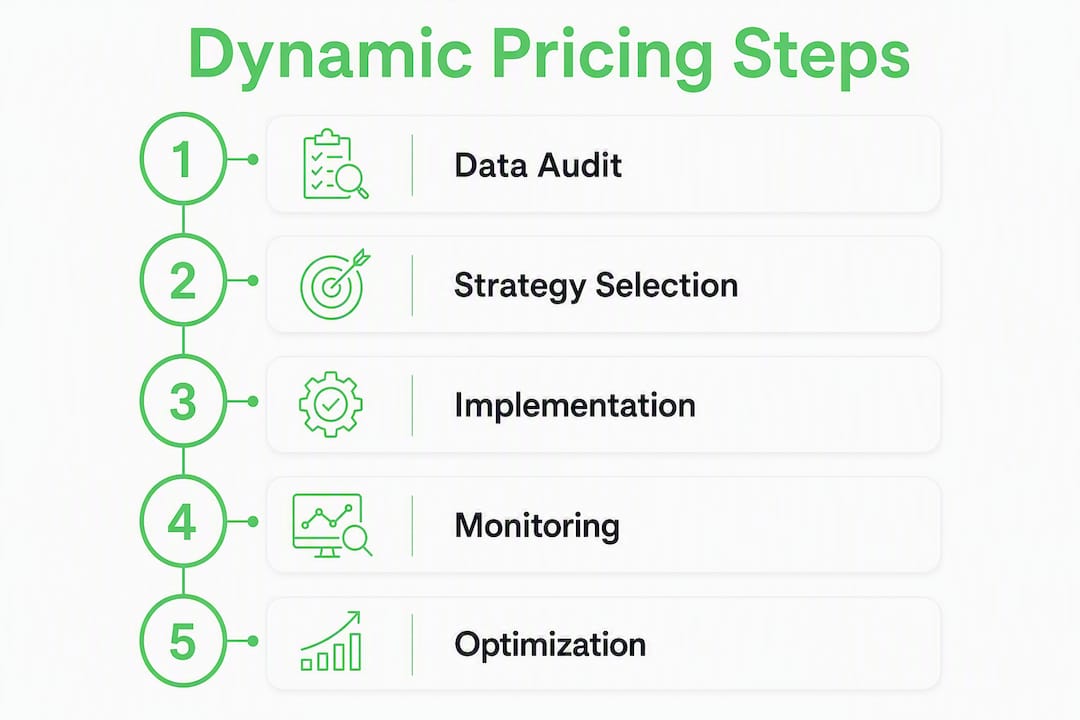
- How to implement a dynamic pricing strategy step by step
- U.S. legal and ethical considerations you need to know
- A practical E-E-A-T checklist for online retailers
- Key Takeaways
- Dynamic pricing rewards discipline more than technology
- How Punchvirtualmanager can support your pricing strategy
- Useful sources for further reading
What does dynamic pricing actually mean?
Dynamic pricing is the practice of setting prices that move in response to real-time market signals rather than staying fixed. The contrast with static pricing is straightforward: a fixed price is set once and reviewed periodically, while a dynamic price is recalculated continuously or at defined intervals.
A few terms appear throughout any serious discussion of this model, so it helps to define them clearly before going further:
- Trigger: A specific condition that causes a price change, such as inventory falling below a threshold or a competitor lowering their price.
- Price floor: The minimum price a business will accept, set to protect margin regardless of how low demand drops.
- Price ceiling: The maximum price the system is allowed to charge, used to prevent reputational damage from extreme spikes.
- Price elasticity: A measure of how sensitive demand is to price changes. High elasticity means small price moves cause large demand shifts.
- Surge pricing: A specific form of demand-based dynamic pricing that raises prices sharply during peak demand periods. Uber’s model is the most cited example.
- Rule-based pricing: A system where price changes follow predefined “if/then” logic without machine learning.
- Algorithmic pricing: A system where machine learning models predict optimal prices based on multiple variables simultaneously.
- Segmented pricing: Showing different prices to different customer groups (students, loyalty members) based on a defined category.
- Personalized pricing: Showing different prices to different individuals based on their specific behavioral or purchase data. This is distinct from dynamic pricing, which shows the same price to all shoppers at a given moment.
The distinction between dynamic and personalized pricing matters both commercially and legally. Dynamic pricing responds to market conditions; personalized pricing responds to individual profiles. Regulators and consumers treat them differently.
How does dynamic pricing work in practice?
The mechanics of a dynamic pricing system follow a consistent flow: data comes in, a model processes it, rules filter the output, and the updated price pushes to the sales channel. Here is how each step operates.
Data collection. The system ingests multiple real-time and historical inputs: current inventory levels, sales velocity (units sold per hour), site traffic volume, competitor prices scraped from the web, time-of-day and day-of-week signals, and customer browsing behavior. The quality of these feeds determines everything downstream.
Model processing. AI and machine learning models process these inputs simultaneously, identifying patterns that a human analyst would miss. A model might learn that demand for a specific product spikes on Thursday evenings and that a 12% price increase at that time does not reduce conversion. That relationship gets encoded into the pricing logic.
Rule engine filtering. Before any price goes live, it passes through a rule engine that enforces the price floor and ceiling, checks that the change does not exceed a defined percentage move in a single update, and flags anomalies for human review. This layer is what prevents a data error from triggering a $0.01 listing or a $10,000 price on a $50 item.
Channel update. The approved price pushes to the relevant sales channel, whether that is a product page, a marketplace listing, a booking engine, or a point-of-sale system. Update cadence varies widely: airlines and rideshare platforms reprice by the minute; most e-commerce retailers update hourly or daily; hotels typically reprice several times per day.
Feedback loop. Conversion data, revenue, and margin flow back into the model, which retrains on the new observations. Over time, the model improves its elasticity estimates and trigger accuracy.
Where errors arise most often: outdated inventory feeds and unvalidated competitor data. If the system believes stock is lower than it actually is, it may raise prices unnecessarily. If a competitor’s feed contains a scraping error, the system may match a price that was never real. Poor data quality is the most common failure point in automated pricing deployments.

Common dynamic pricing strategies and when to use each
The four principal dynamic pricing models cover most commercial use cases. Understanding which one fits a given business depends on the primary objective, the available data, and the customer’s tolerance for price variability.
Demand-based pricing. Prices rise when demand is high and fall when demand is low. Airlines and rideshare platforms use this most aggressively. The trigger is a demand signal: search volume, booking pace, or real-time request density. Best suited for businesses with perishable inventory (a seat, a hotel room, a driver’s time) where unsold capacity has zero recovery value.
Time-based pricing. Prices vary by time of day, day of week, or season. Happy hour discounts, early-bird rates, and peak-season hotel rates are all time-based. The trigger is a calendar or clock signal rather than live demand data. Simpler to implement than demand-based models and effective for businesses with predictable demand cycles.
Competitor-based pricing. The system monitors competitor prices and adjusts to maintain a defined position: match, undercut by a fixed margin, or stay a percentage above. Common in e-commerce marketplaces where price comparison is frictionless. Requires reliable competitor data feeds and clear rules about which competitors to track. Startup competitor branding analysis is a useful discipline to undertake before building these rules.
Inventory-based pricing. Prices adjust based on stock levels. Shopify describes two common rules: raise price when inventory falls below a threshold, and discount when stock ages past a set number of days. This model protects margin on scarce items and clears slow-moving stock before it becomes a write-off.
Segmented pricing. Different customer groups see different prices based on a defined category: loyalty tier, geographic region, purchase history, or membership status. This is not personalized pricing (which uses individual behavioral data) but it does require customer identification at the point of pricing.
| Strategy | Typical industries | Primary business goal | Data and tech required | Customer risk |
|---|---|---|---|---|
| Demand-based | Airlines, rideshare, hotels | Maximize revenue per unit | Real-time demand signals, ML model | High if spikes are extreme |
| Time-based | Restaurants, hospitality, utilities | Shift demand to off-peak periods | Calendar logic, basic rules engine | Low to moderate |
| Competitor-based | E-commerce, retail, fuel | Maintain competitive position | Competitor price feeds, matching rules | Low if changes are gradual |
| Inventory-based | Retail, e-commerce, perishables | Protect margin, clear stock | Inventory management system, threshold rules | Low |
| Segmented | SaaS, travel, entertainment | Capture willingness to pay by group | CRM, customer identification | Moderate if perceived as unfair |
What technology and data do you need to run dynamic pricing?
A working dynamic pricing system sits on top of several connected components. Buying a pricing tool without the underlying data infrastructure is one of the most common implementation mistakes.
The core tech stack:
- Pricing engine: The software layer that receives data inputs, applies the model or rules, and outputs a price recommendation. This can be a standalone tool or a module within a broader commerce platform.
- Data warehouse: A centralized store for historical sales, inventory, and behavioral data. Without clean historical data, machine learning models have nothing to train on.
- Real-time data streams: Live feeds for inventory levels, site traffic, and competitor prices. These typically arrive via API connections to inventory management systems, web analytics platforms, and price-monitoring tools.
- API-led product catalog: A product information system that can receive price updates and push them to all connected channels simultaneously, keeping pricing consistent across a website, marketplace listings, and mobile apps.
- Analytics and reporting layer: Tools such as Google Analytics 4, Looker, or Tableau that surface the metrics needed to evaluate pricing performance.
Key metrics to track:
- Revenue lift: The percentage increase in total revenue attributable to dynamic pricing versus a fixed-price baseline.
- Price elasticity by SKU: How much demand changes for each product when price moves by a defined amount.
- Conversion rate by price point: Whether higher prices reduce conversion enough to offset the margin gain.
- Sell-through rate: The percentage of available inventory sold within a target period. Dynamic pricing should improve this.
- Margin by SKU: Gross margin per product, tracked to confirm that price moves are not eroding profitability.
- A/B test results: Measured differences in revenue or conversion between a control group (fixed price) and a test group (dynamic price). Tracking these digital marketing metrics rigorously is what separates a successful rollout from an expensive guess.
Pro Tip: Before enabling any automation, audit every data feed for latency and accuracy. A pricing engine is only as reliable as the inventory and competitor data it receives. Run a two-week data quality check before connecting any automated price-update logic.
Pro Tip: Start with one metric as your north star, typically revenue lift or sell-through rate, and resist the temptation to optimize for margin and conversion simultaneously in the first phase. Conflicting objectives produce conflicting signals and make it impossible to diagnose what is working.

Where is dynamic pricing used? Industry examples
Dynamic pricing appears across industries with very different triggers, objectives, and customer expectations. The following examples show how the same underlying logic plays out in distinct commercial contexts.
Airlines. U.S. carriers such as American Airlines and Delta use revenue management systems that have been refining demand-based pricing since the 1980s. The trigger is booking pace relative to historical fill rates for a given route and departure date. Prices on the same seat can move many times between the booking window opening and the flight departing. The objective is to fill every seat at the highest price the market will bear at each point in time.
Hotels. Major hotel brands adjust room rates based on occupancy forecasts, local event calendars, and competitor availability. A hotel near a convention center will raise rates weeks before a large conference and lower them if the booking pace lags behind forecast. The data inputs include the hotel’s own reservation system, competitor rate feeds, and event databases.
Rideshare (Uber). Uber’s surge pricing is the most publicly visible form of dynamic pricing in the United States. When ride requests in a geographic area exceed available drivers, the algorithm raises the fare multiplier. The stated objective is to attract more drivers to the area and reduce demand to a level the available supply can serve. The trigger is a real-time supply-demand imbalance measured at the neighborhood level.
E-commerce (Amazon-style marketplaces). Amazon reprices millions of listings continuously, responding to competitor prices, Buy Box eligibility rules, and inventory levels. Third-party sellers on the platform often use automated repricing tools to stay competitive. The scale is what distinguishes this from traditional retail: a single retailer might manage pricing decisions across hundreds of thousands of SKUs simultaneously.
Live event ticketing. Dynamic pricing in ticketing has drawn significant public attention, particularly for high-demand concerts. Platforms adjust ticket prices based on remaining inventory and real-time demand signals. When Oasis announced reunion tour dates in 2024, ticket prices surged well beyond face value through dynamic pricing mechanisms, prompting regulatory scrutiny in the UK and renewed debate in the U.S. about consumer protection in ticketing markets.
Scale and customer expectations differ significantly across these sectors. Airline passengers have accepted variable pricing for decades. Hotel guests understand seasonal rates. Rideshare users tolerate surge pricing because the alternative is no ride. Event ticket buyers, however, often feel that dynamic pricing violates an implicit promise of fair access, which is why ticketing remains the most politically sensitive application of the model.
Business benefits, customer impacts, and risks
Dynamic pricing offers real commercial advantages, but it also carries risks that a fixed-price model does not. Both sides deserve honest treatment.
Core benefits:
- Revenue optimization. Prices align with what the market will pay at each moment, capturing value that a static price would leave uncaptured during high-demand periods.
- Margin protection. Static prices cause quiet margin leakage when costs rise or demand shifts. Dynamic pricing adjusts faster than a quarterly pricing review.
- Inventory management. Automated discounts on aging stock reduce write-offs and free up working capital without requiring manual intervention.
- Competitive responsiveness. Competitor-based rules keep prices in range without requiring a pricing analyst to monitor the market manually.
Customer impacts:
- Customers who buy at a high point in the price cycle may feel overcharged when they later see a lower price for the same item.
- Loyalty effects are mixed. Frequent travelers and hotel loyalty members often receive rate guarantees that insulate them from the worst price swings, which can actually strengthen loyalty. Casual buyers have no such protection.
- Short-term price sensitivity is higher in categories where comparison shopping is easy, such as e-commerce, than in categories where switching is inconvenient, such as a hotel room booked the night before arrival.
Risks:
- Customer backlash. Extreme or poorly explained price spikes generate social media complaints and press coverage that can damage brand perception faster than the revenue gain justifies.
- Price discrimination concerns. If algorithmic pricing correlates with protected characteristics such as race or zip code, it may expose a business to legal and reputational risk even if the correlation was unintentional.
- Cascade price wars. In competitor-based models, two businesses matching each other’s automated price cuts can drive prices below cost before either notices.
- Data quality failures. A corrupted inventory feed or a bad competitor price scrape can trigger a price move that harms both revenue and customer trust.
Pro Tip: Set price floors and ceilings before enabling any automation. These guardrails are the single most important protection against data errors and reputational damage from erratic automated spikes. Review them quarterly as cost structures change.
How to implement a dynamic pricing strategy step by step
Implementing dynamic pricing is an operational shift, not just a software purchase. Businesses that treat it as a technology project without addressing data governance and cross-functional alignment consistently underperform those that treat it as a business process change.
Assess data readiness. Audit inventory feeds, sales data, and competitor data for accuracy, completeness, and latency. If the data is not clean and current, fix it before proceeding.
Define objectives. Decide whether the primary goal is revenue lift, margin protection, inventory clearance, or competitive positioning. A single clear objective makes model selection and success measurement straightforward.
Choose a pricing model. Select the strategy type (demand-based, time-based, competitor-based, inventory-based, or segmented) that fits the objective and the available data. Most businesses start with one model and add complexity later.
Build rules and guardrails. Define price floors, ceilings, maximum percentage moves per update, and blackout periods (such as promotional windows where prices should not change automatically).
Integrate with channels. Connect the pricing engine to the product catalog and all sales channels via API. Test that price updates propagate correctly and within an acceptable time window.
Assign cross-functional roles. Pricing decisions touch finance, marketing, operations, and customer service. Define who owns the model, who reviews anomalies, and who handles customer complaints about price changes.
Run a controlled pilot. Pair dynamic pricing with A/B testing before broad deployment. Apply dynamic pricing to a subset of products or a defined customer segment, hold a control group at fixed prices, and measure the difference in revenue and conversion over a defined period.
Measure and iterate. Track the key metrics from the pilot: revenue lift, sell-through rate, conversion rate, and margin by SKU. Use the results to refine rules, retrain models, and expand scope.
Scale and retrain. As the model accumulates more data, retrain it on a defined schedule, typically monthly or quarterly, to keep elasticity estimates current. Market conditions change, and a model trained on last year’s data may misfire on this year’s demand patterns.
| Phase | Metrics to track | Decision point |
|---|---|---|
| Pilot (weeks 1–4) | Revenue lift vs. control, conversion rate by price point | Continue if lift is positive and conversion drop is within tolerance |
| Expansion (weeks 5–12) | Sell-through rate, margin by SKU, customer complaint volume | Expand SKU coverage if metrics hold; investigate anomalies |
| Scale (month 4+) | Total revenue, price elasticity accuracy, model prediction error | Schedule model retraining; review guardrails against current cost structure |
U.S. legal and ethical considerations you need to know
Dynamic pricing operates within a legal framework in the United States that businesses must understand before deploying aggressive price changes.
Price gouging. There is no single federal price gouging law in the U.S. Instead, most states have their own statutes that activate during declared emergencies. These laws vary significantly: some cap prices at a fixed percentage above pre-emergency levels, others use a “unconscionably excessive” standard. Businesses should consult legal counsel for specific incidents, as the rules differ by state and by product category.
FTC oversight. The Federal Trade Commission has authority to act against unfair or deceptive pricing practices under Section 5 of the FTC Act. Practices that mislead consumers about the basis for a price, such as displaying a false “original price” to make a dynamic price look like a discount, fall within this scope.
Discriminatory pricing risk. If a pricing algorithm produces outcomes that systematically charge higher prices to consumers in certain zip codes or demographic groups, it may attract scrutiny under consumer protection law even if the algorithm itself does not reference protected characteristics. The correlation, not the intent, is what creates legal exposure.
Operationalizing compliance:
- Maintain documented price floors and ceilings that prevent extreme moves.
- Keep audit logs of every price change, including the trigger, the data inputs, and the resulting price. These records are essential if a regulator or plaintiff requests evidence of pricing rationale.
- Run regular audits of pricing outcomes by geography and customer segment to detect unintended discriminatory patterns.
- Avoid displaying reference prices (such as “was $X”) unless the item was genuinely sold at that price for a meaningful period. Fabricated reference prices are a common FTC enforcement target.
Ethics checklist for customer communication:
- Disclose that prices may vary based on demand or availability in your terms of service and, where relevant, on the product page.
- Avoid framing a dynamic price increase as a “limited time offer” when the price will simply return to normal after the demand spike passes.
- Offer price-match guarantees or loyalty rate protections where the business model allows, to reduce customer perception of unfairness.
- Monitor social media sentiment after significant price moves. Customer complaints that go unanswered publicly tend to escalate faster than those addressed promptly.
A practical E-E-A-T checklist for online retailers
Credibility in dynamic pricing comes from execution discipline, not just technology. The following checklist combines governance steps with trust-building actions that online retailers can apply immediately.
- Set and document price floors and ceilings before enabling any automated price changes.
- Publish a plain-language explanation of your pricing practices on your website, either in your FAQ or your terms of service. Transparency reduces customer complaints and demonstrates good faith to regulators.
- Maintain audit logs of every automated price change, including the trigger condition, the data inputs, and the timestamp.
- Measure customer sentiment after price changes using post-purchase surveys, Net Promoter Score tracking, and social media monitoring.
- Run controlled experiments before scaling. Define the hypothesis, the test and control segments, the duration, the minimum sample size for statistical validity, and the rollback conditions if results are negative.
- Validate all data feeds weekly. Confirm that inventory counts, competitor prices, and demand signals are accurate and current before each pricing cycle.
- Review guardrails quarterly against current cost structures and market conditions.
- Assign a named owner for pricing anomaly review, someone who receives alerts when a price moves outside expected bounds and can intervene before the change causes customer harm.
Pro Tip: To prove causality rather than correlation in a pricing experiment, randomize assignment at the customer or session level rather than the product level. Product-level randomization confounds the test with demand differences between products. Session-level randomization isolates the price effect.
Pro Tip: Preserving brand trust while optimizing prices requires a simple rule: never let the algorithm make a move that you would be uncomfortable explaining to a customer or a journalist. If the answer to “why did the price change?” is not something you can state clearly and honestly, the guardrail is set too loosely.
Punchvirtualmanager supports pricing-adjacent tasks including analytics setup, conversion rate optimization, and campaign measurement. The agency does not build pricing engine software, but it does help businesses measure the demand signals and marketing performance data that feed into pricing decisions.
Key Takeaways
Dynamic pricing delivers measurable revenue and inventory benefits when it is built on clean data, clear guardrails, and a staged experimental rollout rather than deployed as a plug-and-play software switch.
| Point | Details |
|---|---|
| Core definition | Dynamic pricing adjusts prices in real time based on demand, inventory, competitor moves, and time signals. |
| Primary benefits | Revenue optimization, margin protection, and faster inventory clearance are the three most consistent commercial gains. |
| Biggest risk | Poor data quality is the most common failure point; bad inventory or competitor feeds trigger harmful automated price moves. |
| U.S. legal exposure | Price gouging rules vary by state; FTC oversight covers deceptive reference prices and discriminatory pricing outcomes. |
| Punchvirtualmanager | Supports the analytics, conversion tracking, and campaign measurement that feed reliable demand signals into pricing decisions. |
Dynamic pricing rewards discipline more than technology
The conventional wisdom treats dynamic pricing as a technology problem: buy the right tool, connect the feeds, and watch revenue climb. That framing misses the harder part. The businesses that get the most from dynamic pricing are not the ones with the most sophisticated algorithms. They are the ones that invested in data governance first, defined clear objectives before choosing a model, and ran controlled experiments before scaling.
There is also a tendency to focus entirely on the upside, the revenue lift during demand spikes, while underestimating the reputational cost of a single badly handled price surge. Uber’s surge pricing is the most cited example of dynamic pricing in the world, and it is also the most cited example of customer backlash. The two facts are not unrelated. Transparency and guardrails are not optional compliance steps; they are what makes the model sustainable over time.
One more thing worth stating plainly: dynamic pricing is not only a tool for raising prices. Businesses use it to lower prices to clear inventory, stimulate demand in slow periods, and respond to competitive pressure. A business that only uses dynamic pricing to capture upside during demand spikes is using half the tool and taking on all the reputational risk.
How Punchvirtualmanager can support your pricing strategy
Pricing decisions are only as good as the data behind them. Punchvirtualmanager’s data-driven digital marketing services give businesses the analytics foundation, conversion tracking, and campaign measurement infrastructure that dynamic pricing depends on. When you know which traffic sources drive your highest-converting visitors, which Google Ads campaigns correlate with demand spikes, and how conversion rates shift across price points, you have the inputs that make a pricing model work.

The agency’s work covers Google Ads management, SEO, social media marketing, and analytics setup, not pricing engine software development. The distinction matters: Punchvirtualmanager helps you measure demand, track campaign performance, and interpret the signals that should inform your pricing rules. Businesses that want to run pricing experiments also benefit from having clean conversion data and properly configured analytics before the first test goes live. Explore the digital marketing packages to find the right level of ongoing support for your business.
Useful sources for further reading
| Source | What it covers | Why it’s useful |
|---|---|---|
| Dynamic Pricing: What Is It & Why It’s Important — HBS Online | Core definition, business rationale, and strategic framing | Authoritative academic perspective from Harvard Business School |
| Dynamic Pricing Explained — Stripe | Mechanics, strategy types, and operational considerations | Practical, commerce-focused explanation from a major payments platform |
| Dynamic Pricing: What Is It & How It Effects Sales — Salesforce | Strategy types, data quality risks, and A/B testing guidance | Strong on implementation and the role of CRM data in pricing |
| Dynamic Pricing: Influencing Factors + Maximizing Profits — BigCommerce | E-commerce focus, personalized vs. dynamic pricing distinction, margin protection | Directly relevant for online retailers managing large SKU catalogs |
| What Is Dynamic Pricing? How It Works & Examples — Shopify | Rule-based triggers, e-commerce examples, and practical implementation notes | Accessible starting point for merchants on or considering Shopify |
| How AI Is Shaping the Next Frontier of Dynamic Pricing — Lumenalta | Machine learning applications in pricing, real-time data processing | Useful for understanding where algorithmic pricing is heading |
| Why Dynamic Pricing Is Making Concerts So Expensive — Northeastern University | Ticketing industry case study, consumer backlash, and regulatory context | Grounded analysis of the ethical and political dimensions of dynamic pricing |