
Financial risk management is the systematic process organizations use to protect economic value by identifying, measuring, and responding to financial exposures before they cause harm. It applies to banks, corporations, investment firms, and small businesses alike, and its core purpose is to shield cash flows and firm value from uncertainty. Rather than eliminating risk entirely, the goal is to optimize the risk-return tradeoff so that managed exposures can support higher expected returns.
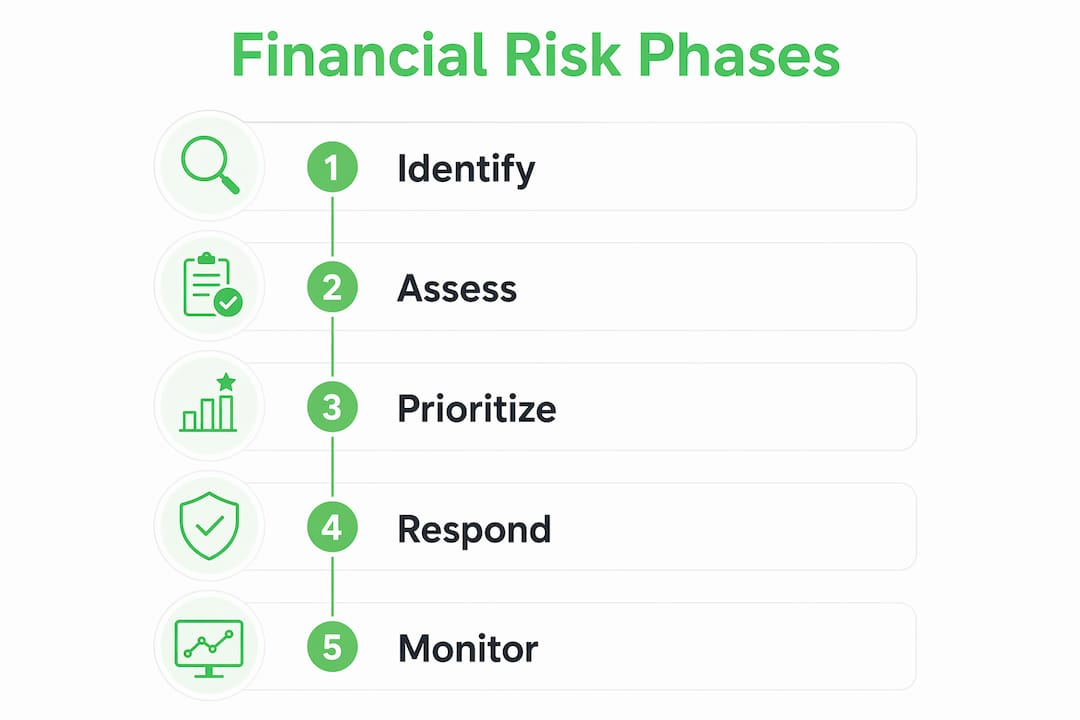
The standard lifecycle covers five phases:
- Identify financial exposures across the business
- Assess and measure each exposure using quantitative and qualitative tools
- Prioritize risks by potential impact and likelihood
- Respond and mitigate through hedging, diversification, insurance, or limits
- Monitor and report on a defined cadence to catch emerging threats early
Table of Contents
- What is financial risk management and how does the framework work?
- What are the primary types of financial risk?
- How is financial risk measured?
- What techniques actually reduce financial risk?
- Which tools and systems support modern financial risk management?
- What U.S. regulatory frameworks govern financial risk management?
- How do organizations structure and govern their risk programs?
- Short scenarios that show financial risk management in practice
- How to start your financial risk management program in 30–90 days
- What financial risk management delivers, and where it falls short
- Key Takeaways
- Why most businesses underestimate the cost of doing this late
- Useful sources
What is financial risk management and how does the framework work?
The five-phase framework is the backbone of every credible risk program, from a community bank to a Fortune 500 treasury. Each phase has a distinct owner, output, and cadence.
Identification is where the finance team, often led by the CFO or a Chief Risk Officer (CRO), catalogs every exposure the business faces: interest rate movements, foreign currency receivables, counterparty defaults, and operational failures. The output is a risk register, a living document that lists each exposure, its source, and its potential financial impact.
Assessment and measurement converts the register into numbers. Analysts apply quantitative models (Value at Risk, stress tests, credit scoring) and qualitative judgments to estimate severity and probability. The output is a ranked risk map.
Prioritization forces a decision: which risks warrant active management and which are acceptable? This is where risk appetite statements come in. A firm might decide it will tolerate up to a defined level of FX loss but will hedge anything beyond that threshold.
Response and mitigation is the action phase. Hedging, insurance, collateral requirements, credit limits, and liquidity buffers are all deployed here. The choice of tool depends on the nature of the exposure and the firm’s capacity.
Monitoring and reporting closes the loop. Dashboards, exception reports, and escalation triggers keep management informed between formal reviews. Businesses that treat risk management as a reactive, annual activity often face cash crunches; integrating monitoring into monthly reporting preserves resilience far more effectively.
| Deliverable | Typical Cadence | Owner |
|---|---|---|
| Risk register update | Monthly | CFO / Risk Manager |
| VaR / stress test run | Daily (banks) / Monthly (corporates) | Risk Analytics |
| Liquidity report | Daily (banks) / Weekly (corporates) | Treasury |
| Board risk report | Quarterly | CRO / CFO |
| Annual risk appetite review | Annually | Board / Risk Committee |
Pro Tip: Embed the risk register review into your monthly finance close rather than treating it as a standalone annual exercise. Tying it to the close means the data is fresh, owners are already in the room, and emerging exposures surface before they become crises.
What are the primary types of financial risk?
Understanding which category an exposure falls into is the first step toward managing it correctly. The primary categories are market risk, credit risk, liquidity risk, operational risk, and currency/FX risk, with legal/regulatory and reputational risk as important cross-cutting categories.
- Market risk is the potential loss from movements in interest rates, equity prices, or commodity prices. A bank holding a bond portfolio faces market risk every time rates shift.
- Credit risk is the risk that a counterparty fails to meet its obligations. A manufacturer extending 60-day payment terms to customers carries credit risk on every open invoice.
- Liquidity risk is the danger of being unable to meet short-term obligations, even when the business is profitable on paper. A firm can be solvent on its balance sheet and still run out of cash if its assets are illiquid.
- Operational risk covers losses from failed internal processes, systems, human error, or external events. A payroll processing error or a ransomware attack both fall here.
- Currency/FX risk arises when revenues, costs, or assets are denominated in a foreign currency. A U.S. exporter invoicing in euros faces FX risk on every receivable.
- Legal and regulatory risk becomes a financial risk when non-compliance triggers fines, litigation costs, or forced business changes. For most non-financial firms, this is a secondary but consequential category.
- Reputational risk translates into financial loss through customer attrition, higher borrowing costs, or lost contracts. It often amplifies the impact of other risk events.
Banks and financial institutions tend to prioritize market and credit risk because those exposures are large, frequent, and directly tied to their core business model. Non-financial corporations typically rank liquidity and operational risk higher, since their primary concern is protecting cash flows and business continuity rather than managing a trading book.
How is financial risk measured?
Measurement turns a qualitative concern into a number management can act on. The most widely used tools in practice are Value at Risk, Conditional VaR, stress testing, credit metrics, and liquidity ratios.
Value at Risk (VaR) estimates the maximum loss a portfolio or position is likely to suffer over a given time horizon at a specified confidence level. A one-day 99% VaR of $1 million means the firm expects to lose no more than $1 million on 99 out of 100 trading days.

Conditional VaR (CVaR), also called Expected Shortfall (ES), goes further by measuring the average loss in the worst-case scenarios beyond the VaR threshold. It is more sensitive to tail risk and has become the preferred metric under modern regulatory standards.
Stress testing and scenario analysis ask “what if?” rather than “how likely?” A firm might model the impact of a 2008-style credit freeze, a 30% currency depreciation, or a sudden interest rate spike. These tests reveal vulnerabilities that probability-based models can miss.
PD, LGD, and EAD are the three credit metrics used to quantify expected credit loss. Probability of Default (PD) estimates how likely a borrower is to default; Loss Given Default (LGD) estimates how much is lost if they do; Exposure at Default (EAD) measures the outstanding balance at the time of default. Together, they feed into credit pricing and capital allocation.
Liquidity ratios such as the Current Ratio and the Liquidity Coverage Ratio (LCR) measure a firm’s ability to cover short-term obligations. Cash flow forecasting and stress-tested liquidity gap analysis complement these ratios.
| Metric | Best Used For | Main Limitation |
|---|---|---|
| VaR | Daily trading risk, regulatory capital | Underestimates tail losses |
| CVaR / Expected Shortfall | Tail risk, stress capital | Computationally intensive |
| Stress Testing | Scenario planning, capital adequacy | Scenarios may miss novel events |
| PD / LGD / EAD | Credit pricing, loan provisioning | Relies on historical default data |
| Liquidity Ratios | Short-term solvency monitoring | Static; misses timing mismatches |
One consistent challenge across all these tools is data quality. A stress test built on incomplete or stale inputs produces misleading outputs. The model is only as reliable as the data feeding it.
What techniques actually reduce financial risk?
Mitigation is where strategy meets execution. The right technique depends on the type of exposure, the firm’s risk appetite, and the cost of the hedge relative to the potential loss.
- Hedging with derivatives uses instruments like forward contracts, options, and interest rate swaps to lock in prices or rates. A U.S. importer buying goods priced in euros might use a forward contract to fix the exchange rate and remove FX uncertainty from the transaction.
- Diversification reduces concentration risk by spreading exposures across counterparties, asset classes, geographies, or revenue streams. It does not eliminate risk but lowers the correlation between losses.
- Insurance transfers specific, well-defined risks to a third party. Property insurance, trade credit insurance, and directors and officers (D&O) liability coverage are common corporate tools.
- Collateral and margining reduce credit risk by requiring counterparties to post assets against their obligations. Secured lending and derivatives margining both use this mechanism.
- Contractual transfer shifts risk through contract terms: indemnification clauses, warranty caps, and force majeure provisions all allocate financial exposure between parties.
- Credit limits and approval policies prevent concentration in any single counterparty. A credit policy that caps exposure to any one customer at a defined percentage of receivables is a simple, effective control.
- Liquidity buffers and committed credit facilities protect against the liquidity trap: being profitable on paper but unable to meet immediate obligations. Maintaining a revolving credit facility or a cash reserve is a standard mitigation for this specific risk.
One distinction worth making is between risks that can be hedged and gaps that require resilience. A currency exposure can be hedged with a forward contract. A supply chain disruption or a key-person dependency cannot. Those require operational fixes: diverse suppliers, cross-trained staff, and cash buffers. Governance decisions, including who approves hedges above a certain size and how exceptions are escalated, are as important as the instruments themselves.
Which tools and systems support modern financial risk management?
The technology stack for risk management ranges from a well-structured spreadsheet to a full enterprise risk platform, and the right choice depends on firm size, complexity, and budget.

For smaller businesses and early-stage programs, spreadsheet-based models in Microsoft Excel or Google Sheets are often sufficient. A well-designed cash flow model, a simple risk register, and a monthly variance report can cover the basics without significant investment.
As complexity grows, treasury management systems (TMS) such as Kyriba or SAP Treasury automate cash positioning, FX exposure tracking, and bank connectivity. These tools reduce manual error and give treasury teams real-time visibility into liquidity.
Risk engines designed for VaR calculation and stress testing are standard in banks and large investment firms. These platforms run Monte Carlo simulations and historical scenario analyses across large portfolios.
At the frontier, AI and machine learning are now core components of modern risk programs. Fraud detection, continuous transaction monitoring, and adverse-media screening all rely on AI-driven pattern recognition to catch high-velocity threats that rule-based systems miss. The role of AI in financial operations continues to expand, with models now flagging anomalies in real-time rather than in overnight batch runs.
Pro Tip: Automation amplifies the quality of your inputs. Before deploying any risk tool, audit the data feeds it relies on. If your accounts receivable aging report is three weeks stale or your FX exposures are manually keyed, the system will produce confident-looking outputs built on unreliable data. Data governance is not optional.
What U.S. regulatory frameworks govern financial risk management?
U.S.-based firms operate under several overlapping regulatory frameworks, and the applicable rules depend on firm type and industry.
- Basel III / Basel IV (as implemented by U.S. banking regulators including the Federal Reserve, OCC, and FDIC) sets capital adequacy, leverage, and liquidity requirements for banks. The Liquidity Coverage Ratio (LCR) and Net Stable Funding Ratio (NSFR) are direct products of Basel standards.
- The Dodd-Frank Wall Street Reform and Consumer Protection Act (2010) introduced sweeping changes to derivatives markets, requiring central clearing and reporting for most standardized swaps. It also established the Financial Stability Oversight Council (FSOC) to monitor systemic risk.
- The Sarbanes-Oxley Act (SOX) applies to all U.S. public companies. Section 404 requires management and external auditors to assess and report on internal controls over financial reporting, which directly intersects with operational and financial risk governance.
- SEC oversight applies to registered investment advisers, broker-dealers, and public companies. The SEC’s risk-related requirements cover disclosure of material risks in annual reports (Form 10-K), insider trading controls, and market conduct rules.
- COSO and ISO 31000 are not legal mandates but widely adopted frameworks for enterprise risk management. COSO’s ERM framework is the standard reference for U.S. public companies building integrated risk programs.
For non-financial corporations, SOX and SEC disclosure requirements are the most directly relevant. Banks and broker-dealers face the full Basel and Dodd-Frank stack. Understanding which rules apply to your firm type is the starting point for building a compliant risk program.
How do organizations structure and govern their risk programs?
A risk program without clear ownership is a policy document, not a functioning control. Effective governance assigns accountability at every level of the organization.
The Chief Risk Officer (CRO) owns the enterprise risk framework, sets the risk appetite statement, and reports to the board. In firms without a dedicated CRO, the CFO typically absorbs this function. The CFO owns financial risk reporting and ensures that risk exposures are reflected in financial planning and capital allocation decisions.
The risk committee (a board-level or senior management committee) reviews the risk appetite statement, approves major hedging strategies, and receives escalated exceptions. It provides the governance layer between day-to-day risk management and board oversight.
Front-office and business unit managers own the risks generated by their activities. A sales manager who extends credit terms owns the credit risk on those receivables, even if treasury manages the hedge. This distributed ownership model is what makes risk culture real rather than theoretical.
Internal audit provides independent assurance that controls are operating as designed. It is the third line of defense in the standard three-lines model: business units own risk (first line), risk and compliance functions set standards and monitor (second line), and internal audit tests and reports (third line).
Core governance documents include the risk appetite statement (what the firm is willing to lose and under what conditions), limit structures (maximum exposures by counterparty, currency, or asset class), and escalation procedures (who is notified when a limit is breached and within what timeframe). Reporting lines should be clear enough that a new employee can answer two questions: “Who do I tell when something goes wrong?” and “How quickly?”
Short scenarios that show financial risk management in practice
Abstract frameworks become clearer through concrete situations. The following four scenarios illustrate how risk management decisions play out in real business contexts.
Scenario 1: Hedging an FX receivable. A U.S. manufacturer closes a $2 million export contract priced in euros, with payment due in 90 days. If currency exchange rates change adversely before payment arrives, the dollar value of the receivable falls. The treasury team buys a 90-day forward contract to lock in the current exchange rate. When payment arrives, the hedge offsets the FX loss. The lesson: FX hedges are most effective when applied at contract signing, not after the rate has already moved.
Scenario 2: A liquidity buffer preventing distress. A profitable mid-size retailer carries strong earnings but has most of its assets tied up in inventory. A supplier demands accelerated payment during a supply chain disruption. Without a committed revolving credit facility, the retailer cannot meet the demand and faces a forced sale of inventory at a discount. A firm with a pre-arranged revolver draws on it, pays the supplier, and avoids the distress sale. The practical action: secure a committed credit line before you need it, not during a crisis.
Scenario 3: Collateral limiting credit loss. A commercial lender extends a $500,000 loan to a small business and requires the borrower to pledge real estate as collateral. The borrower later defaults. Because the collateral was properly documented and perfected, the lender recovers most of the outstanding balance through the collateral sale rather than absorbing a full loss. Collateral requirements are most valuable when documented rigorously at origination.
Scenario 4: Fraud detection through automation. A financial services firm deploys continuous transaction monitoring using AI-driven anomaly detection. The system flags a pattern of small, repeated transfers to a new external account that individually fall below manual review thresholds. The alert triggers an investigation that uncovers an internal fraud scheme. Without automated transaction monitoring, the pattern would have been invisible in manual sampling. The action: automate monitoring for high-frequency, low-value transactions where manual review is impractical.
How to start your financial risk management program in 30–90 days
Getting started does not require a dedicated risk team or enterprise software. A structured 90-day plan can build a functional foundation for most small and mid-size businesses.
- Days 0–30: Run a financial exposure diagnostic. List every significant financial obligation, revenue stream, and asset. Identify where the business is exposed to price movements, counterparty failure, or cash shortfalls. A simple spreadsheet is sufficient at this stage.
- Days 0–30: Build a basic risk register. For each exposure, record: what it is, what could go wrong, the estimated financial impact, and who owns it. Assign an owner to every line item.
- Days 0–30: Assess your liquidity position. Calculate your current ratio and map your cash flow for the next 90 days. If you do not have a committed credit facility, begin the process of securing one. Profitable businesses fail due to liquidity gaps more often than most managers expect.
- Days 30–90: Assign metrics and set thresholds. Decide which risks warrant quantitative tracking. At minimum, track a cash flow forecast, an accounts receivable aging report, and a basic FX exposure summary if you transact in foreign currencies.
- Days 30–90: Establish a monitoring cadence. Commit to reviewing the risk register and key metrics monthly, tied to your finance close. Quarterly reviews alone are too infrequent to catch fast-moving exposures.
- Days 30–90: Define escalation rules. Write down who is notified when a metric breaches its threshold and within what timeframe. Even a one-page escalation policy is better than none.
- Next 6 months: Review hedging and insurance coverage. Assess whether existing insurance policies cover your material operational risks. Evaluate whether FX or interest rate hedges are appropriate given your exposure profile.
- Next 6 months: Formalize governance. Draft a one-page risk appetite statement. Bring the risk register to a management meeting at least quarterly. If you use external advisors for accounting or financial consulting, ask them to review your risk register annually.
Pro Tip: Small firms often skip the committed credit line because they are not currently in distress. That is exactly the wrong time to skip it. Banks extend revolvers to healthy businesses; they restrict credit to distressed ones. Arrange the facility when your financials are strong.
For businesses that need support building financial monitoring processes, Punchvirtualmanager’s finance and accounting services include virtual CFO support that covers risk identification, cash flow forecasting, and financial reporting cadence.
What financial risk management delivers, and where it falls short
The benefits of a functioning risk program are concrete: more stable cash flows, lower cost of capital, better capital allocation, and fewer unpleasant surprises in management accounts. Uncertainty about future cash flows raises a firm’s cost of capital and can reduce firm value, so reducing that uncertainty has a direct financial payoff.
Risk management also improves decision-making quality. When managers understand the financial consequences of a strategic choice, they can price risk into contracts, set appropriate margins, and allocate capital to higher-return activities with greater confidence.
The limitations are equally real. Models built on historical data can fail in novel conditions. A VaR model calibrated on normal market behavior will underestimate losses in a crisis. Overreliance on a single metric or hedge can create a false sense of security. Governance gaps, where policies exist on paper but are not enforced, are among the most common failure modes in practice.
Financial risk management is also most effective for near-term, quantifiable exposures. For longer-term or highly uncertain risks, firms need to complement their FRM program with resilience measures: cash buffers, operational flexibility, and diverse revenue streams. The two approaches are not substitutes; they are complements.
Key Takeaways
Financial risk management protects firm value by systematically identifying, measuring, and responding to financial exposures before they become losses.
| Point | Details |
|---|---|
| Core definition | FRM is a five-phase process: identify, assess, prioritize, respond, and monitor financial exposures. |
| Top measurement tools | VaR, CVaR, stress testing, PD/LGD/EAD, and liquidity ratios are the standard metrics across banking and corporate finance. |
| Primary risk categories | Market, credit, liquidity, operational, and FX risk are the five main types; legal and reputational risk are cross-cutting. |
| Key mitigation strategies | Hedging, diversification, insurance, collateral, credit limits, and liquidity buffers each address different exposure types. |
| Immediate next step | Build a risk register and secure a committed credit facility before you face a cash shortfall, not after. |
Why most businesses underestimate the cost of doing this late
The most common mistake in financial risk management is not getting the models wrong. It is starting too late, or treating the process as a compliance exercise rather than a management tool. By the time a cash crisis is visible in the bank account, the window for low-cost mitigation has usually closed.
The firms that manage risk well tend to share one habit: they review exposures on the same cycle as their financial reporting, not on a separate annual schedule. That cadence keeps risk data current and keeps the conversation in the room where financial decisions are actually made. For business managers who want to build that habit without a full-time risk team, pairing a structured risk register with external financial advisory support is a practical starting point. Punchvirtualmanager’s digital marketing and financial consulting services are built for businesses that need expert support without the overhead of in-house specialists.

Useful sources
- Financial Risk Management 101 (Thomson Reuters) — A practitioner-oriented overview of the five-phase FRM lifecycle, definitions, and process guidance.
- Financial Risk Management Process (Corporate Finance Institute) — Detailed explanations of VaR, CVaR, stress testing, and credit metrics with worked examples.
- Financial Risk (Investopedia) — Accessible definitions of risk categories and practical notes on liquidity risk and committed credit facilities.
- What Is Calculated Risk (Nationwide) — Frames the risk-return tradeoff and explains why managed risk can support higher returns.
- Financial Risk Management: Types, Benefits & Process (NetSuite) — Practical guidance for small and mid-size businesses on integrating risk monitoring into monthly reporting.
- Risk, the Limits of Financial Risk Management, and Corporate Resilience (Annual Reviews) — Academic review distinguishing hedgeable risks from resilience gaps; useful for understanding FRM’s limits.
- Operational Risks in Financial Services (Academia.edu) — Research on data quality and cross-functional ownership as critical success factors in risk programs.
- AI Governance Frameworks in Financial Compliance (Sigma360) — Covers AI-driven fraud detection, transaction monitoring, and governance considerations for automated risk tools.
- Managing Financial Risk (Stanford Fingate) — Stanford’s institutional guidance on financial risk management principles and controls.
- AI Tools for the Financial Close Process (AI Ledger) — Explains how automation supports the financial close and monthly monitoring cadence.