
Market positioning is defined as the deliberate choice of where a product or brand sits in a customer’s mind relative to alternatives, answering three questions: What is this? Who is it for? Why is it better? This concept sits at the heart of the S-T-P framework (Segmentation, Targeting, Positioning), which is one of the most widely applied models in marketing strategy. Every advertising message, pricing decision, and product feature either reinforces or undermines a brand’s position. Business owners and marketers who understand market positioning in marketing gain a clear foundation for every decision they make, from campaign copy to sales conversations. Punchvirtualmanager works with businesses daily to define and communicate exactly this kind of position.
What is market positioning, and what are its core components?
Market positioning is the strategic choice that shapes how customers perceive your product or brand compared to alternatives. It is not a tagline or a logo. It is a documented strategic choice that guides every marketing asset your business produces.
Three components form the foundation of any positioning strategy.

Target audience defines exactly who the product serves. The more specific this definition, the stronger the position. A financial software product aimed at “small business owners” is weaker than one aimed at “freelance accountants managing fewer than 20 clients.”
Market category tells customers what type of product they are evaluating. Placing your product in the wrong category confuses buyers and slows decisions. A project management tool that calls itself a “communication platform” loses clarity against tools with sharper category definitions.
Differentiated value proposition explains why your product is the better choice for that specific audience. This is not a list of features. It is a single, clear reason that matters to the defined customer.
Common types of positioning strategies
Different businesses use different positioning approaches depending on their market, product, and customer base. The table below summarizes the most common types.
| Positioning type | Core claim | Typical use case |
|---|---|---|
| Quality-based | “The best product in the category” | Premium goods, luxury brands |
| Price-based | “The most affordable option” | Budget retail, entry-level services |
| Usage-based | “Built for a specific situation” | Niche software, specialized tools |
| Niche-based | “Made for a specific audience” | Industry-specific products |
| Emotional | “Aligned with your values or identity” | Lifestyle brands, cause-driven products |
Pro Tip: Choose your positioning type based on what your target customers say they value most, not what you believe your product does best. Customer interviews and survey data reveal the gap between internal assumptions and actual buyer priorities.
How does positioning differ from messaging, branding, and value proposition?
Positioning defines “where” you play; messaging communicates that position. Confusing the two is one of the most common and costly mistakes in marketing. A business that treats its tagline as its positioning has skipped the strategic work entirely.
The table below clarifies how these four concepts differ.
| Concept | Scope | Lifespan | Primary owner | Output |
|---|---|---|---|---|
| Market positioning | Whole brand or product line | 3–5 years | Marketing leadership | Positioning document |
| Brand positioning | Emotional identity and values | Long term | Brand or executive team | Brand guidelines |
| Value proposition | Single product or offer | 1–2 years | Product marketing | One-page statement |
| Messaging | Campaign or channel specific | Weeks to months | Marketing team | Copy, scripts, ads |
Brand positioning relates to emotional identity and is broader than product positioning. A company like a South African accounting firm might hold a brand position around “trusted local expertise,” while its individual services each carry their own product-level positions. The two must align, but they operate at different levels.
Mixing these concepts leads to real problems. A sales team that writes its own messaging without a positioning document will drift from the brand. A marketing team that updates messaging without revisiting positioning will produce campaigns that feel disconnected from one another. Omnichannel branding depends on this consistency across every customer touchpoint.
Why is market positioning important for business success?
Clear market positioning increases customer loyalty, profitability, and marketing efficiency by directing resources toward audiences most likely to convert. This is the practical business case for investing time in positioning before spending money on advertising.
Strong positioning also delivers pricing power. Effective positioning sustains larger profit margins) by moving the conversation beyond price comparisons. When a customer understands exactly why your product is the right fit for their situation, price becomes one factor among several rather than the deciding one.
Weak positioning produces the opposite effect. Failure to define clear positioning results in customers defaulting to price or superficial feature comparisons. This is how businesses end up in price wars they cannot win, competing against larger players with lower cost structures.
Pro Tip: Align your positioning with your product development roadmap. When the product team builds features that the positioning does not support, or when marketing promises capabilities the product cannot deliver, customer trust erodes quickly. Positioning should sit in every product planning meeting.
Positioning also reduces marketing waste. A business with a defined position knows which channels, messages, and audiences to prioritize. Without that clarity, marketing budgets spread across too many audiences and produce weak results across all of them. A well-defined digital marketing strategy depends on positioning as its starting point.
How can businesses create an effective positioning strategy?
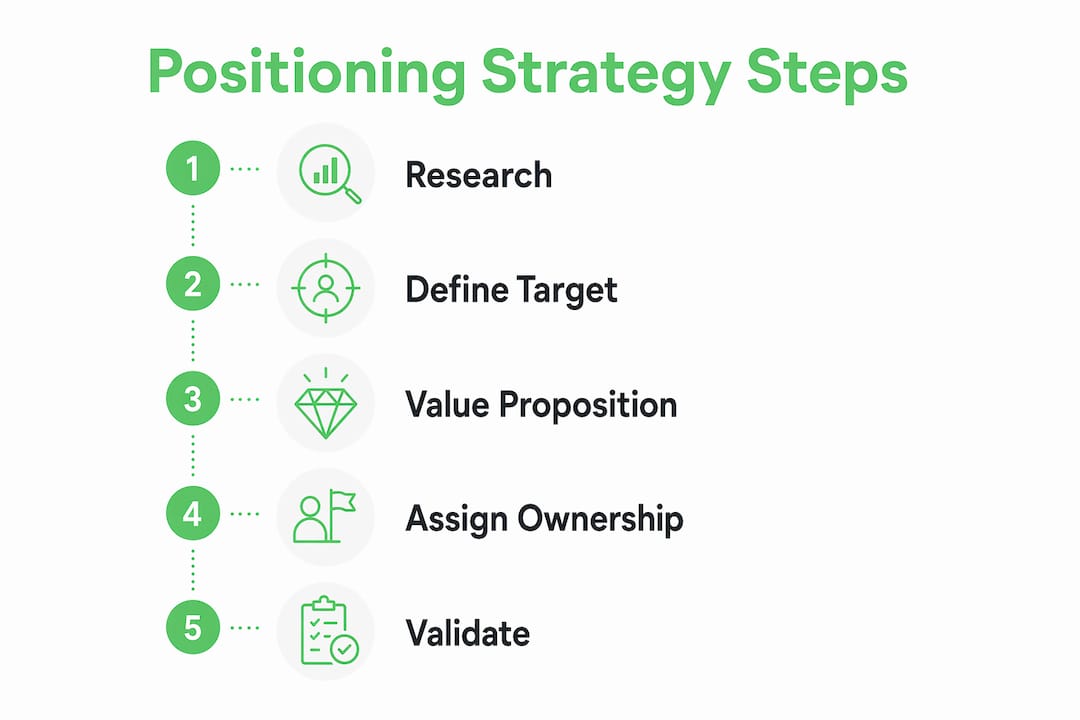
Developing strong positioning follows a clear process. Skipping steps produces vague results that fail in the market.
Step 1: Research your market and customers
Start with primary research. Interview current customers, lost prospects, and people who chose a competitor. Ask what problem they were solving, what alternatives they considered, and what made them decide. This data reveals how customers actually categorize your product, which is often different from how you describe it internally.
Step 2: Define your target customer with specificity
Forced specificity in positioning is critical. Broad appeals dilute a brand’s competitive edge. Define your target customer by role, industry, company size, behavior, or situation. The goal is not to exclude everyone else. The goal is to be the obvious choice for one defined group.
Step 3: Articulate your differentiated value
Write one sentence that names your target customer, the category you compete in, and the single most important reason you are better than the alternatives. Test this sentence with real customers. If they do not immediately recognize themselves and their problem in it, revise it.
Step 4: Assign ownership and validate
Assigning product marketing ownership prevents positioning drift and inconsistent messaging. One person or team must own the positioning document and have authority to enforce it across sales, marketing, and product. Leadership validation is not optional. Without executive buy-in, positioning collapses the moment a sales leader rewrites the pitch deck.
Common positioning pitfalls to avoid
- Positioning to everyone, which means positioning to no one
- Basing positioning on internal assumptions rather than customer research
- Treating positioning as a one-time exercise rather than a living document
- Letting sales or product teams create their own parallel positioning
- Confusing a tagline or slogan with a positioning statement
- Copying a competitor’s position instead of finding an uncontested space
- Failing to update positioning when the market or product changes significantly
Positioning rooted in research and testing keeps product development aligned with customer needs and market realities. Businesses that revisit their positioning annually outperform those that treat it as a launch-day document.
Key Takeaways
Market positioning is the single strategic decision that determines whether every marketing dollar you spend works together or pulls in different directions.
| Point | Details |
|---|---|
| Core definition | Positioning defines where your brand sits in the customer’s mind relative to alternatives. |
| Three components | Every position requires a target audience, a market category, and a differentiated value claim. |
| Distinct from messaging | Positioning is the strategy; messaging is how you communicate that strategy to the market. |
| Business impact | Strong positioning builds pricing power, loyalty, and marketing efficiency. |
| Ownership matters | Assign one team to own and enforce positioning to prevent drift across departments. |
The part most businesses skip entirely
Most businesses I work with have messaging. They have a website, a pitch deck, and a social media presence. What they rarely have is a positioning document. They have never written down, in one place, who they serve, what category they compete in, and why they win. That absence shows up everywhere: in sales calls that go off script, in ads that attract the wrong customers, and in marketing teams that rebuild their strategy from scratch every quarter.
The uncomfortable truth about brand positioning is that it requires saying no. No to certain customer segments. No to certain use cases. No to the instinct to appeal to as many people as possible. Vague positioning fails to stand out and weakens brand visibility among ideal customers. Every business owner I have spoken to understands this intellectually. Very few act on it.
A positioning document is a single-page strategic document influencing product development, sales strategies, pricing, and marketing messaging. When it exists and leadership enforces it, sales cycles shorten. Marketing teams produce work that feels coherent. Customers refer others because they can articulate what the brand does and for whom. That compounding effect is the real return on positioning investment. Prioritize it before the next campaign, not after.
— Steel
How Punchvirtualmanager helps you build a clear market position
Knowing what market positioning is and building one that works in your market are two different challenges. Punchvirtualmanager brings both strategic clarity and execution capability to businesses across South Africa.
Punchvirtualmanager’s digital marketing services are built around data-driven decision making, which means every campaign starts from a defined position rather than guesswork. The agency’s 99% advertising success rate reflects what happens when positioning and execution align. Whether you need to define your position from scratch or communicate it more effectively across channels, the team at Punchvirtualmanager provides the guidance and support to get there. Explore the available marketing packages to find the right fit for your business goals.
FAQ
What is the definition of market positioning?
Market positioning is the deliberate choice of where a product or brand sits in a customer’s mind relative to alternatives. It answers what the product is, who it serves, and why it is better than the competition.
How does market positioning differ from brand positioning?
Market positioning focuses on where a specific product competes in its category. Brand positioning operates at a broader level, defining the emotional identity and long-term values of the entire organization.
Why is market positioning important for small businesses?
Clear positioning directs marketing spend toward the customers most likely to convert, which reduces waste and increases return on investment. It also prevents price-only competition by giving customers a reason to choose beyond cost.
What are the main types of market positioning strategies?
The most common types are quality-based, price-based, usage-based, niche-based, and emotional positioning. The right choice depends on what your defined target customer values most.
How often should a business update its positioning?
Positioning should be reviewed at least once a year and whenever a significant product change, market shift, or new competitor enters the space. Treating positioning as a static document leads to drift between what the brand promises and what it delivers.