
Omnichannel branding is defined as the practice of delivering a cohesive brand experience across every customer touchpoint, both online and offline, so the brand is perceived consistently as customers move between channels. This means aligning visual identity, messaging, tone, and service quality so that a customer who sees your Instagram ad, visits your website, and walks into your store encounters the same brand. The industry term for this practice is omnichannel marketing, and it goes well beyond simply being present on multiple platforms. Brands like Nike, Starbucks, and Sephora have built their reputations on this model, using integrated systems to carry customer context from one channel to the next. For marketing professionals and brand managers, understanding what omnichannel branding means in practice is the starting point for building real customer loyalty.
What is omnichannel branding vs. multichannel branding?
Omnichannel and multichannel branding are not the same thing, and the difference matters more than most brand managers expect. Multichannel branding maintains separate channel strategies, meaning each platform operates with its own messaging, visuals, and customer experience. The result is fragmentation. A customer might receive a promotional email that contradicts the offer shown on the website, or find that the in-store staff has no record of their online purchase history.
Omnichannel branding synchronizes all touchpoints into a single, connected customer journey. The brand experience does not restart every time a customer switches channels. Instead, context carries forward, and the messaging stays consistent.

| Factor | Multichannel branding | Omnichannel branding |
|---|---|---|
| Channel strategy | Independent per channel | Unified across all channels |
| Messaging | May vary by platform | Consistent and coordinated |
| Customer data | Siloed per channel | Shared and centralized |
| Customer experience | Fragmented | Connected and continuous |
| Brand recognition | Inconsistent | Reinforced at every touchpoint |
The practical impact of this distinction shows up in customer loyalty. When a brand delivers a connected experience, customers recognize it faster and trust it more. When the experience is fragmented, brand recognition weakens and customers are more likely to disengage. Multichannel gives you reach. Omnichannel gives you retention.
Key elements of a strong omnichannel brand strategy
Effective omnichannel branding rests on four core elements: visual consistency, messaging alignment, unified customer data, and cross-team governance. Each one is necessary. Skipping any of them produces gaps that customers notice, even if they cannot name exactly what feels off.
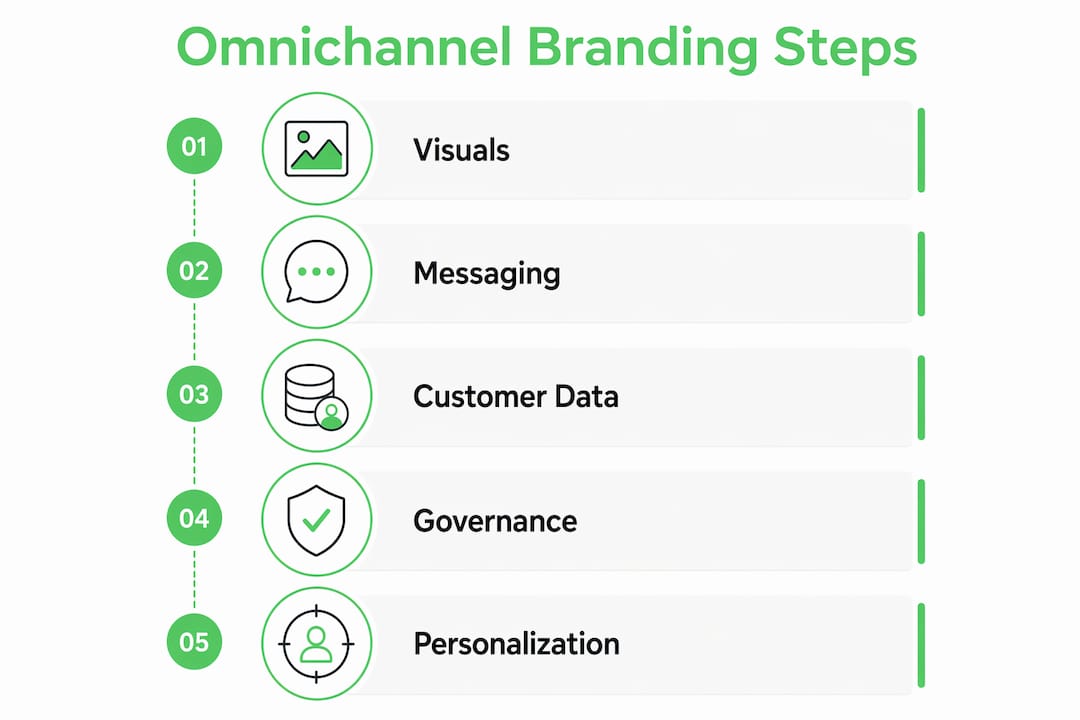
Visual and messaging consistency means your logo, color palette, typography, and brand voice appear the same way on your website, your app, your social media profiles, and your physical locations. Salesforce identifies brand guidelines for identity and messaging as the foundation for maintaining consistent look, feel, and tone across digital and offline channels. Without a documented brand guide, individual teams make their own decisions, and drift happens fast.
Unified customer data is what separates a truly connected experience from a coordinated-looking one. When your CRM, e-commerce platform, and customer service system share data, a store associate can see that a customer browsed a product online but did not purchase. That context changes the conversation entirely.
Cross-team governance is the operational layer that holds everything together. Shopify’s research on omnichannel experience confirms that coordinating channel owners around journey stages prevents branding and messaging drift even at scale. This means assigning clear ownership for each channel while requiring those owners to align on shared brand definitions.
Key elements to document in your brand governance framework:
- Logo usage rules and approved color codes
- Tone of voice guidelines with examples for each channel type
- Approved messaging for core campaigns, broken down by channel
- Escalation paths when channel messaging conflicts arise
- Review cadence for brand audits across all active touchpoints
Pro Tip: Map your customer journey before you write a single brand guideline. Identify every touchpoint a customer uses from awareness to purchase to support, then assign a channel owner to each stage. This prevents the common mistake of building guidelines in isolation from how customers actually move through your brand.
How does customer data drive omnichannel personalization?
Personalization is what makes omnichannel branding feel relevant rather than just consistent. Consistent branding builds recognition. Personalized branding builds relationships. The two work together, but data is the engine behind both.
Salesforce research shows that integrated customer data and a unified view enable personalized and consistent messaging across touchpoints, allowing service agents and store associates to have context from online interactions. That context is what lets a brand pick up a conversation where it left off, rather than starting from zero every time a customer switches channels.
A practical approach to data-driven omnichannel personalization follows four steps:
- Consolidate data sources. Connect your CRM, website analytics, e-commerce platform, email marketing tool, and point-of-sale system into a single customer view. Platforms like Salesforce Marketing Cloud and HubSpot are built for this purpose.
- Segment by behavior, not just demographics. A customer who browsed running shoes three times but did not buy needs a different message than one who purchased last week. Behavioral data produces more relevant personalization than age or location alone.
- Carry context across channels. When a customer abandons a cart online, the next touchpoint, whether email, SMS, or in-store, should reference that specific action. Qualtrics notes that customers expect to pick up where they left off, whether online, in-store, or via customer service.
- Test and refine messaging by channel. Personalization is not a one-time setup. Review which messages perform best on each channel and adjust the data rules that trigger them.
Pro Tip: Start with one high-traffic customer journey, such as cart abandonment or post-purchase follow-up, and build your data integration around that single flow. Proving value on one journey makes it easier to get budget and buy-in for broader integration.
Common pitfalls in omnichannel branding execution
Most omnichannel branding failures come from the same set of avoidable mistakes. Recognizing them early saves significant time and budget.
Salesforce research is direct on this point: omnichannel branding often fails when teams focus only on creative consistency without aligning customer journey mechanics like hand-offs and message timing across channels. A brand can have a perfect style guide and still deliver a broken experience if the systems behind the scenes do not communicate.
The most common pitfalls brand managers encounter include:
- Siloed teams. When the social media team, the email team, and the in-store team operate without shared visibility into campaign timing or customer status, they send conflicting messages. A customer who just received a loyalty reward email should not receive a generic acquisition offer the same afternoon.
- Inconsistent data access. If your customer service team cannot see a customer’s online purchase history, they cannot deliver a connected experience. Data access is a branding issue, not just a technical one.
- Treating all channels as equal. Each channel has its own format, audience behavior, and context. Omnichannel branding does not mean posting the same content everywhere. It means adapting the same core message to fit each channel’s format while keeping the brand identity intact.
- No brand audit process. Without regular reviews, channels drift. A quarterly audit of all active touchpoints against your brand guidelines catches inconsistencies before customers do.
The solution to most of these pitfalls is centralized brand governance combined with cross-functional alignment meetings. When channel owners meet regularly around shared journey stages, the coordination problems that cause brand drift become visible and fixable.
How do you measure the impact of omnichannel branding?
Measuring omnichannel branding requires tracking both brand-level metrics and customer experience metrics together. Neither set tells the full story on its own.
Shopify’s research confirms that consistent branding across all channels reinforces brand identity, builds customer loyalty, and increases brand awareness with potential customers. The business case for omnichannel branding is clear. The challenge is attributing results to specific branding decisions rather than campaign spend.
| Metric | What it measures | Why it matters for omnichannel branding |
|---|---|---|
| Customer satisfaction score (CSAT) | Quality of individual interactions | Shows whether channel experiences meet expectations |
| Net Promoter Score (NPS) | Overall brand loyalty | Reflects cumulative brand perception across all touchpoints |
| Cross-channel conversion rate | Purchases that span multiple channels | Indicates how well channels hand off to each other |
| Brand recall rate | Unprompted brand recognition | Measures the strength of consistent visual and messaging identity |
| Customer retention rate | Repeat purchase behavior | Tracks long-term loyalty driven by connected experiences |
Track these metrics by channel and in aggregate. A drop in CSAT on one channel while NPS holds steady often signals a localized execution problem rather than a brand strategy failure. That distinction matters when you are deciding where to invest resources.
Key Takeaways
Omnichannel branding requires integrating visual identity, customer data, and cross-team governance to deliver connected experiences that build lasting brand loyalty.
| Point | Details |
|---|---|
| Definition is specific | Omnichannel branding aligns visuals, messaging, tone, and service across every channel, not just presence on multiple platforms. |
| Omnichannel beats multichannel | Multichannel gives reach; omnichannel gives retention through connected, continuous customer journeys. |
| Data is the foundation | Unified customer data lets brands carry context across channels and deliver relevant personalization at each touchpoint. |
| Governance prevents drift | Centralized brand guidelines and cross-functional alignment stop messaging inconsistencies before they reach customers. |
| Measure both brand and experience | Track NPS, CSAT, cross-channel conversion, and brand recall together to assess the full impact of your omnichannel strategy. |
Why most brands get omnichannel branding wrong
The brands I see struggle most with omnichannel branding are not the ones with weak creative. They are the ones with strong creative and broken operations behind it. A beautifully consistent visual identity means very little if the customer service team is working from a different system than the e-commerce team, and neither one knows what the email team sent last Tuesday.
The real work of omnichannel branding is organizational, not aesthetic. Getting your social media marketing to match your in-store experience requires people from different departments to agree on shared definitions, shared data, and shared timelines. That is a governance problem, not a design problem.
My advice to brand managers starting this process: resist the urge to build the perfect brand guide first. Instead, map one complete customer journey from first touchpoint to post-purchase, identify every hand-off point, and ask who owns each one. The gaps you find in that exercise will tell you exactly where your omnichannel branding breaks down. Fix the hand-offs before you refine the typography.
Brands that succeed at scale treat omnichannel branding as an ongoing operational discipline, not a one-time creative project. The ones that fail treat it as a style guide update.
— Steel
Punchvirtualmanager’s approach to connected brand experiences
Building a consistent brand across every channel requires both the right strategy and the right execution partner. Punchvirtualmanager works with businesses to align their digital marketing, web presence, and messaging into a connected system that customers recognize at every touchpoint.

From data-driven digital marketing that integrates customer behavior across channels to tailored digital marketing packages designed around your specific brand goals, Punchvirtualmanager brings the cross-channel expertise that omnichannel branding demands. The agency’s 99% advertising success rate reflects what happens when consistent messaging meets coordinated execution. If you are ready to build a brand experience that holds together across every channel, Punchvirtualmanager is the place to start.
FAQ
What is omnichannel branding in simple terms?
Omnichannel branding is the practice of delivering the same brand experience, including consistent visuals, messaging, and service quality, across every channel a customer uses. The goal is for customers to recognize and trust your brand whether they engage online, in-store, or through customer service.
How does omnichannel branding differ from multichannel branding?
Multichannel branding uses separate strategies for each channel, which often creates fragmented experiences. Omnichannel branding connects those channels so the customer journey is continuous and the brand identity stays consistent throughout.
Why is brand consistency important in omnichannel marketing?
Consistent branding across all channels reinforces brand identity, builds customer loyalty, and increases brand awareness. Without consistency, customers receive mixed signals that weaken recognition and reduce trust.
What data do you need for omnichannel branding?
Effective omnichannel branding requires a unified customer view that combines data from your CRM, e-commerce platform, email system, and point-of-sale tools. This shared data lets every channel carry context from previous customer interactions.
What metrics measure omnichannel branding success?
The most useful metrics are Net Promoter Score, customer satisfaction score, cross-channel conversion rate, brand recall rate, and customer retention rate. Tracking these together gives a complete picture of how well your brand experience holds across channels.
Recommended
- Digital Marketing Packages – Punch Virtual Manager
- Social Media Marketing – Punch Virtual Manager
- Data-Driven Digital Marketing Services for Business Growth – Punch Virtual Manager
- The Comprehensive SEO Audit Blueprint: Critical Technical, On-Page, and Off-Page Elements for Sustainable Organic Visibility – Punch Virtual Manager