
Remarketing is a digital marketing strategy that re-engages people who have already visited your website, used your app, or interacted with your brand but did not complete a desired action, such as making a purchase. Rather than starting from scratch with cold audiences, remarketing builds on existing familiarity by delivering personalized messages through channels like email, SMS, and display ads on platforms including Google Ads, Meta Ads, and Amazon Ads. The goal is straightforward: bring warm leads back and give them a reason to convert.
Remarketing works across several owned and paid channels:
- Email and SMS to re-engage past visitors using first-party data from CRM lists or sign-ups
- Display ads served through the Google Display Network to previous site visitors as they browse other websites
- Social ads on Meta Ads targeting users who engaged with your brand’s page or website
- Amazon Ads reaching shoppers who viewed your products but did not purchase
- Push notifications for app users who dropped off before completing an action
The strategy relies heavily on first-party data, meaning information your business collects directly from customers, rather than purchased lists or third-party sources.
What is the difference between remarketing and retargeting?
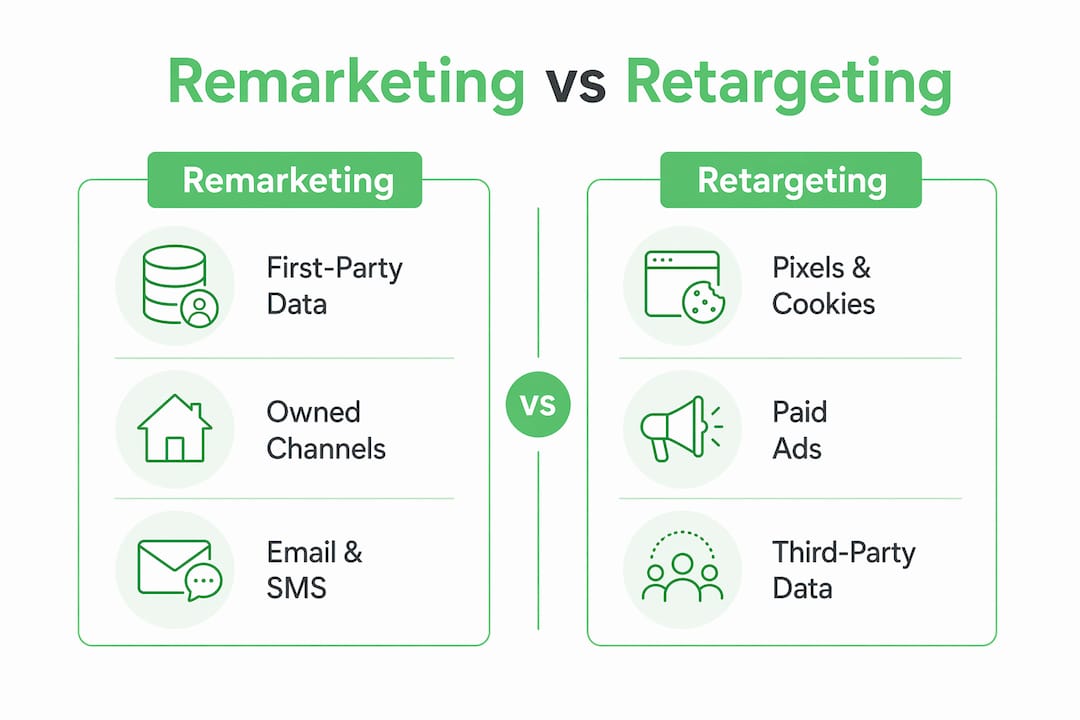
The two terms are often used interchangeably in 2026, but they describe different approaches. Understanding the distinction helps you build a more coordinated campaign.
Remarketing vs retargeting breaks down like this:
- Remarketing is the broader strategy. It uses owned channels (email, SMS, direct mail) and first-party data such as CRM lists, email subscribers, and past purchase behavior to re-engage existing or past customers.
- Retargeting is a subset of remarketing. It uses paid ad platforms like Google Ads, Meta Ads, and LinkedIn, along with third-party data from cookies, tags, or pixels, to reach prospective customers who visited your site.
A practical example: a visitor browses your product page and leaves without buying. Retargeting serves that person a display ad on another website they visit later. Remarketing sends them a follow-up email with a discount code. Both tactics pursue the same person through different channels, and effective strategies use both in coordination. Retargeting ads bring visitors back to your site; remarketing emails nurture leads who have shown interest but have not yet converted.
The key difference comes down to data source and channel. Retargeting depends on pixels and cookies placed on your site. Remarketing draws from data your business already owns.

How does remarketing work with pixel tags and audience lists?
Remarketing relies on two core technical mechanisms: pixel tags and audience lists. Together, they allow ad platforms to identify past visitors and serve them relevant ads.
- Pixel tags are small snippets of code placed on your website. When a visitor lands on a page, the pixel fires and stores a cookie in their browser, logging that visit.
- Audience lists are built from that cookie data or from first-party sources like email subscriber lists uploaded directly to Google Ads or Meta Ads.
- Ad delivery happens when a user on your list visits a site within the Google Display Network or scrolls through Meta, triggering your ad to appear.
Pixel tracking enables platforms like the Google Display Network and Meta to recognize users and serve targeted ads on partnered sites. You can customize the pixel code for different pages, so a visitor who viewed a specific product category sees ads relevant to that category rather than a generic brand message.
Dynamic remarketing takes this further. Rather than showing a standard ad, dynamic ads display the exact products a visitor viewed or left in their cart, pulling details like product images, names, and prices directly from your product feed. Google Ads supports this through its dynamic remarketing tag combined with a product or service feed uploaded to Google Merchant Center.
Privacy regulations, including GDPR in Europe and evolving cookie restrictions in the United States, are pushing marketers toward first-party data. Pixel tags and cookies remain useful, but modern remarketing increasingly relies on user consent mechanisms and first-party audience lists to stay compliant.
Key insight: Dynamic remarketing consistently outperforms static ads in relevance because it shows visitors exactly what they already expressed interest in, rather than a generic brand message.
What are the key business benefits of remarketing?
Remarketing delivers measurable advantages across the customer journey, from awareness through to conversion and loyalty.
- Higher conversion rates. Visitors who already know your brand are more likely to convert than cold audiences. Remarketing targets warm leads who have already demonstrated interest.
- Cart abandonment recovery. Abandoned cart emails sent 1–3 hours, 24 hours, and 72 hours after abandonment are among the most effective recovery tools available. Typical cart abandonment retargeting conversion rates range from 3% to 8%.
- Improved return on investment. Email remarketing delivers the highest ROI of any retargeting channel, particularly for abandoned cart recovery sequences sent at strategic intervals.
- Brand awareness and loyalty. Repeated exposure across multiple channels keeps your brand top of mind during a shopper’s consideration phase, even when they are not ready to buy immediately.
- Relevant, less intrusive advertising. Segmented remarketing, where ads reflect a visitor’s specific browsing behavior, feels more like a helpful reminder than an interruption.
Remarketing also supports multi-channel engagement. A visitor might see a display ad on a news site, receive a follow-up email the next day, and encounter a social ad two days later. That coordinated sequence, built around omnichannel branding, reinforces your message without requiring the visitor to return to your site on their own initiative.
Amazon Ads highlights another dimension: remarketing can move shoppers through the funnel by including messaging about unique product features or promotional codes, addressing hesitation rather than simply repeating the same brand impression.

How to run an effective remarketing campaign in 2026
Executing a remarketing campaign involves several concrete steps, and the order matters.
- Tag your website. Install a pixel tag (Google Ads tag or Meta Pixel) on all relevant pages. Customize the tag parameters for key pages such as product pages, the cart, and the checkout confirmation page.
- Build segmented audience lists. Group visitors by behavior: those who viewed a product, those who added to cart, those who reached checkout but did not complete payment. Each segment warrants a different message.
- Set up campaigns on your chosen platforms. Google Ads, Meta Ads, and Amazon Ads each have dedicated remarketing campaign types. For Google, this includes display remarketing, search remarketing using RLSA (Remarketing Lists for Search Ads), and dynamic remarketing.
- Create dynamic or personalized ad content. Use the product feed in Google Ads or a catalog in Meta Ads to serve ads featuring the exact items a visitor viewed.
- Schedule cart abandonment emails. Send the first email 1–3 hours after abandonment, a follow-up at 24 hours, and a final reminder at 72 hours. This sequence, supported by email timing research, consistently outperforms single-message recovery attempts.
- Integrate email and SMS. Remarketing is not limited to paid ads. Email and SMS sequences targeting visitors who provided contact details extend your reach through owned channels at a lower cost per contact.
- Monitor performance with the right metrics. Track conversion rate, cost per conversion, click-through rate, and return on ad spend. Reviewing digital marketing metrics regularly helps identify which audience segments and ad formats are performing and which need adjustment.
Pro Tip: Segment visitors by their exact interaction, not just by “visited the site.” A visitor who reached the checkout page is far closer to converting than one who read a blog post. Tailor your ad copy and offer accordingly, and you will spend less while converting more.
Privacy and consent in remarketing
Consent is not optional. GDPR in Europe requires explicit user consent before placing tracking cookies. In the United States, state-level privacy laws such as the California Consumer Privacy Act (CCPA) set similar expectations. Practically, this means your site needs a clear cookie consent banner, and your remarketing audiences should be built only from users who opted in.
Transparent ad controls and personalized, helpful content are the two factors most likely to maintain user trust in remarketing. Ads that feel relevant and respectful of the user’s browsing context perform better and generate fewer negative reactions than generic, repetitive placements. Frequency capping, which limits how many times a user sees the same ad within a set period, is a practical tool for avoiding ad fatigue.
Businesses that avoid common digital marketing mistakes, including ignoring consent requirements or failing to segment audiences, tend to see stronger long-term results from their remarketing programs.
Key Takeaways
Remarketing re-engages past visitors using first-party data across email, SMS, and paid ad platforms, making it one of the most cost-efficient conversion strategies available to businesses in 2026.
| Point | Details |
|---|---|
| Remarketing vs retargeting | Remarketing uses owned channels and first-party data; retargeting uses paid ads and pixel-based third-party data. |
| Cart abandonment timing | Recovery emails sent at 1–3 hours, 24 hours, and 72 hours post-abandonment achieve the highest conversion rates, with typical conversion rates ranging from 3% to 8%. |
| Dynamic ads outperform static | Showing visitors the exact products they viewed drives stronger relevance and higher click-through rates. |
| Segmentation is critical | Grouping visitors by specific behavior, not just site visits, produces more relevant ads and better ROI. |
| Privacy compliance is required | GDPR and CCPA require user consent before tracking; first-party data is the foundation of compliant remarketing. |
Ready to put remarketing to work for your business? Punchvirtualmanager offers data-driven digital marketing services designed to help businesses build, launch, and measure remarketing campaigns that deliver real results. From pixel setup to audience segmentation and multi-channel execution, the team provides the expertise and ongoing support your campaigns need to perform.

Explore lead generation through remarketing or review Punchvirtualmanager’s digital marketing packages to find the right fit for your goals.