
Effective debt management preserves cash flow, lowers interest costs, and protects your ability to borrow in the future — and for small business owners, those three outcomes directly determine whether growth is possible or just theoretical. When debt service consumes a disproportionate share of monthly revenue, the business loses its ability to hire, market, or absorb unexpected costs. The practical starting point is straightforward: build a complete debt inventory and run a 30–90 day cash-flow forecast before doing anything else.
Why it matters right now:
- Debt management stabilizes cash flow, reduces interest expense, and protects credit scores, freeing revenue to reinvest in growth rather than debt service.
- A formal Debt Management Plan (DMP) can last 48 months or more, so understanding the commitment before enrolling is critical.
- Consistent repayment behavior correlates with measurable improvements in mental health and professional productivity, according to large-sample research.
Table of Contents
- How does debt affect your day-to-day business operations?
- What does a Debt Management Plan actually look like in the U.S.?
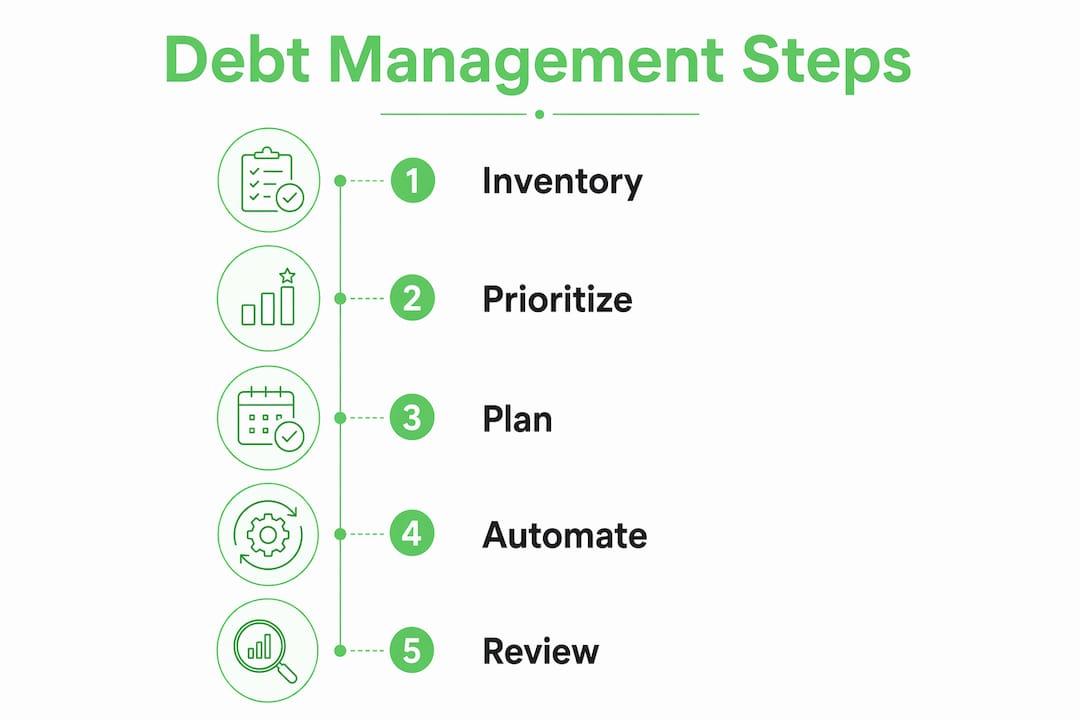
- A 7-step checklist small business owners can act on today
- When should you hire a financial consultant or virtual CFO?
- How the psychology of repayment shapes your results
- Key Takeaways
- The case for fixing finances before scaling growth
- Punchvirtualmanager’s financial forecasting and debt-strategy support
- Trusted sources and further reading
How does debt affect your day-to-day business operations?
Debt service pressure shows up in operating decisions long before a business approaches insolvency. When a significant portion of monthly revenue goes toward loan repayments and interest, working capital shrinks. That means delayed supplier payments, reduced inventory orders, and a marketing budget that gets cut first because it feels discretionary. For a small business trying to grow, those cutbacks compound: fewer marketing dollars produce fewer leads, which reduces revenue, which makes debt harder to service.
High-interest debt accelerates this cycle. Interest charges compound by adding to the principal balance, so a business carrying high-rate credit card debt or short-term loans pays interest on interest each month. High-interest obligations can exceed the return on any investment the business might otherwise make, which is why prioritizing high-interest repayment is a foundational principle of sound financial planning.
Repayment behavior also shapes credit scores and future borrowing costs. Late or missed payments lower credit scores, which either closes off future credit entirely or forces the business to borrow at higher rates. That feedback loop is one reason why the FTC’s guidance on debt management emphasizes contacting creditors early rather than avoiding them.
Operational effects owners commonly experience:
- Paused hiring because payroll risk feels too high alongside debt obligations
- Reduced ad spend, which cuts lead generation at exactly the wrong time
- Supplier payment delays that damage trade relationships and credit terms
- Difficulty qualifying for a business line of credit when it’s most needed
Statistic callout: Research linking smart-money habits to mental health found that consistent repayment and saving behaviors produce measurable improvements in energy, focus, and professional relationships — outcomes that translate directly into business performance.
What does a Debt Management Plan actually look like in the U.S.?
A Debt Management Plan is a structured repayment program administered by a nonprofit credit counseling agency. The agency negotiates with creditors on your behalf to reduce interest rates, waive late fees, and consolidate multiple unsecured balances into a single monthly payment. According to the FTC, DMPs cover unsecured debts such as credit cards; they do not apply to secured debts like mortgages or vehicle loans.

The typical DMP commitment runs several years. During that period, the creditor may require you to stop using existing credit lines, and some accounts may be closed, which can temporarily lower your credit score. Over time, consistent on-time payments through the plan tend to improve credit, as the NCOA notes. The key is staying current throughout the plan’s duration.
Comparing the main debt-relief options:
| Option | How it works | Requires new credit? | Best for |
|---|---|---|---|
| Debt Management Plan (DMP) | Counselor negotiates with creditors; one monthly payment | No | Unsecured debt; steady income |
| Debt consolidation loan | New loan pays off existing debts | Yes | Good credit; multiple balances |
| Debt settlement | Negotiates lump-sum payoff below balance | No | Severe hardship; last resort |
| Bankruptcy | Legal discharge or restructuring | No | Overwhelming debt; no viable repayment path |
The CFPB is clear that choosing the wrong route can worsen outcomes. Debt settlement, for example, typically requires stopping payments while negotiating, which damages credit and may trigger lawsuits. Consolidation requires access to new credit, which may not be available if scores are already low.
For business owners who mix personal and business debt, the SBA recommends formalizing separate accounts and repayment plans to improve creditworthiness and simplify creditor negotiations. That separation also matters when preparing documentation for lenders or investors.
A 7-step checklist small business owners can act on today
- Build a complete debt inventory. List every obligation, business and personal, secured and unsecured. Record the creditor, balance, interest rate, minimum payment, and due date. Separate columns for business versus personal debt matter for both tax and negotiation purposes.
- Run a 30–90 day cash-flow forecast. Identify where payment pressure concentrates and what repayment capacity actually exists. A financial forecasting guide can help structure this if you haven’t done it before.
- Prioritize by interest rate and business criticality. Payroll obligations and secured loans where default triggers asset loss come first. High-interest unsecured debt comes next. Minimum payments on everything else maintain standing while you focus resources.
- Contact creditors or a nonprofit credit counselor early. When unsecured balances dominate, ask about DMP options. Document every agreement in writing. Creditors are more cooperative when contacted proactively rather than after missed payments.
- Automate minimum and plan payments. Set up automatic transfers to a dedicated debt-payments account so operational chaos doesn’t cause missed deadlines.
- Build a small emergency fund alongside repayment. One to three months of core operating costs prevents the cycle of re-borrowing to cover unexpected expenses. Even a modest buffer changes the risk profile significantly.
- Track outcomes monthly and reforecast. Adjust the plan as balances change. Celebrate cleared accounts — those wins build momentum for the longer obligations.
Pro Tip: Set up a separate bank account labeled “Debt Payments” and automate transfers into it on payday. Treating debt service as a fixed, pre-committed expense removes the decision friction that causes missed payments during busy operational periods. Practitioners consistently cite automation as one of the highest-impact tactics for small businesses managing multiple obligations.
Debt inventory spreadsheet columns to include: Creditor name | Account type (secured/unsecured) | Business or personal | Current balance | Interest rate | Minimum payment | Due date | Notes (e.g., DMP enrolled, negotiation pending).
When should you hire a financial consultant or virtual CFO?
DIY steps work well when debt is manageable, cash flow is predictable, and creditor relationships are straightforward. The calculus changes when any of the following apply:
- Persistent liquidity shortfalls despite cutting costs
- Complex creditor negotiations involving multiple parties or secured assets
- Mixed personal and business debt requiring legal or structural separation
- A need for credible financial forecasts to present to lenders or investors
A financial consultant or virtual CFO typically handles cash-flow forecasting, creditor negotiation support, DMP facilitation, budgeting, and preparing lender-ready summaries. Fee structures vary: hourly engagements suit short-term rescue work, while monthly arrangements fit ongoing advisory needs. For owners who are uncertain, a short-term diagnostic project is a low-risk way to assess fit before committing to a longer engagement.
Questions to ask any candidate: Have you worked with small businesses on DMP facilitation or creditor negotiations? Can you share examples of negotiated outcomes? What does your forecasting template look like, and how often do you update it? Can you provide references from businesses at a similar stage?
Red flags to watch for:
- Guarantees of specific settlement amounts before reviewing your financials
- Instructions to stop all payments immediately as a negotiation tactic
- High upfront fees before any work is completed
- Pressure to sign long-term contracts before a diagnostic phase
How the psychology of repayment shapes your results
Debt repayment behavior is as important as the math. A technically optimal repayment plan fails if the owner loses motivation six months in. Structuring early wins, specifically eliminating one small, high-interest account first, builds the confidence that sustains longer-term discipline.
Two repayment frameworks address this differently. The avalanche method targets the highest-interest debt first, minimizing total interest paid over time. The snowball method targets the smallest balance first, generating faster visible progress. Neither is universally superior; the right choice depends on whether the owner is more motivated by financial efficiency or psychological momentum.
Practical behavioral tactics:
- Use a visual progress tracker (a simple spreadsheet or a whiteboard chart) to make repayment progress tangible
- Automate payments to remove the weekly decision of whether to pay or defer
- Schedule a monthly 30-minute review to update balances and reforecast
Pro Tip: Track one metric that feels meaningful to you personally, such as the percentage of high-interest debt eliminated in the past 90 days. A single, owner-defined metric is easier to maintain than a complex dashboard, and seeing it move creates the momentum that keeps the plan on track.
Research confirms that consistent repayment and saving habits reduce financial stress and improve mental clarity, which in turn supports better business decision-making.
Key Takeaways
Effective debt management is the foundation of business financial health: it stabilizes cash flow, reduces total borrowing costs, and creates the capacity to invest in growth rather than service obligations indefinitely.
| Point | Details |
|---|---|
| Start with a debt inventory | List every obligation with balance, rate, and due date before making any repayment decisions. |
| Forecast cash flow first | A 30–90 day forecast reveals payment pressure points and realistic repayment capacity. |
| DMPs cover unsecured debt only | Plans typically run 48 months or more and do not apply to mortgages or vehicle loans. |
| Automate to protect consistency | Automated payments to a dedicated account prevent missed deadlines during operational chaos. |
| Punchvirtualmanager offers remote support | Financial forecasting, debt strategy, and virtual CFO services are available for businesses that need structured outside help. |
The case for fixing finances before scaling growth
The conventional advice is to grow your way out of debt. Spend more on marketing, generate more revenue, and use the surplus to pay down obligations. In practice, this sequence often fails. Marketing spend without predictable cash flow produces inconsistent campaigns, and inconsistent campaigns produce poor return on investment. The debt doesn’t shrink; the marketing budget gets blamed.
The more defensible sequence is the reverse: stabilize cash flow first, then allocate a defined and protected marketing budget. When a business clears a high-rate liability, the freed monthly cash can be directed toward a focused, measurable marketing test rather than spread thinly across channels. That test produces data. Data justifies the next investment. The common marketing mistakes that drain small business budgets are far more likely to occur when financial pressure forces reactive, underfunded campaigns. Punchvirtualmanager’s combined finance and marketing capability exists precisely for this sequence: get the numbers right, then scale the growth.
Punchvirtualmanager’s financial forecasting and debt-strategy support
When financial pressure is real and the to-do list is long, having a structured outside perspective changes outcomes. Punchvirtualmanager provides financial forecasting and accounting services designed for small businesses that need clarity on cash flow, debt position, and growth capacity without the overhead of a full-time CFO.
The engagement starts with a diagnostic: a structured review of your current debt obligations, cash-flow position, and financial forecasting gaps. From there, the team can support creditor documentation, monthly forecasting, and budget alignment between debt service and digital marketing investment. The goal is a financial picture clear enough to make confident decisions about where to cut, where to hold, and where to grow. To get started, visit the finance and accounting services page and request an initial consultation.
This article provides general financial information for educational purposes. It is not a substitute for professional financial, legal, or tax advice. Readers should verify current U.S. regulations and consult a qualified professional for guidance specific to their situation.
Trusted sources and further reading
The guidance in this article follows U.S. frameworks. Readers outside the U.S. should consult local counsel and financial regulators for jurisdiction-specific rules.
- How to get out of debt — Federal Trade Commission (FTC): consumer rights, DMP guidance, and debt-collector rules
- What is a debt relief program? — Consumer Financial Protection Bureau (CFPB): differences between consolidation, DMPs, and settlement
- 5 ways to separate your personal and business finances — U.S. Small Business Administration (SBA): practical steps for financial separation and creditworthiness
- What is a debt management plan? — National Council on Aging (NCOA): balanced overview of DMP trade-offs
- Smart debt management for small businesses — American Bank: practitioner-focused tactics including payment automation
- Study linking smart-money habits and mental health — Money.com: large-sample research on repayment behavior and wellbeing