
Mobile marketing is defined as any promotional activity delivered to customers through smartphones, tablets, or other mobile devices, and it is the dominant digital channel for customer engagement in 2026. Over 70% of global digital traffic originates from mobile devices, which means your customers are already on mobile before they ever reach your website. That figure is not a trend. It is the baseline reality for every small business operating online. Google’s mobile-first indexing means your search rankings depend primarily on how your site performs on a phone screen. Understanding why mobile marketing matters is the first step toward building a growth strategy that actually reaches people where they spend most of their time.
Why mobile marketing matters more than any other digital channel
The performance gap between mobile and desktop marketing is measurable and significant. SMS marketing achieves open rates of up to 98%, compared to roughly 25% for email. That gap means a text message is nearly four times more likely to be read than an email sent to the same customer.
Push notifications deliver click-through rates of 4–8%, while non-segmented email campaigns average just 1–2%. The difference comes from timing and context. Push notifications reach customers on a device they check constantly, at the moment the message arrives.
The revenue case is equally clear. Brands that optimize mobile experiences report up to 50% higher conversion rates and a 25–60% increase in customer lifetime value. Those are not marginal improvements. They represent the difference between a campaign that breaks even and one that funds the next quarter’s growth.
| Channel | Open or click-through rate | Key advantage |
|---|---|---|
| SMS marketing | Up to 98% open rate | Immediate visibility, no inbox competition |
| Push notifications | 4–8% click-through rate | Real-time delivery, behavior-triggered |
| Email (non-segmented) | ~25% open rate, 1–2% CTR | Low cost, broad reach |
| Desktop display ads | Below 1% CTR | Wide audience, low engagement |
Pro Tip: Combine SMS for time-sensitive offers with push notifications for behavior-triggered follow-ups. Using both together produces higher engagement than either channel alone.
How mobile user behavior creates unique marketing opportunities
Mobile is the most personal device in a customer’s daily life. It sits in a pocket, wakes up with its owner, and travels everywhere. That proximity creates a category of marketing opportunity that desktop simply cannot replicate.
The concept of micro-moments describes the brief, intent-driven interactions people have on their phones throughout the day. A customer searching “best coffee near me” at 8:00 AM is in a buying micro-moment. A business that appears in that search, with a fast-loading mobile page and a clear call to action, captures a sale that a slower or desktop-only competitor misses entirely.
Geolocation targeting makes this even more specific. A retailer can send a promotional message to customers who enter a defined geographic area around a store. That kind of contextual precision is unique to mobile and is not available through traditional digital channels.
Mobile behavioral data, including geolocation and session patterns, enables AI-driven personalization that increases both retention and average order value. The phone generates richer behavioral signals than any other device, and those signals feed personalization engines that make every message more relevant.
Mobile marketing also extends well beyond consumer audiences. Over 57% of LinkedIn traffic comes from mobile, which confirms that B2B decision-makers are just as active on their phones as retail shoppers. A mobile-focused digital marketing strategy must account for both audiences.
Key mobile behaviors that create marketing opportunities:
- Micro-moment intent: Customers search, compare, and buy in short bursts throughout the day, often without sitting at a desk.
- In-app engagement: Time spent inside apps creates natural touchpoints for in-app messaging and personalized offers.
- Social browsing: Mobile users scroll social feeds more frequently than desktop users, increasing ad exposure frequency.
- Voice search: A growing share of mobile queries are voice-based, which changes keyword structure and local SEO priorities.
- Notification responsiveness: Mobile users respond to well-timed push notifications faster than to any other digital prompt.
Pro Tip: Design every mobile message around a single action. A push notification that asks a customer to browse, share, and buy in one tap will underperform a notification that asks for one clear step.
What mobile marketing strategies should small businesses prioritize?
Small businesses often spread their marketing budget across too many channels without fully committing to any one of them. Mobile marketing rewards focus and execution quality over volume.
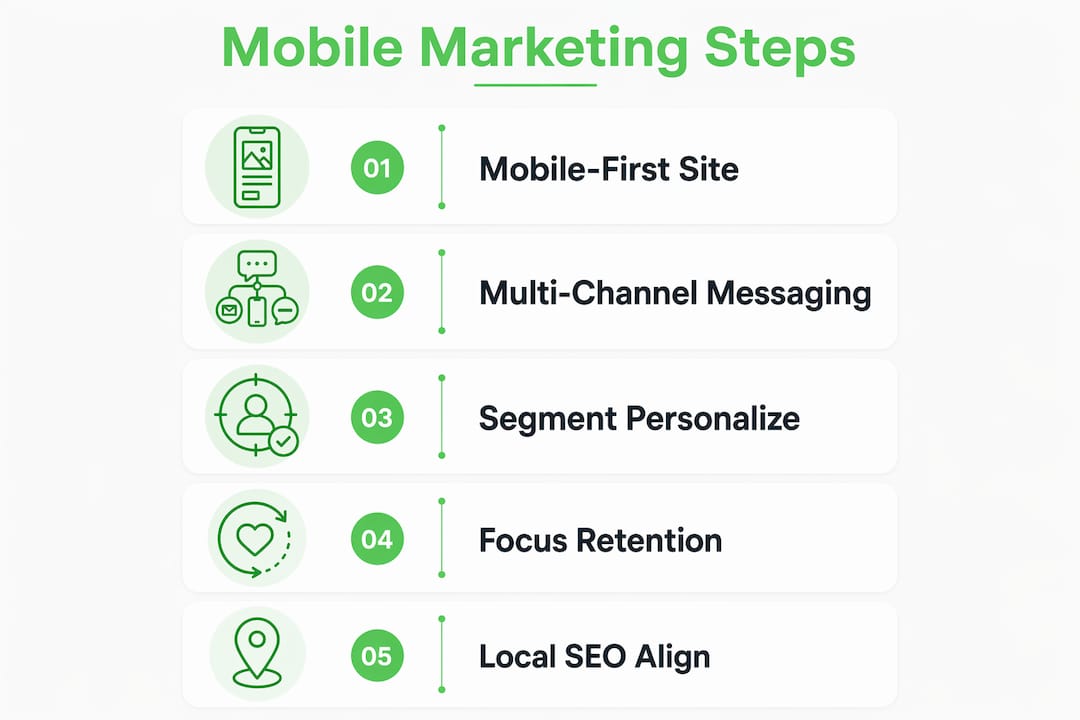
1. Build a mobile-first website
A mobile-first website is not a scaled-down desktop site. It is designed from the phone screen outward, with fast load times, large tap targets, and a checkout process that works with one thumb. Poor mobile UX, including slow load times and complicated checkout flows, creates a conversion gap where traffic is high , but revenue stays low. Fix the UX before spending on paid traffic.
2. Use multi-channel messaging flows
Combining push notifications, in-app messaging, and email as a fallback produces superior engagement compared to isolated campaigns. A practical flow looks like this: send a push notification first, follow with an in-app message if the customer opens the app, and use email as a fallback for customers who do not engage within 24 hours. Each channel catches a different segment of your audience.
3. Segment and personalize every message
Generic broadcast messages produce generic results. Segment your audience by purchase history, location, and behavior, then write messages that reflect what each group actually cares about. A customer who bought running shoes last month responds differently to a promotion than a first-time visitor browsing your homepage.
4. Focus on retention, not just acquisition
Acquiring a new customer costs significantly more than retaining an existing one. Mobile marketing excels at retention through loyalty programs, personalized reorder reminders, and exclusive app-only offers. Build lifecycle messaging flows that keep customers engaged after the first purchase, not just before it.
5. Align mobile marketing with local SEO
Local SEO and mobile optimization work together because most local searches happen on phones. A Google Business Profile with accurate hours, photos, and reviews feeds directly into the mobile search results that customers see when they are nearby and ready to buy. Treat local SEO as a mobile marketing channel, not a separate task.
How does mobile marketing connect online and offline retail?
Mobile marketing does not stop at the digital boundary. It reaches into physical stores and changes how customers behave while they shop in person.
Nearly 80% of retail customers use smartphones while shopping in stores. They check prices, read reviews, scan QR codes, and compare alternatives without leaving the aisle. This behavior, called showrooming, means your mobile presence influences in-store purchase decisions even when the customer is already standing in front of your product.
| Customer touchpoint | Mobile’s role | Business opportunity |
|---|---|---|
| Pre-visit search | Customer finds store hours and directions on mobile | Optimize Google Business Profile for mobile search |
| In-store browsing | Customer scans QR codes and checks reviews | Use QR codes to deliver mobile-exclusive offers |
| Checkout | Customer pays via mobile wallet | Accept mobile payments to reduce friction |
| Post-visit follow-up | Customer receives SMS receipt or loyalty update | Trigger retention messages based on purchase data |
The connection between mobile engagement and search rankings is also direct. Google measures engagement signals such as time on page, bounce rate, and page speed through the mobile experience. A site that performs well on mobile earns better organic rankings, which brings more mobile traffic, which generates more engagement signals. The cycle compounds over time.
Omnichannel consistency matters here. A customer who sees a promotion on a mobile ad expects to find the same offer when they walk into the store. Inconsistency between online and offline messaging erodes trust faster than almost any other mistake a small business can make.
Key Takeaways
Mobile marketing is the highest-return channel available to small businesses in 2026, and businesses that treat it as their primary channel, not a secondary one, consistently outperform those that do not.
| Point | Details |
|---|---|
| Mobile dominates digital traffic | Over 70% of global digital traffic comes from mobile, making mobile-first design non-negotiable. |
| SMS and push outperform email | SMS open rates reach 98% and push CTRs hit 4–8%, far above standard email benchmarks. |
| Mobile UX drives conversions | Fixing slow load times and checkout friction can increase conversion rates by up to 50%. |
| Retention beats acquisition | Lifecycle messaging flows on mobile keep existing customers engaged at a lower cost than acquiring new ones. |
| Mobile connects online and offline | 80% of in-store shoppers use their phones, making mobile the link between digital campaigns and physical sales. |
The mobile-first mindset most small businesses still get wrong
Most small businesses I work with treat mobile as a checkbox. They make their website “mobile-friendly” and call it done. That approach misses the point entirely.
Mobile-first means designing every customer interaction around the phone experience before thinking about anything else. It means your checkout loads in under three seconds on a mid-range Android device. It means your SMS messages arrive at 10:00 AM on a Tuesday, not at 7:00 PM on a Friday when nobody wants to hear from a brand. Timing and relevance are not nice-to-haves. They are the difference between a message that converts and one that gets deleted.
The businesses I have seen grow fastest on mobile share one habit: they obsess over what the customer is doing at the moment the message arrives. They ask, “Is this person near our store? Did they abandon a cart? Have they bought from us before?” That context shapes every word of the message. Volume without context produces unsubscribes, not sales.
The other overlooked pitfall is treating mobile marketing as separate from SEO. Your mobile page speed, your Google Business Profile, and your local keyword targeting all feed the same algorithm. A business that fixes its mobile UX and invests in SEO services at the same time compounds its results faster than one that treats them as separate projects.
Mobile marketing is not complicated. It is disciplined. Send the right message, to the right person, at the right moment, on a page that loads fast enough to hold their attention. Do that consistently, and the numbers follow.
— Steel
How Punchvirtualmanager helps small businesses win on mobile
Small businesses rarely lack ambition. They lack the time and technical depth to execute mobile marketing well across every channel at once.

Punchvirtualmanager builds data-driven digital marketing programs for small and medium businesses in South Africa, with a focus on mobile UX, local SEO, and multi-channel messaging that actually converts. The agency’s digital marketing packages are structured to address mobile performance, search visibility, and customer retention together, not as isolated services. With a 99% advertising success rate and a team that communicates transparently at every stage, Punchvirtualmanager gives business owners a clear picture of what their mobile marketing is doing and where it is going.
FAQ
What is mobile marketing?
Mobile marketing is any promotional activity delivered to customers through smartphones or tablets, including SMS, push notifications, in-app messages, and mobile-optimized ads. It is the primary digital channel for customer engagement in 2026.
Why does mobile marketing matter for small businesses?
Mobile devices account for over 70% of global digital traffic, and Google ranks websites based on their mobile experience. Small businesses that ignore mobile lose both search visibility and customer engagement to competitors who do not.
What is the most effective mobile marketing channel?
SMS marketing achieves open rates of up to 98%, making it the highest-performing channel for direct customer communication. Combining SMS with push notifications and in-app messaging produces the strongest overall engagement.
How does mobile marketing affect SEO?
Google’s mobile-first indexing evaluates search rankings based on the mobile version of a website. A fast, well-structured mobile site earns higher organic rankings, which drives more traffic and compounds over time.
Why does mobile commerce matter for physical retailers?
Nearly 80% of in-store shoppers use their smartphones while browsing, checking prices, and reading reviews. Mobile marketing reaches these customers in real time, influencing purchase decisions even when they are already inside a physical store.
Recommended
- Data-Driven Digital Marketing Services for Business Growth – Punch Virtual Manager
- Social Media Marketing Best Practices for Small Businesses
- Local SEO vs Traditional Marketing: Which Works Better for South African Businesses? – Punch Virtual Manager
- Why Local SEO Is Essential for South African Businesses – Punch Virtual Manager