
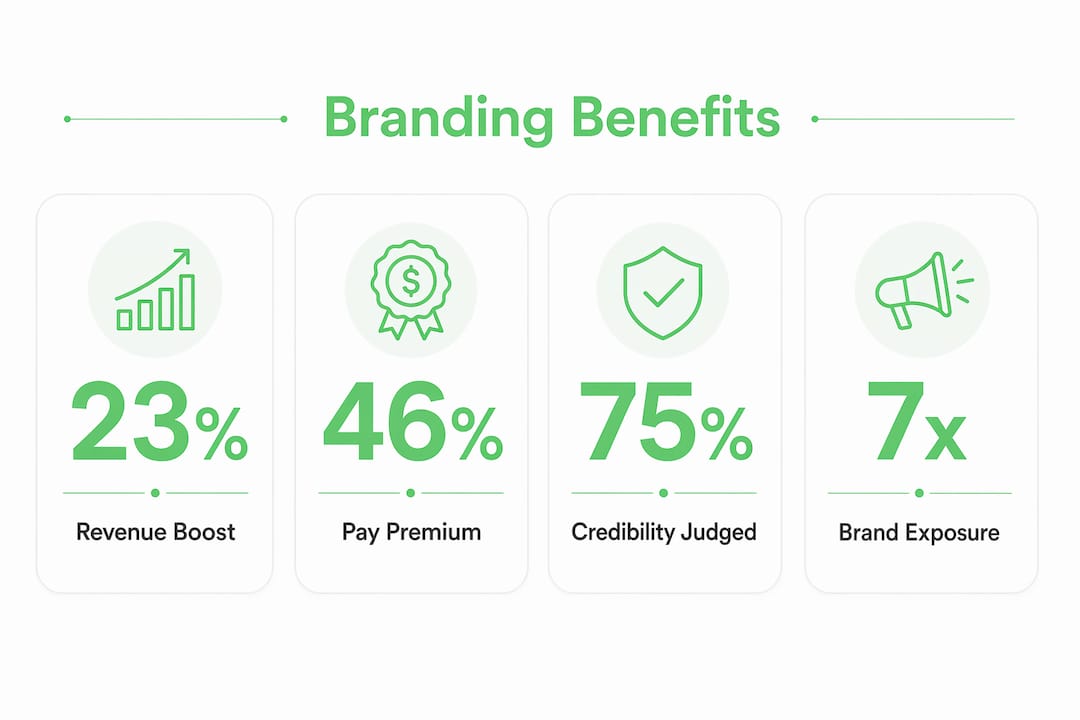
Website branding is defined as the deliberate crafting of a site’s visual and experiential identity to build trust, recognition, and customer loyalty. For small business owners, why website branding matters comes down to a single measurable reality: users judge 75% of a company’s credibility based on website design alone. That number means your site is not just a digital brochure. It is your first and often only chance to earn a visitor’s confidence. Consistent logos, color schemes, typography, and tone work together to signal professionalism before a single word is read.
Why website branding matters for trust and credibility
Trust is the currency that converts visitors into paying customers. When a website looks polished and consistent, visitors process information faster and feel more confident about the business behind it. When it looks inconsistent or generic, doubt sets in immediately.
Brand trust has a direct financial impact. 68% of consumers are willing to pay more for products from brands they trust. That willingness to pay a premium does not come from advertising alone. It comes from repeated, reliable brand experiences across every page of your website.
The visual elements that build trust most effectively include:
- Logo placement and consistency: A logo that appears in the same position on every page signals stability.
- Color palette discipline: Using the same 2–3 colors throughout reduces visual noise and builds recognition.
- Typography standards: Consistent font choices across headings and body text signal attention to detail.
- Tone of voice: Whether formal or conversational, a consistent writing style makes your brand feel human and reliable.
- Professional imagery: High-quality, on-brand photos reinforce credibility far more than stock images.
Research confirms that 46% of customers pay premium prices for brands they perceive as credible. That credibility is built, not assumed. Every page, every button, and every headline either adds to or subtracts from that perception.
Pro Tip: Brand consistency is one of the most underrated factors in user experience. When visitors do not have to “figure out” your site, they spend more time engaging with your content, which also sends positive signals to search engines.
How does website branding improve user experience and conversion rates?
Clear branding reduces cognitive load. When visitors land on a well-branded site, they immediately understand who you are, what you offer, and why they should stay. That clarity directly reduces bounce rates and increases the time spent on your site.

Consistent branding can increase revenue by up to 23% through stronger recognition and trust. This is not a marginal gain. For a small business generating $10,000 per month in online sales, that figure represents a meaningful difference in annual revenue.
The table below shows how branding quality affects key performance indicators for websites:
| Metric | Strong branding | Weak branding |
|---|---|---|
| Bounce rate | Lower, visitors stay longer | Higher, visitors leave quickly |
| Conversion rate | Up to 23% improvement | Below industry average |
| Perceived credibility | High, visitors trust the business | Low, visitors question legitimacy |
| Return visits | More frequent | Rare |
| Premium pricing power | Supported by brand trust | Difficult to justify |
A well-branded site also affects perceived loading speed. When a page looks organized and intentional, visitors tolerate minor delays better than they do on cluttered, inconsistent sites. The visual experience shapes the emotional experience, and that emotional experience drives purchasing decisions.
Investing in a clear brand identity on your website can improve conversion rates by up to 23%. The mechanism is straightforward: clarity builds confidence, and confidence drives action. A visitor who trusts your brand is far more likely to fill out a contact form, make a purchase, or request a quote.
For small businesses competing against larger, better-funded brands, a professional website identity is one of the most cost-effective ways to close the credibility gap. Punchvirtualmanager works with small business owners across South Africa to build responsive web designs that apply these principles from the ground up.
What is the relationship between website branding and SEO?
Website branding and search engine optimization are more connected than most small business owners realize. Search engines like Google do not just read your content. They measure how users interact with it. A well-branded site keeps visitors engaged longer, which sends positive behavioral signals to search algorithms.
The specific ways branding improves SEO performance include:
- Lower bounce rates: Visitors who trust your brand stay on your site longer, reducing the bounce rate that search engines use as a quality signal.
- More branded searches: When people recognize your brand, they search for it by name. Branded search volume is a strong indicator of authority.
- Backlink opportunities: Credible, well-branded sites attract more organic links from other websites, which remains one of Google’s strongest ranking factors.
- Consistent content signals: A unified brand voice and visual identity help search engines categorize your site accurately, improving topical authority.
- User trust metrics: Pages with clear branding generate more clicks in search results because users recognize and trust the brand name.
Brand identity is a technical imperative that reduces cognitive fatigue and boosts SEO through improved user metrics. Treating branding as purely cosmetic is a costly mistake. Every design decision on your website either supports or undermines the engagement signals that search engines measure.
A practical example: two websites selling the same product, priced identically, with similar content. The one with consistent branding, clear navigation, and a recognizable visual identity will generate longer sessions and more return visits. Those behavioral differences accumulate into measurable ranking advantages over time. For a deeper look at how these factors connect, Punchvirtualmanager’s SEO audit blueprint covers the technical and on-page elements that support brand-driven organic visibility.
How can small businesses maintain consistent branding as they grow?
Brand consistency becomes harder to maintain as a business grows. More team members, more content, and more channels all create opportunities for brand drift. Brand drift is the gradual erosion of visual and messaging consistency that happens when different people produce content without shared standards.
The solution is active governance, not passive hope. Here are four practical steps to maintain consistent website branding as your business scales:
- Create a brand style guide. Document your logo usage rules, color codes, approved fonts, tone of voice, and image standards. A written guide removes ambiguity for anyone creating content.
- Use a Digital Asset Management system. Successful companies use DAM integrated with CMS platforms to maintain branding consistency. A DAM system stores approved logos, images, and templates in one central location, so contributors always use the correct assets.
- Build approval workflows. Any new page, blog post, or campaign asset should pass through a review step before publishing. This catches off-brand content before it reaches your audience.
- Audit your site regularly. Schedule a quarterly review of your website to check for inconsistent fonts, outdated logos, or off-tone copy. Small inconsistencies compound over time.
- Train every contributor. Anyone who writes, designs, or publishes content for your business needs to understand your brand standards. A one-hour onboarding session on brand guidelines pays dividends for years.
Pro Tip: Treat your brand guidelines as a living document. Update them whenever you launch a new product line, rebrand a service, or enter a new market. Outdated guidelines are almost as damaging as no guidelines at all.
The Rule of 7 in branding states that potential customers must encounter a brand message at least seven times before they seriously consider making a purchase. That repetition only works if each encounter reinforces the same identity. Inconsistent branding breaks the accumulation effect and forces the count to restart. For guidance on applying this across channels, Punchvirtualmanager’s resource on consistent brand messaging offers a practical framework.
Key Takeaways
Strong website branding directly increases credibility, conversion rates, and search engine performance, making it a foundational business investment rather than an optional marketing expense.
| Point | Details |
|---|---|
| Credibility from design | 75% of users judge a company’s credibility based on website design quality. |
| Revenue impact | Consistent branding can increase revenue by up to 23% through trust and recognition. |
| SEO connection | Branded sites generate lower bounce rates and more branded searches, improving rankings. |
| Brand drift prevention | Use a DAM system integrated with your CMS to keep assets consistent as you grow. |
| Trust drives pricing power | 46% of customers pay premium prices for brands they perceive as credible and reliable. |
Branding is not decoration. It is infrastructure.
The businesses I see struggle most with digital growth share one pattern: they treat branding as something to address after the website is built. They pick a logo quickly, choose colors without a system, and write copy in whatever voice feels right that day. Then they wonder why their conversion rates are flat and their SEO is stagnant.
Branding is not a cosmetic layer applied on top of a working website. It is the structural framework that makes everything else perform better. A clear visual identity reduces the mental effort visitors need to trust you. That reduced effort translates directly into longer sessions, lower bounce rates, and more purchases. These are measurable outcomes, not marketing theory.
The clients who invest in branding early, and govern it consistently, see compounding returns. Their sites rank better because users engage more. They charge higher prices because their brand signals quality. They attract better referral partners because their online presence looks credible. None of that happens by accident.
Small business owners often feel that professional branding is out of reach financially. That perception is outdated. The tools and expertise available today make it entirely achievable, and the cost of not doing it, in lost conversions and missed rankings, far exceeds the investment.
— Steel
How Punchvirtualmanager supports your website branding goals
Building a recognizable, trusted brand online requires more than a good-looking homepage. It requires a coordinated approach across design, content, and digital marketing.

Punchvirtualmanager offers digital marketing services designed specifically for small businesses that want to build a stronger online identity and attract more customers. From responsive web design to brand-aligned content strategies, the agency’s team provides the structure and support that small business owners need to compete effectively. Explore the available digital marketing packages to find a solution that fits your business size and growth goals. With a 99% advertising success rate and a commitment to transparent communication, Punchvirtualmanager delivers measurable results for businesses ready to take their branding seriously.
FAQ
Why does website branding matter for small businesses?
Website branding builds the trust and credibility that convert visitors into customers. Research shows 75% of users judge a company’s credibility based on website design, making consistent branding a direct driver of sales.
How does branding affect conversion rates?
Clear, consistent branding can improve conversion rates by up to 23% by reducing cognitive load and building visitor confidence. When users trust a brand visually, they are more likely to take action.
What is brand drift and why does it matter?
Brand drift is the gradual erosion of visual and messaging consistency that occurs when multiple contributors create content without shared standards. It weakens recognition and undermines the trust your branding has built over time.
How many times does a customer need to see a brand before buying?
The Rule of 7 states that potential customers must encounter a brand message at least seven times before seriously considering a purchase. Consistent website branding accelerates this recognition process across every visit.
Does website branding affect SEO performance?
Yes. Well-branded sites generate lower bounce rates, longer session durations, and more branded searches, all of which are behavioral signals that search engines use to assess site quality and authority.